CONTENT
China’s service robotics sector is moving from novelty to operating infrastructure. Pudu Robotics matters because its machines already work inside restaurants, hotels, retail sites, healthcare facilities, and large commercial properties. The Shenzhen company focuses on repeatable tasks such as food delivery, room delivery, dish collection, floor care, and internal transport.
The timing is important. China is pushing embodied intelligence toward scaled commercial use, while service businesses want automation that can operate at existing sites with minimal disruption.
Pudu reported that 2025 revenue grew by more than 100 percent, cumulative shipments surpassed 120,000 units, and overseas markets accounted for more than 80 percent of revenue for a third consecutive year. Its current company page reports more than 130,000 units shipped across over 85 countries and regions.
China’s robotics conversation has expanded toward humanoids and embodied AI, yet proven service robots offer a clearer route from engineering to recurring business value. They operate in structured environments, handle measurable tasks, and can scale across multisite networks.
Pudu reflects a wider Chinese advantage in hardware supply chains, product iteration, and domestic testing. Official Chinese reporting in 2025 highlighted the shift from demonstrations of embodied intelligence toward scaled commercialization. Pudu sits close to this transition because it combines established task-specific robots with newer semi-humanoid and general embodied systems.
Capital is supporting that expansion. In April 2026, the company announced a nearly US$150 million funding round and a valuation exceeding US$1.5 billion. Pudu said cumulative funding had exceeded US$300 million. The capital can support product development, manufacturing, regional service, and industrial expansion.
Pudu’s portfolio follows workflows inside a commercial site. Some robots move meals and used dishes. Others guide customers, deliver items between floors, or clean large areas. A customer can begin with one task and later add machines under a broader operating system.
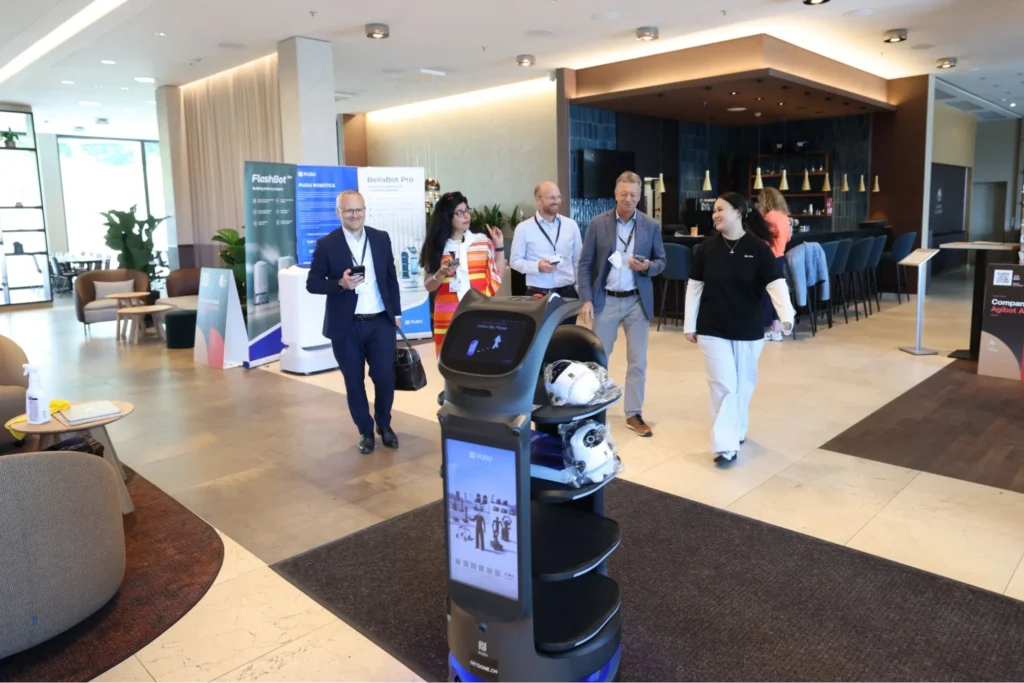
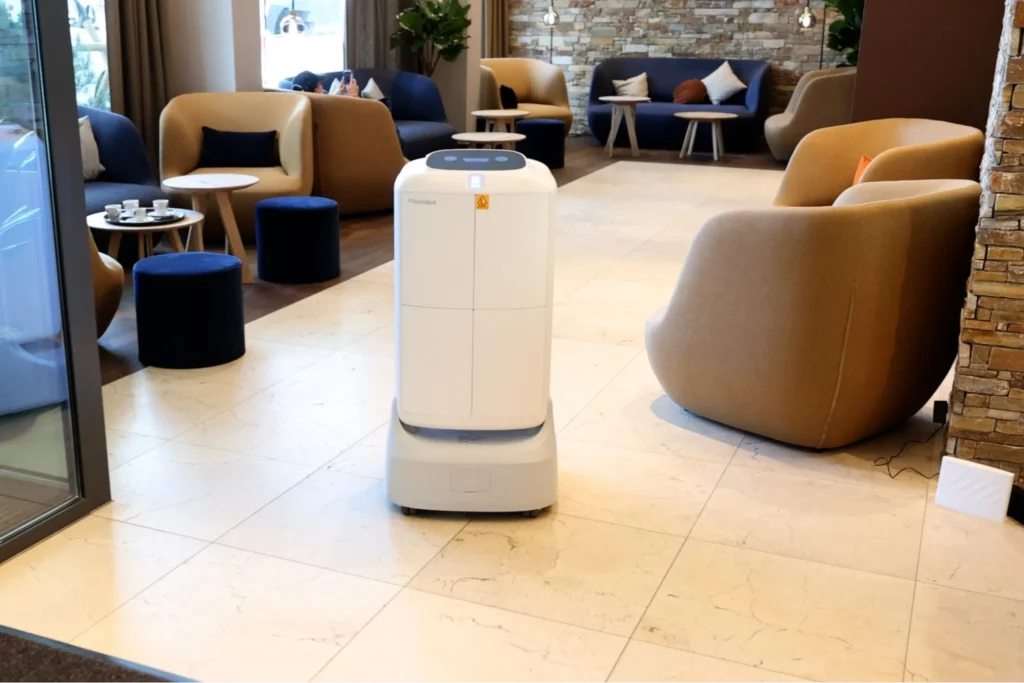
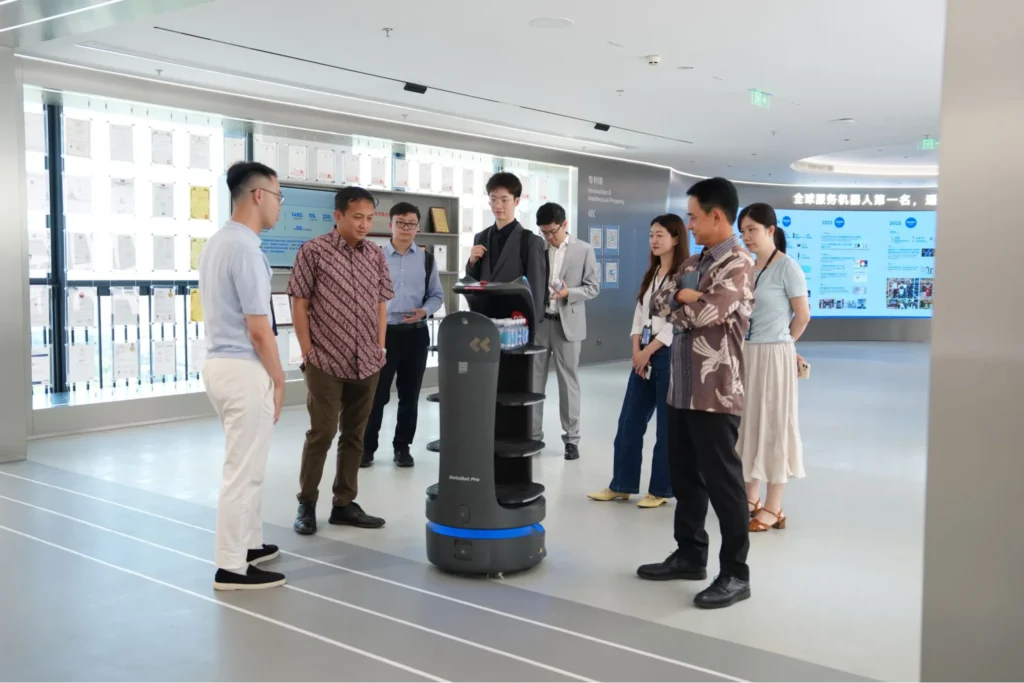
BellaBot remains the company’s most recognizable restaurant product. The current Bellabot uses LiDAR and visual SLAM for positioning, while three RGBD cameras and LiDAR support obstacle detection. Its trays carry meals from the kitchen to dining areas, and interactive features give the robot a visible customer-facing role.
The commercial value of the bellabot robot comes from reducing the need to walk repeatedly between kitchens and tables. Staff can spend more time on guest needs, order issues, recommendations, and table service.
At Expo 2025 Osaka, BellaBot Pro greeted visitors at the China Pavilion alongside other Pudu robots. In the Japanese and Korean food service markets, the Bella series holds the number one market position.
KettyBot Pro combines greeting, guidance, and delivery with an 18.5-inch display for promotional content. HolaBot focuses on higher-volume collection and transport, including used dishes and hotel items. The portfolio separates customer engagement from heavier back-of-house movement.
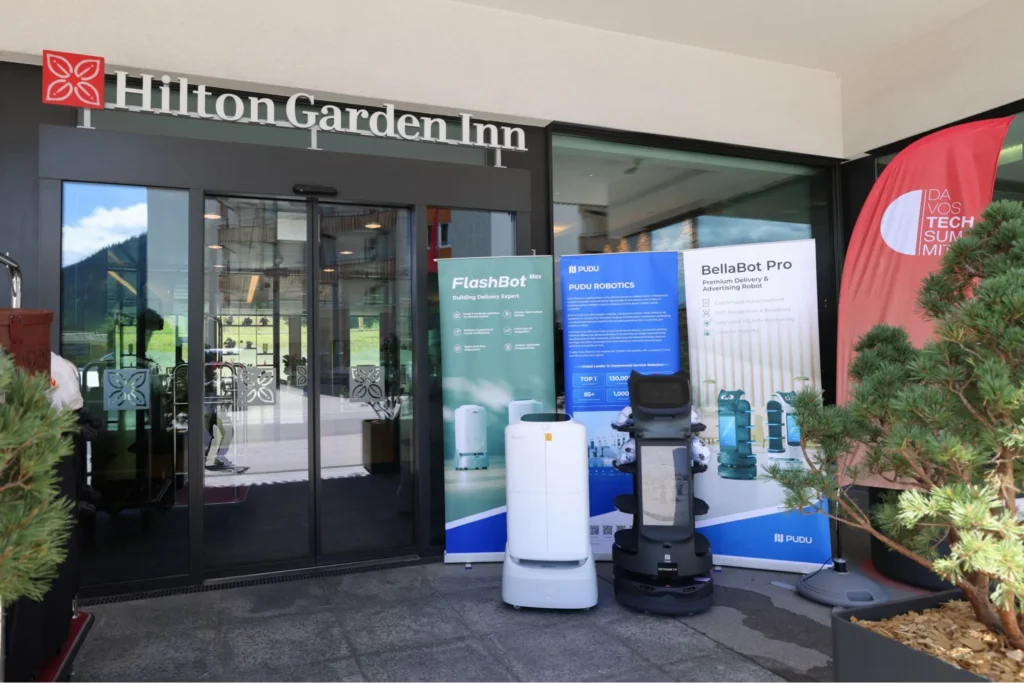
Hotel automation places greater demands on indoor navigation because a robot may need to call an elevator, pass through access points, traverse multiple floors, and protect guests’ items. FlashBot Max addresses this by providing IoT integration, adjustable compartments, access verification, rapid multi-floor mapping, and multi-robot scheduling.
Launched in March 2025, it is the world’s first commercial semi-humanoid embodied AI service robot, integrating DeepSeek and other major AI models to deliver natural dialogue, front-desk consultation, guest greeting, and 导购 recommendations across hotels, restaurants, retail, healthcare, and public services.
Pudu’s June 2026 agreement with Shenzhen Culture and Tourism Industry Development Co. points toward a broader model. The companies plan to build a fully robot-serviced hotel on the West Artificial Island of the Shenzhen Zhongshan Link, with trial operations scheduled by the end of 2026.
The project will connect multiple robot types through a shared operating system across reception, delivery, cleaning, and other functions.
Commercial cleaning robots are a larger part of Pudu’s strategy because the task is frequent, measurable, and common across many industries.
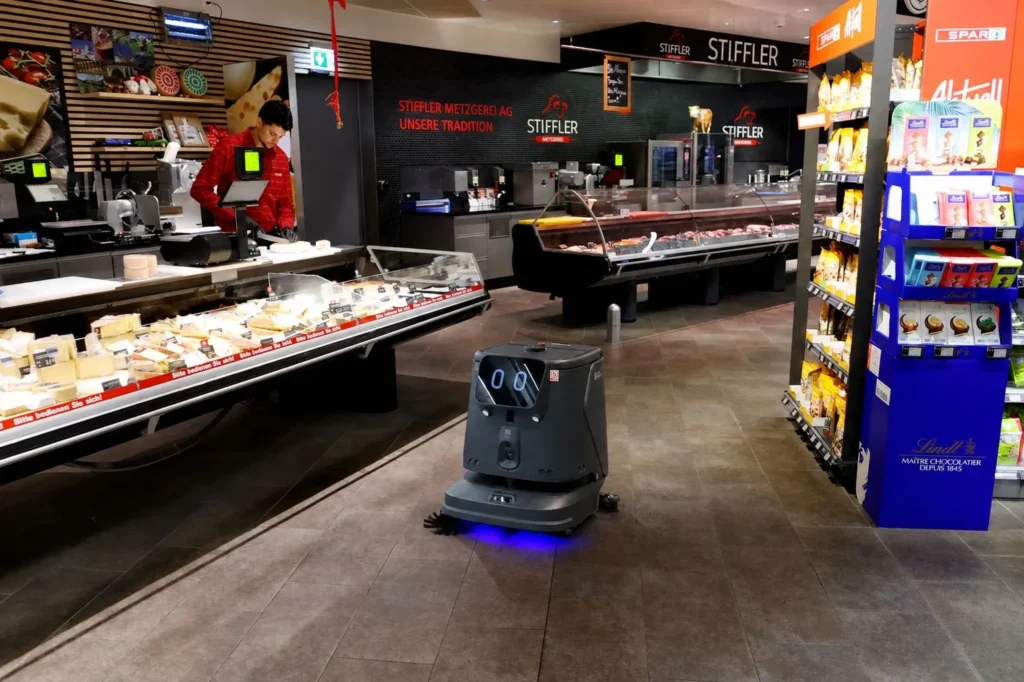
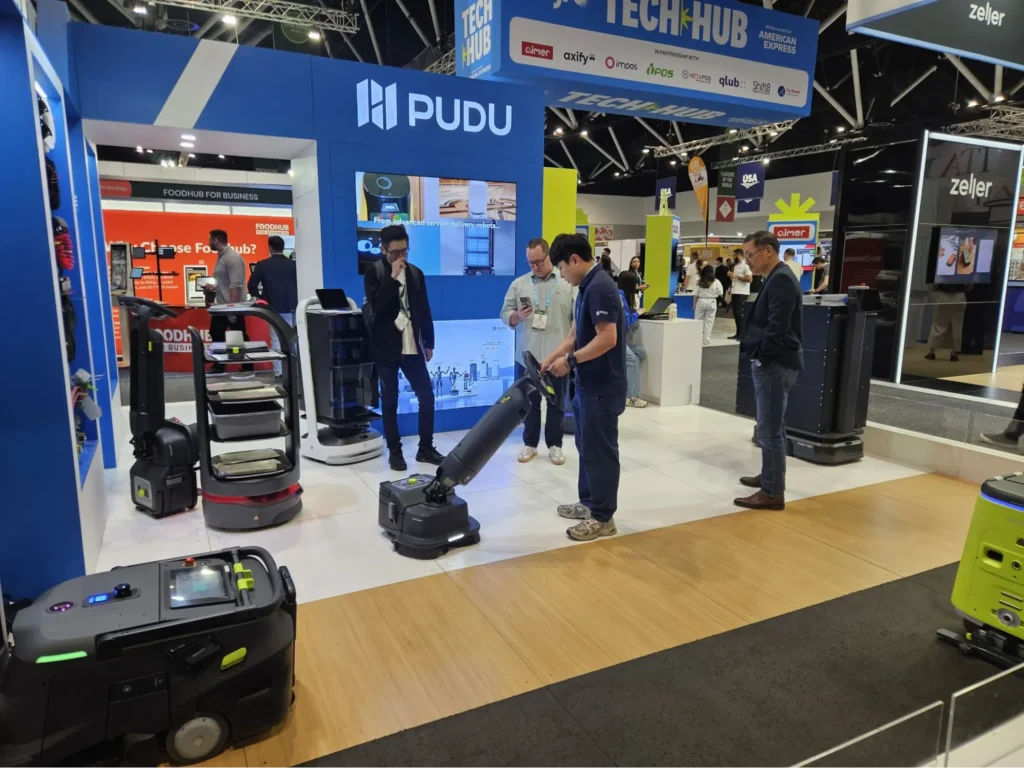
The Pudu CC1 combines sweeping, scrubbing, vacuuming, and mopping in one platform. Its current product page lists visual SLAM and laser SLAM, automatic charging, optional water supply and drainage stations, breakpoint resume cleaning, and digital cleaning reports. These functions support mixed floor environments across hotels, offices, retail sites, healthcare facilities, and transport locations.
Pudu expanded this line in May 2025 with CC1 Pro. The model added a rear AI camera for real-time cleaning performance detection, spot recleaning, floor recognition, operational heatmaps, and component monitoring. This development shows a shift from route completion toward verifiable cleaning results.
In Switzerland, discount supermarket chain Denner deployed 200 PUDU CC1 robots across its store network starting in fall 2025. The deployment expanded from an initial four-store pilot after proving the robots could handle increased cleaning workloads resulting from expanded fresh-produce offerings.
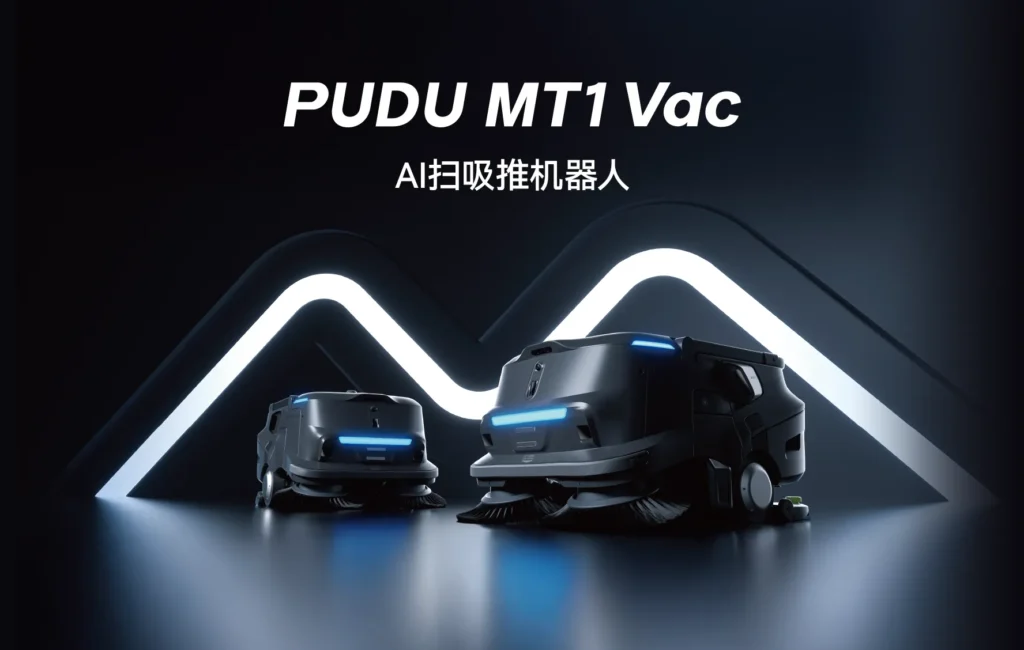
The Pudu MT1 line targets larger dry cleaning environments. The standard MT1 combines long runtime, automated docking, and continuous operation.
Pudu launched MT1 Vac in July 2025 for sweeping and vacuuming across commercial and industrial sites. It launched MT1 Max in August 2025 with 3D LiDAR, multisensor perception, adaptive cleaning, and broader use across complex large-scale environments.
April 2026 saw the launch of the AI-native PUDU BG1 Series, a large scrubber-dryer platform that completes the cleaning lineup, from small CC1 and MT1 models to large BG1 units, for warehouses, retail complexes, industrial plants, and transport hubs.
Built on a dual-chip, high-compute architecture with 3D VSLAM and LiDAR, BG1 supports AI-driven spot cleaning, adaptive brush pressure, and an all-in-one docking station for unmanned 24/7 operation. The BG1 leverages millions of operating hours from earlier models
The industrial delivery business, launched just over a year ago, has already shipped more than 4,000 units. The PUDU T300 autonomous mobile robot deployed at Everbiz Industrial handles cross-floor material transport and integrates with elevators and MES dispatch systems.
The deployment expanded from one to ten production lines in under a month and reportedly saved 35 to 45 labor hours per month.
The PUDU T150, introduced in early 2026 as a 150 kg light-load industrial delivery robot, lowers the automation barrier for small and medium enterprises.
In embodied AI, Pudu Robotics launched PuduFM 1.0, an embodied intelligence foundation model built around physical intuition, and PuduAgent, a universal embodied AI agent platform.
These platforms represent the company’s evolution from commercial service robotics into broader intelligent robotics applications, supporting what founder and CEO Felix Zhang describes as “globalizing Physical AI”.
The company also unveiled the PUDU D9 full-size bipedal humanoid robot and the PUDU D7 industrial-grade evolvable humanoid robot in 2026
Pudu’s growth also reflects the internationalization of Chinese robotics. The company reported that overseas markets generated more than 80 percent of revenue in 2025. Its current footprint covers more than 85 countries and regions, with overseas subsidiaries in Japan, South Korea, Singapore, the United States, and the Netherlands.
Service robotics exports require more than hardware. Customers need mapping, workflow design, training, maintenance, spare parts, software support, and local building integration. Regional support capacity can influence adoption as much as specifications.
Pudu opened a United States headquarters in Dallas in April 2026. The move signals that global growth now depends on local operations, customer support, and distributor reach.
The company’s distribution strategy relies on local partnerships. In Taiwan, strategic partner Aurotek launched three new AI robots across cleaning, security inspection, and industrial material handling in April 2026. In Europe, distributor Robobee facilitated the Denner deployment.
Partner relationships increased 63.6% year over year. This partner-led approach allows Pudu Robotics to navigate local regulations, customer expectations, and service requirements while maintaining centralized R&D and manufacturing.
Pudu’s development offers three practical lessons. Start with a repetitive workflow and clear operating data. Design the deployment around the building rather than the robot alone. Treat software, service, and staff adoption as part of the investment case.
Restaurant robots may be the most visible entry point, but Pudu’s recent product activity shows greater emphasis on cleaning, multifloor logistics, mixed fleets, and embodied intelligence. This broadening matters because customers usually buy outcomes such as faster internal delivery, more consistent floor care, and better use of staff time.
The next phase will depend on execution. Product variety creates more use cases, yet it increases demands for service, integration, and fleet management. Pudu Robotics has moved beyond a single-category identity. Its larger opportunity lies in becoming an operating layer for repetitive physical work across commercial buildings.
ChoZan helps global companies interpret China’s shifts in robotics, AI, retail, and technology through market intelligence, competitive analysis, and strategy. We connect product activity with commercial context so teams can act with a clearer view of China’s innovation ecosystem.
Official product pages direct buyers to request a demo rather than list one universal price. The cost of a Pudu robot depends on the model, accessories, software, site mapping, integrations, support, and local distributor terms.
A bellabot can suit a smaller restaurant when aisles, turning space, pickup points, and table routes fit the robot’s requirements. A site survey and a live route test should precede a purchasing decision.
The Bellabot robot uses an automotive-grade suspension system and obstacle-sensing capabilities to ensure stable delivery. Results still depend on cup design, tray loading, floor condition, route layout, speed settings, and staff operating practices.
FlashBot Max supports cloud and hardware elevator control options. Pudu says its cloud solution can operate without elevator modifications, but the correct setup depends on the building, elevator system, access controls, and local integration requirements.
Deployment time varies by site size, mapping needs, route complexity, network readiness, elevator or door integration, staff training, and fleet size. A simple single-floor route usually requires less work than a multi-floor rollout.
KettyBot Pro includes an 18.5-inch display for customized advertising, while BellaBot Pro also includes screens for commercial information. Content planning should support the service journey rather than interrupt movement or guest interaction.
Routine care may include sensor cleaning, wheel and tray checks, battery monitoring, software updates, consumable replacement, and cleaning system maintenance. Buyers should confirm service response times, access to spare parts, and local technical coverage before deployment.
The Pudu CC1 can vacuum soft carpets using a separately purchased carpet-cleaning assembly. The Pudu MT1 Vac is designed for dry cleaning on carpet and hard floors, with automatic floor recognition.
Pudu products use sensors, cameras, LiDAR, obstacle avoidance, speed controls, and visual or audio alerts, depending on the model. Safe operation still requires suitable routes, staff training, site rules, maintenance, and local compliance checks.
PuduFM 1.0 is a Pudu Robotics embodied intelligence foundation model built around physical intuition. It enables robots to comprehend spatial structures, predict causal relationships, and continuously evolve through real-world interaction.