CONTENT
Arctech Solar Ltd is a commonly searched name for Arctech Solar Holding Co Ltd, a Chinese solar tracker manufacturer listed on Shanghai’s STAR Market under stock code 688408.
The company supplies tracking systems, fixed structures, cleaning robots, and related energy products for utility-scale solar projects. Its commercial significance stems from how tracker engineering affects electricity production, construction costs, weather resilience, and ongoing maintenance.
Understanding its market position requires examining tracker architecture, control systems, terrain adaptability, financial performance, and local delivery capacity.
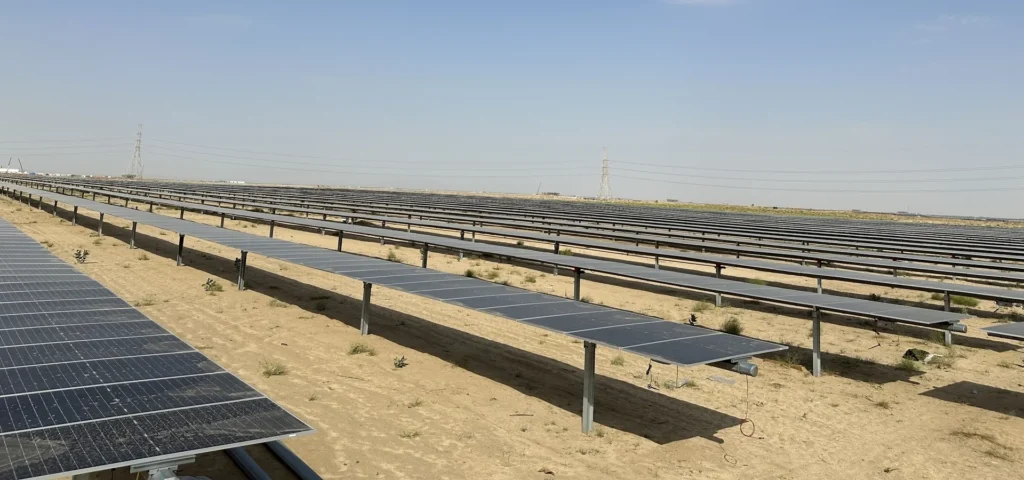
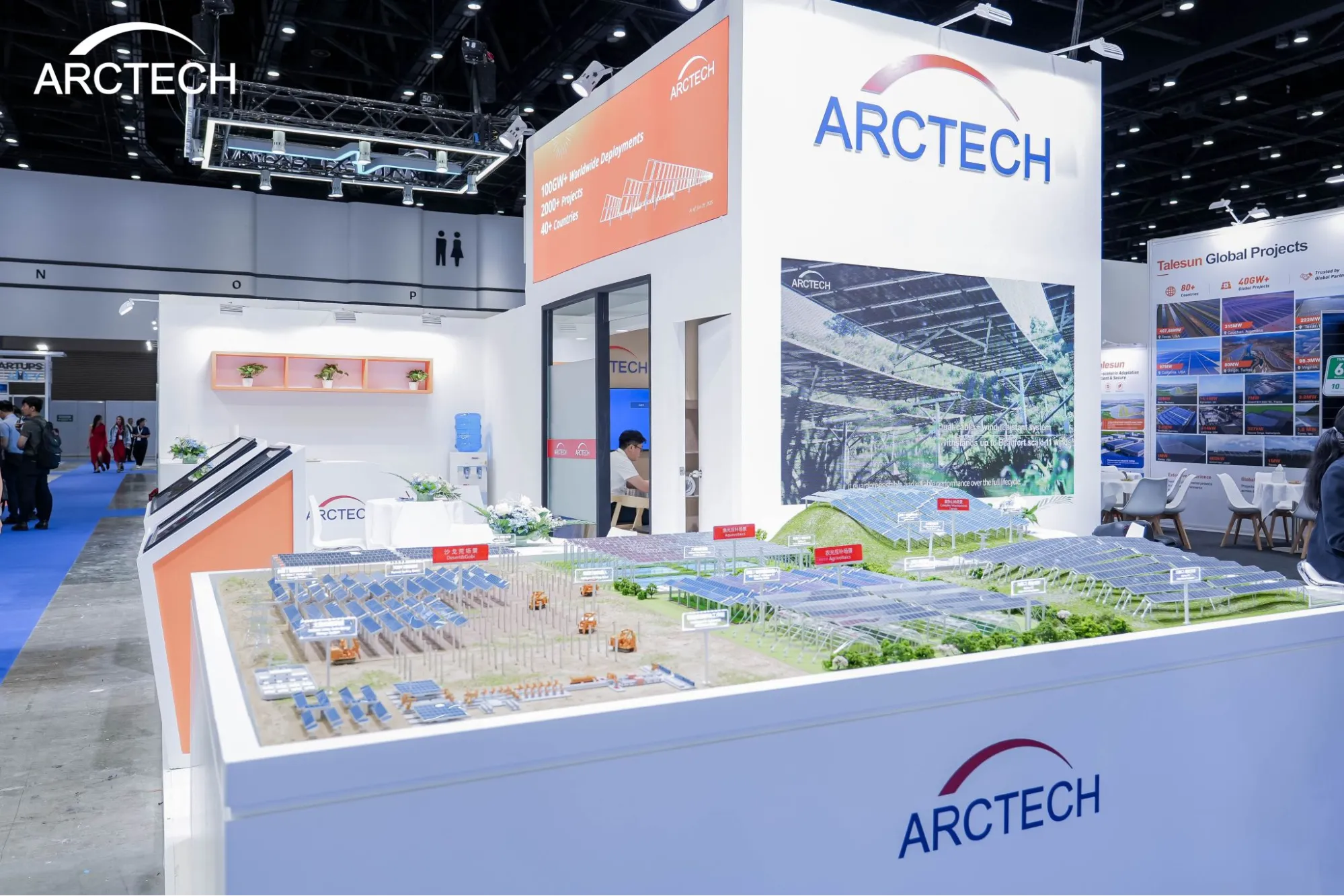
Arctech’s company overview reports more than 100 GW of tracking and racking supplied to nearly 2,000 plants across 40 countries.
The company’s products include single-axis solar trackers, fixed-tilt structures, cleaning robots, and energy storage systems.
Its global ranking varies across research providers. Wood Mackenzie reported that global tracker shipments exceeded 134 GWdc in 2025, up 19% year over year. Its ranking placed Nextpower first, GameChange Energy second, and Arctech next.
Arctech separately cited S&P Global Energy research that ranked the company second globally, with 16 GW shipped and a 12.1% market share.
These differences reflect separate research frameworks. Shipment rankings indicate market presence but do not establish suitability for a particular project.
Arctech’s tracker portfolio includes several structural designs for different project conditions.
| Tracker | Configuration | Structural approach | Main project consideration |
| SkyLine II | 1P | Independent row with synchronous multi-point drives | Structural stiffness, module compatibility, and terrain adaptability |
| SkyWings | 1P | Linked dual-row configuration | Row coordination, field layout, and installation planning |
| SkySmart II | 2P | Independent row | Row geometry, module loading, foundations, and assembly requirements |
A 1P tracker positions modules one high in portrait orientation. A 2P system places two portrait-oriented modules across the tracker structure.
These choices affect foundation design, wiring, cleaning access, structural loading, and field installation.
Arctech’s multi-point drives distribute mechanical force along the tracker row. Their practical value depends on compatibility with the selected module, pile design, damping assumptions, and applicable structural codes.
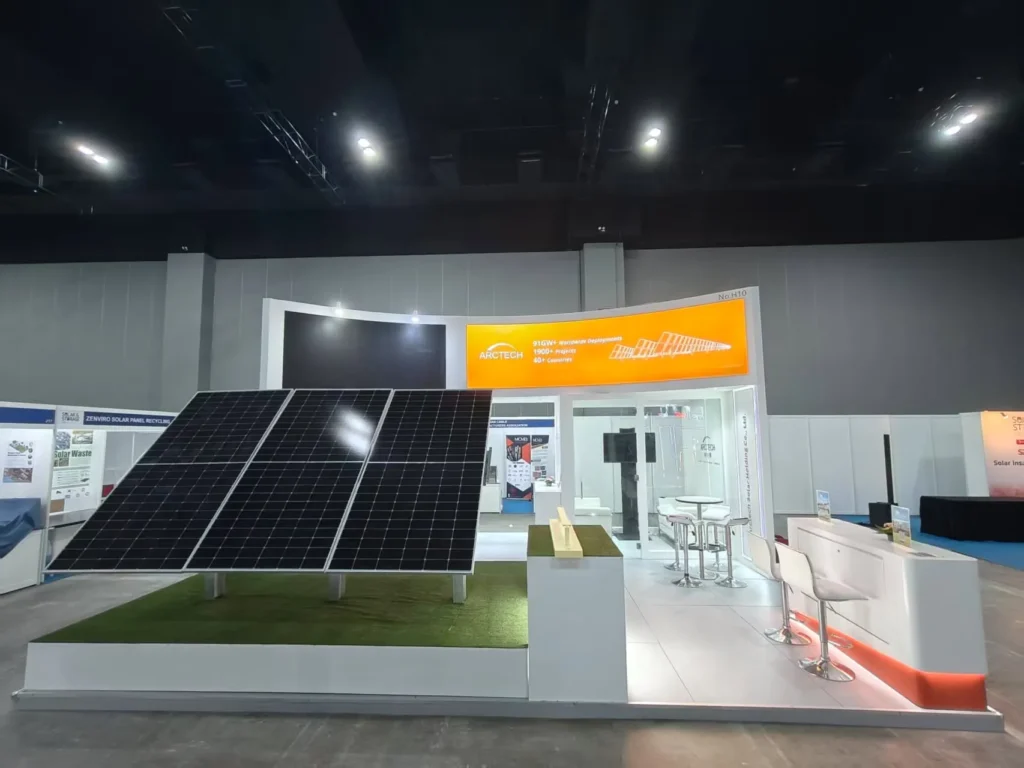
Tracker control systems influence daily positioning, shading management, weather response, and operating continuity.
Backtracking adjusts module position to reduce shading between adjacent rows.
Uneven ground makes this more complex because differences in row height and slope can increase early-morning or late-afternoon shading.
Arctech states that its smart backtracking can increase generation by up to 7% through site-aware shading avoidance.
This is a supplier claim, not a universal production guarantee. Project models should assess the final site layout, terrain surface, weather data, and control assumptions.
Bifacial energy yield also depends on ground reflectivity, mounting height, spacing, and rear-side shading.
Wind-stow settings determine when trackers move into a protective position during adverse weather.
Arctech’s module compatibility guidance lists default thresholds of 22 meters per second for SkyLine II and 20 meters per second for SkySmart II.
The company says project-specific designs can support higher settings.
Engineering assessments should consider wind-tunnel inputs, aeroelastic behavior, sensor placement, communications reliability, power-loss scenarios, and recovery procedures.
The proposed stow strategies must account for the actual module, local wind conditions, and applicable design standards.
Modern solar trackers depend on communications between controllers, weather stations, and supervisory control and data acquisition systems.
Buyers should confirm how the system handles remote access, firmware updates, user permissions, operational data, and communications failures.
Contracts should also define offline operation, access logs, vulnerability response, credential management, and post-warranty software support.
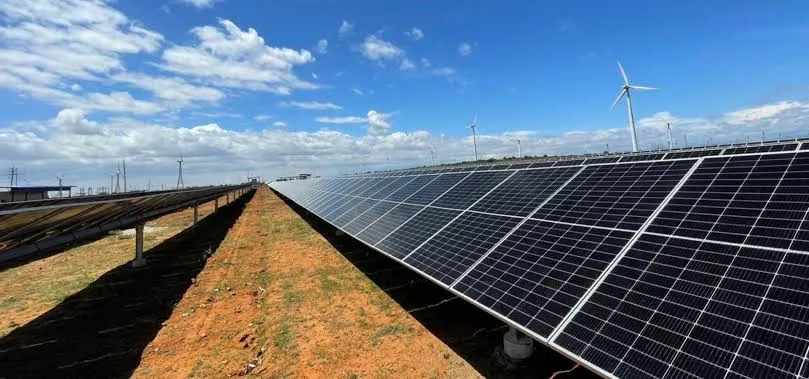
Ground conditions influence grading, foundation design, drainage, construction access, and how much land can support productive solar equipment.
Arctech’s 2026 SkyLine II All-Terrain announcement claims support for slopes of up to 30 degrees.
The company also describes potential reductions of:
Arctech reports that more than 50 GW of SkyLine II systems have been deployed globally. These figures describe company-stated design scenarios rather than guaranteed outcomes.
Strong terrain adaptability may reduce grading and preserve buildable land. However, costs can shift toward surveying, custom pile schedules, control configuration, drainage adjustments, and field quality assurance.
A realistic comparison should account for total installed cost and modeled electricity production.
Match supplier claims with measurable project evidence.
| Claim | Evidence required |
| Smart backtracking can increase generation by up to 7% | Independent energy simulation using the final terrain model, shading assumptions, and weather data |
| SkyLine II supports slopes up to 30 degrees | Topographic survey, structural calculations, foundation design, and construction access plan |
| Earthwork can fall by up to 90% | Comparison between the proposed grading plan and an agreed baseline design |
| Pile-foundation costs can fall by up to 60% | Geotechnical report, pile schedule, material quantities, and refusal-risk assessment |
| Installation time can fall by up to 35% | Contractor labor assumptions, assembly methodology, equipment availability, and construction schedule |
| Wind-stow thresholds support site safety | Wind studies, sensor configuration, module compatibility, safe-state logic, and applicable design standards |
This approach separates manufacturer-reported performance from results demonstrated under actual project conditions.
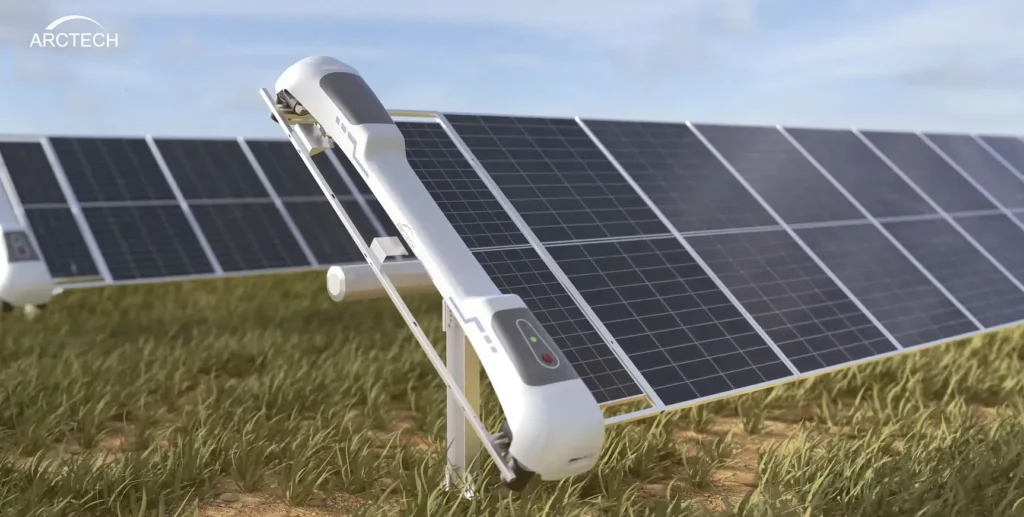
Arctech presented its Tracker+ platform at Intersolar Europe 2025 alongside SkyLine II, SkySmart II, a cable tracker, the StarShine I cleaning robot, and energy storage products.
Its event announcement also reported a 108 MW tracker supply memorandum with Econergy for a Romanian project.
The strategy expands Arctech’s offer beyond conventional solar mounting structures.
Integrated equipment and services can reduce coordination problems between tracker suppliers, cleaning systems, control platforms, and project operators.
The tradeoff is greater dependence on one vendor for software, spare parts, technical support, and system documentation.
Buyers should determine which products are included in the contract, how interfaces are managed, and who remains responsible when different components interact.
Arctech’s 2025 annual report showed a 23.72% decline in revenue and a small net loss. The Shanghai Stock Exchange published the company’s annual report in April 2026.
PV Tech’s March 2026 analysis connected the weaker results to delayed solar projects, slower overseas order conversion, currency pressure, domestic competition, and spending on international expansion.
The company had invested in capacity and market development in Saudi Arabia, Dubai, and Europe.
For project developers, these results raise practical questions about cash generation, factory allocation, parent guarantees, warranty backing, and the financial support available to local operating entities.
A bankability review should assess the contracting company and the resources available in the country where the project will operate.
An effective request for proposal should connect technical claims to contractual deliverables.
Request a project-specific structural design basis, module compatibility assessment, wind studies, corrosion specifications, and an agreed design-responsibility matrix.
Compare the proposed tracker against fixed-tilt and competing systems using the same weather files, degradation assumptions, albedo, availability, and shading inputs.
Include grading, pile foundations, drainage, access roads, labor, preassembly, commissioning, and delivery schedules in the tracker installation assessment.
Confirm factory capacity, production allocation, survey controls, pile tolerances, torque procedures, and construction responsibilities.
Evaluate controller redundancy, weather sensing, safe-state behavior, SCADA integration, remote-access controls, and manual recovery procedures.
Define data ownership, firmware responsibilities, cybersecurity response, and ongoing software support.
Confirm response times, technician availability, spare-parts locations, training, language coverage, escalation procedures, and warranty claim processes.
The agreement should identify the exact supplying entity, available parent guarantees, performance security, and post-commissioning service obligations.
These factors determine how an Arctech Solar tracker contributes to long-term project economics for utility-scale PV.
The Arctech Solar Ltd story shows how Chinese energy companies combine engineering, manufacturing, localization, and ecosystem expansion. ChoZan’s China research, expert calls, and learning expeditions help teams examine those shifts in context and translate them into sharper market, partner, and innovation decisions. Explore the right format for your next China strategy question.
The commonly used search phrase points to Arctech, but the listed parent uses Arctech Solar Holding Co Ltd in English. It trades on Shanghai’s STAR Market under 688408. Contracts should name the exact supplying entity and guarantor.
Arctech Solar Inc usually appears as a naming variation in web searches. Buyers should verify the legal entity on proposals, warranties, bank guarantees, and local registrations because the manufacturing parent, sales subsidiary, and project counterparty may differ.
Yes. Arctech’s current portfolio includes fixed-tilt structures alongside trackers, flexible mounting systems, cleaning robots, and storage. That breadth allows a project to compare structural options with one supplier, though each option still needs independent technical review.
In a 1P tracker, modules sit one high in portrait orientation. A 2P design places two portrait modules side by side. The choice affects row geometry, loads, foundations, cleaning access, wiring, and field assembly.
Arctech says its rigid tracker designs support large modules and lists specific default wind-stow thresholds for SkyLine II and SkySmart II. Project engineers must confirm the exact module dimensions, clamp zones, allowable loads, and warranty compatibility.
Request audited financials, project references, factory allocation, quality plans, design certifications, wind studies, warranty terms, performance security, spare-parts plans, local service staffing, and litigation disclosures. Review the proposed contracting entity as closely as the parent brand.
Commission an independent simulation with the final layout, weather file, terrain surface, albedo, module data, losses, and control logic. Compare the result with fixed tilt and alternative trackers under identical assumptions, including downtime and stow losses.
Ask who owns operational data, which parties receive remote access, where data sits, how firmware receives updates, and how credentials rotate. The contract should cover vulnerability response, offline operation, access logs, backups, and support after warranty expiry.
Confirm technician headcount, travel time, language coverage, commissioning experience, spare-parts locations, escalation paths, and response commitments in writing. Global shipment volume cannot substitute for a staffed service plan in the country where the asset operates.
The EPC should confirm pile tolerances, survey controls, torque procedures, preassembly steps, row alignment, controller commissioning, weather-station placement, punch-list ownership, and as-built records. The installation plan should include training and acceptance criteria before mobilization.