CONTENT

Robot datasets record what machines observe, the actions they take, and the outcomes that follow. China is expanding this resource through teleoperation facilities, published real-machine data collections, and simulation. These systems train embodied AI, which learns to act in physical environments.
The business question is how that data translates into reliable work. China’s recent projects offer useful lessons in collection infrastructure, quality control, and learning from mistakes. A large release can broaden access to training material, but size alone can’t prove a robot will perform profitably in a warehouse, store, or factory.
Useful robotics datasets connect observations with actions over time. Their records can include camera views, joint positions, movement commands, task instructions, and outcomes. A vision-language-action model learns relationships between what it sees, what someone asks it to do, and the movements needed.
The 2025 Robo-DM paper describes the challenge of managing these synchronized video, language, and numerical streams. DROID and Open X-Embodiment are data collections; LeRobot provides tools and a format for recording, sharing, and training with robot data.
| Data type | What it contributes | Main limitation |
| Human-guided robot demonstrations | Examples of actions performed on physical hardware. | Collection requires operators, equipment, and scene resets. |
| Autonomous execution records | Evidence of what a trained model actually does. | Their usefulness depends on clear outcome and intervention labels. |
| Synthetic data | Simulated interactions with controlled variations. | Transfer to physical hardware needs validation. |
These categories serve different purposes. Before comparing offers, a buyer should establish which one a supplier’s headline count measures.
Hugging Face’s September 2025 format update for LeRobot packs multiple episodes into each file and supports streaming. This addresses a separate scaling problem: huge collections must remain practical to load and use.
Standard storage helps teams share a pipeline, but it doesn’t make different robots’ sensors or movement commands interchangeable.
China’s collection infrastructure includes shared facilities and company-operated sites.
A Shanghai government report from January 2025 described a heterogeneous humanoid training base with initial space for 100 robots and more than 10 application scenarios. Its design brought different developers into a common training environment.
In April 2025, Beijing’s municipal portal reported a Shougang Park center with 100 robots, 10 realistic settings, and stated annual capacity exceeding one million multimodal data records. That figure describes capacity, rather than verified annual output.
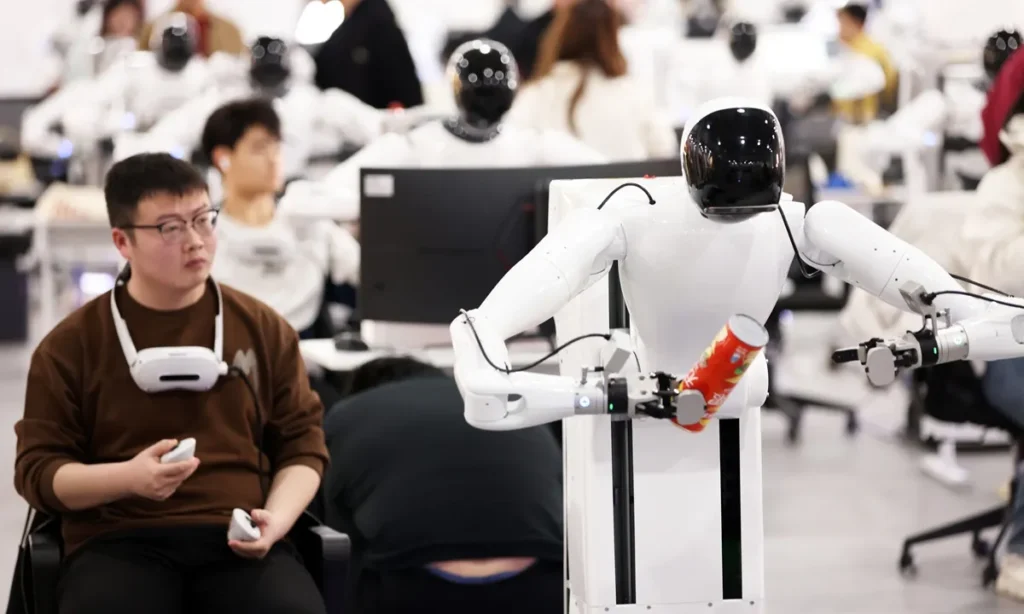
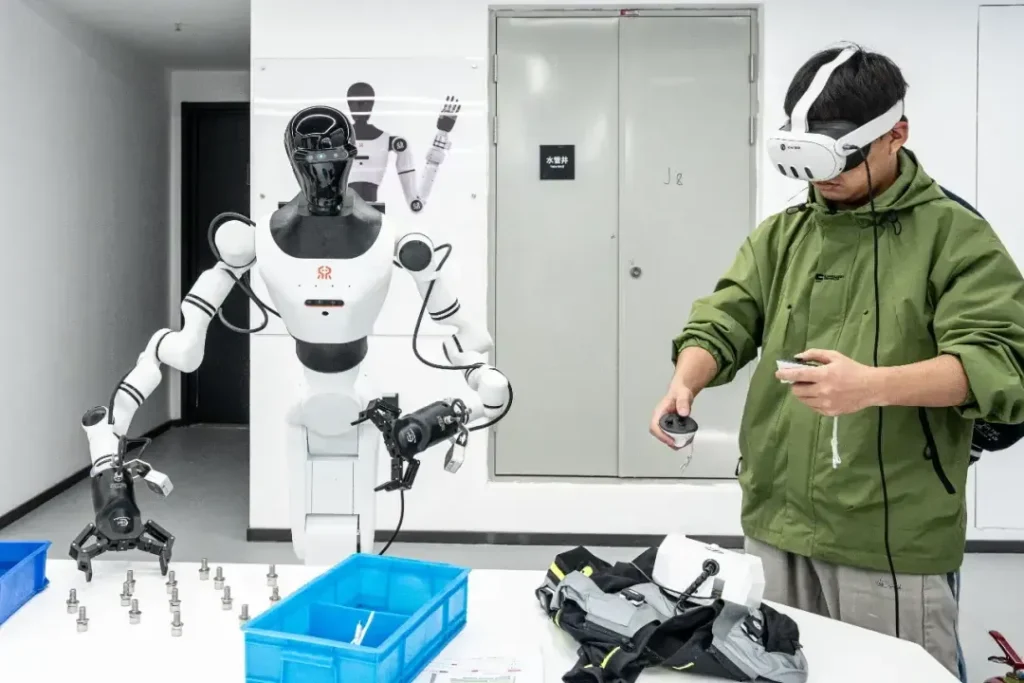
Company sites can operate intensively. Reuters reported in May 2025 that AgiBot’s Shanghai collection facility ran 17 hours daily, with about 100 robots and 200 human operators.
These data factories make the labor behind AI visible. Their production process depends on scene preparation, demonstrations, equipment checks, and review. My assessment is that China’s infrastructure can shorten the path from a collection requirement to a usable batch. It still requires evidence that the batch teaches the intended skill.
AgiBot’s March 2025 research introduced AgiBot World Colosseo, with more than one million trajectories across 217 tasks and five application domains. The project’s release log dates its Beta release to March 1, 2025.
The paper describes mobile dual-arm platforms and a collection process with human review, detailed task annotations, and checks for missing frames. Its physical settings include reconstructed everyday environments. This distinction matters: data recorded on real robots can still come from staged settings.
The value lies in complete interactions, including multi-step work and recovery. Buyers must inspect the robot configuration and task coverage rather than assume that a humanoid label guarantees walking, balance, or human-level dexterity.
AgiBot’s June 2026 Rich Interaction release deliberately records missed grasps, collisions, dropped objects, unstable contact, and liquid splashes. Operators explore how objects respond instead of collecting only successful task demonstrations.
Its September 2026 reinforcement-learning release reports 11,430 trajectories across 14 tasks. These include 1,024 successful autonomous rollouts and 1,369 failed rollouts, alongside expert demonstrations and human corrections.
That structure captures where a model struggles and what happens when a person takes control. For deployment teams, this makes failure analysis more concrete: the records can show which stage needs correction, rather than reducing every attempt to a success score.
These are developer-reported dataset characteristics. They describe available research material, not independently established commercial performance.
Physical collection is one route to scale. Simulation can generate controlled variations without repeating every interaction on hardware.
The 2025 GraspVLA research, from a team including Galbot and Peking University, introduced SynGrasp-1B, a billion-frame grasping dataset generated in simulation. The team’s project page describes variation in objects, lighting, backgrounds, and spatial arrangements.
The unit matters. One billion frames does not mean one billion completed tasks or independent demonstrations.
The researchers reported real-world grasping evaluations, making this a concrete simulation-to-real example. Its scope remains grasping. Results from that task cannot establish reliable performance across an entire production process.
The practical choice is to match data generation to the problem. Simulation can broaden visual and object variation; real-machine data can reveal physical behaviors that the simulator represents poorly. Each source needs evaluation on the target equipment.
China’s research also challenges simple volume targets.
In September 2025 engineering notes, the GO-1 team described successful demonstrations with idle opening frames that taught the model to remain motionless. It also identified checkout sequences where similar visual states made task progress ambiguous.
Its quality check included replaying recorded actions under the same initial conditions. A demonstration can look correct on video but fail when a controller executes its commands.
A study first published in July 2025 and revised in June 2026 found that, in its experiments, task diversity mattered more than additional demonstrations per task. Differences in operators’ movement preferences could also confuse learning.
These findings favor deliberate collection design. A supplier should identify the missing skill or condition, gather relevant examples, and test the resulting policy. Another thousand repetitions of an easy action may contribute less than carefully documented examples of a difficult transition.
China’s facilities create opportunities to collect task-specific material and collaborate on physical testing. Open releases also let teams inspect methods before committing to a supplier.
The economics remain unsettled. Reuters’ August 2026 investigation reported that staff at a Liuzhou collection center cited high operating costs, low data prices, and no clear current path to profitability.
A practical supplier evaluation should request four forms of evidence:
These measures link the dataset to operational requirements. They also reveal costs that a polished demonstration can conceal.
The procurement goal should be a repeatable task at an acceptable total cost. A contract can tie additional collection to measured weaknesses in the pilot. This gives China’s collection capacity a specific business purpose and a testable route to deployment.
Assessing robot datasets also means understanding the companies developing them and the applications they support. At ChoZan, our China expert calls connect global teams with industry specialists to discuss AI, robotics, adoption trends, and business opportunities.
Our tailored China learning expeditions combine company visits, expert discussions, and workshops shaped around specific business objectives. Start with our 2026 humanoid robotics report to frame the questions behind a potential project.
Book a consultation to discuss a focused research or learning brief.
Start with the developer’s official repository or dataset card. AgiBot World 2026 publishes files on Hugging Face. Inspect the release documentation, access requirements, license, and sample structure before downloading a large collection.
Public access does not automatically grant commercial rights. AgiBot World 2026 lists CC BY-NC-SA 4.0, which includes a noncommercial restriction. Check the exact release terms and seek separate permission when your proposed use requires it.
An episode records a sequence of robot interactions from an initial state to an endpoint. A frame captures a single instant in a stream. Compare episode duration and task variety alongside counts, since frames are not independent experiences.
There is no universal episode count for a useful pilot. Begin with a narrow task and a documented baseline. Add examples when evaluation reveals specific gaps, then track the benefit of each collection round against its cost.
Human video can provide visual knowledge and motion representations, but it does not directly provide a robot’s control commands. The AgiBot World paper combines video-derived representations with robot action learning rather than treating both sources as interchangeable.
Keep related recordings together when assigning training and test splits. Reserve distinct objects, locations, or collection sessions for evaluation. Document those choices before training so near-duplicate examples do not make apparent generalization look stronger than it is.
You can begin with a supported robot arm and a clearly defined task. Hugging Face’s collection guide demonstrates an SO-101 setup with teleoperation. Match the hardware to the experiment before committing to a larger platform.
Check the actual annotations rather than infer language from the developer’s location. Review terminology and instruction consistency before combining collections, since translated labels can describe the same movement in different ways.
Define capture boundaries before collection starts. Exclude or redact faces, badges, customer details, screens, and proprietary documents where needed. Agree with the collection partner on storage access, retention, and permitted reuse, then inspect samples for accidental exposure.
A dataset supplies recorded examples; a benchmark defines an evaluation problem and protocol. Some projects provide both. Check the test conditions, scoring rules, and training restrictions before comparing results, because identical data access does not guarantee comparable evaluations.