CONTENT
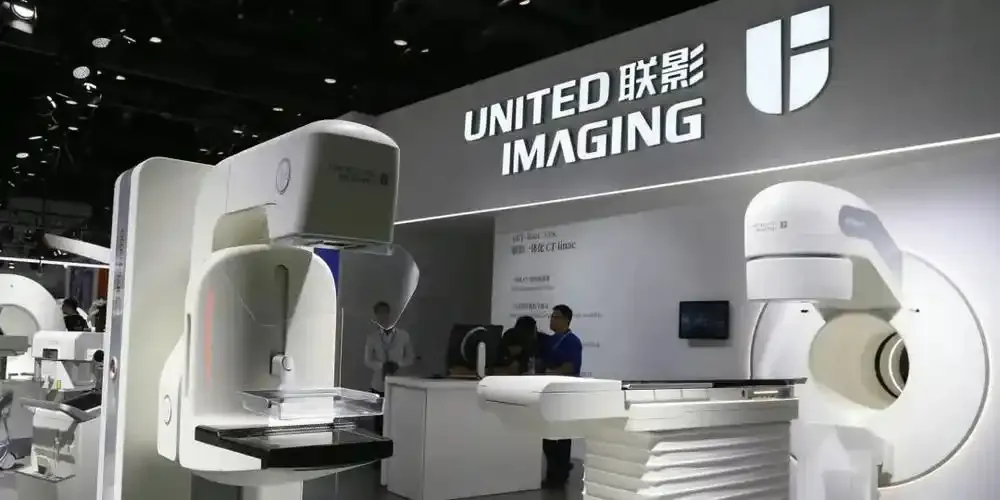
United Imaging is a Shanghai-based medical technology company that manufactures equipment, including MRI, CT, PET/CT, radiotherapy systems, and digital healthcare solutions. Its recent regulatory clearances and international sales show China’s capacity to compete in technically demanding medical markets.
A July 2026 Reuters report identifies GE HealthCare, Siemens Healthineers, and Philips as competitors. The company matters because imaging purchases shape hospital capacity, research options, and operating costs for years. Its progress offers a useful case for studying how Chinese engineering reaches global customers.
The strongest evidence comes from specific products, regulatory records, and financial disclosures, with clear limits on what each can prove.
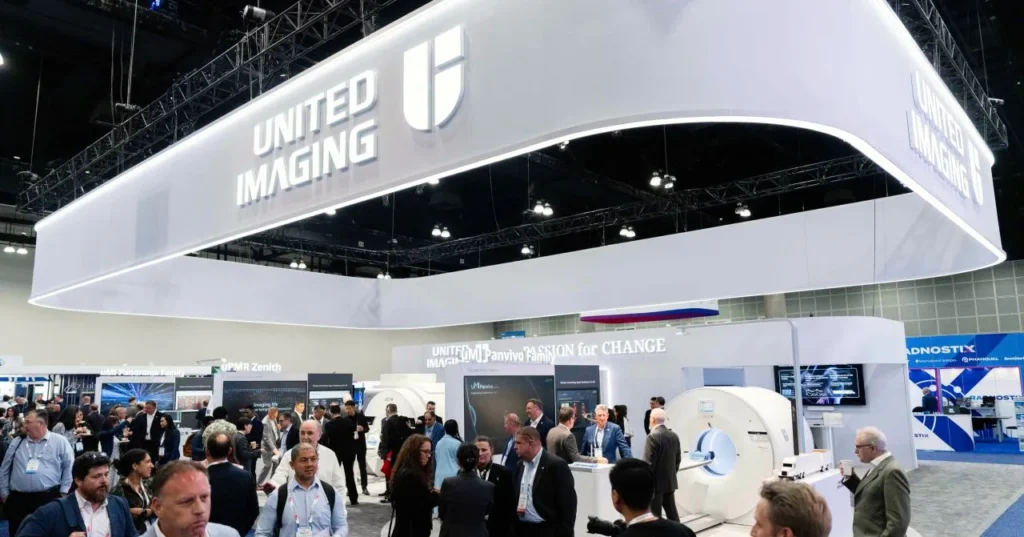
The company’s 2025 results announcement and first-half 2026 earnings discussion show commercial expansion alongside substantial research investment.
| Measure | Period | Company-reported result |
| Total revenue growth | Full year 2025 | 33.98% year over year |
| Overseas revenue growth | Full year 2025 | 51.39% year over year |
| Overseas share of total revenue | First half of 2026 | 25.02% |
| Total R&D investment as a share of revenue | First half of 2026 | 19.61% |
These measures answer different questions. Revenue growth shows commercial traction. The overseas share shows how much business comes from outside China. R&D intensity indicates resources committed to future products, though it cannot determine eventual returns.
The international business still accounts for roughly one-quarter of revenue. That leaves significant room for expansion while keeping the company’s dependence on its domestic market visible.
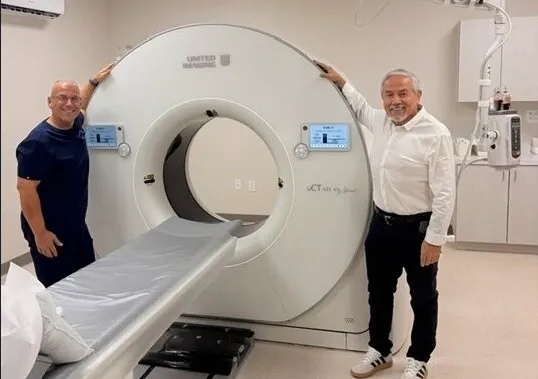
The FDA cleared uMR Ultra on July 17, 2025. The company’s November 2025 product announcement describes this 3T system as designed to visualize movement and physiological processes inside the scanner. The distinction matters for applications where anatomy changes during an examination.
A separate August 5, 2025 clearance covers an updated uMR Jupiter configuration. Its technical summary documents a 5T magnet and added functions, including tFAST for dynamic cardiac and perfusion imaging.
The filing also describes t-ACS, which combines compressed sensing with deep learning for images across multiple time points. These are additions to an existing system.
The strategic distinction is useful. Higher magnetic field strength and faster image acquisition address different constraints. Buyers need to assess the examinations a system can perform, the protocols their teams can run, and the clinical evidence behind each application.
The company’s 2025 half-year report records NMPA marketing authorization for uCT Ultima on August 25, 2025.
Photon-counting technology measures individual X-ray photons and their energy. That changes the information available to reconstruct images and distinguish materials. The competitive challenge therefore reaches into detector engineering and image processing.
Commercial value depends on translating those capabilities into reliable examinations. Evidence should connect image detail and radiation dose with a defined clinical task. Broad claims about better diagnosis need stronger support than a launch announcement.
Shanghai’s importance becomes clearer through clinical testing. The 2025 report documents uCT Ultima deployments for research at Zhongshan Hospital, affiliated with Fudan University, and Ruijin Hospital, affiliated with Shanghai Jiao Tong University School of Medicine.
Those deployments show a link between equipment development and hospital evaluation. This connection can help expose practical problems before wider adoption, from examination protocols to image interpretation. That is an inference from the research arrangement.
Hospital research also creates a demanding test of product usefulness. A technically impressive machine must fit real patient populations and clinical routines. This is a concrete mechanism through which China’s medical technology base can develop expertise that travels beyond the domestic market.
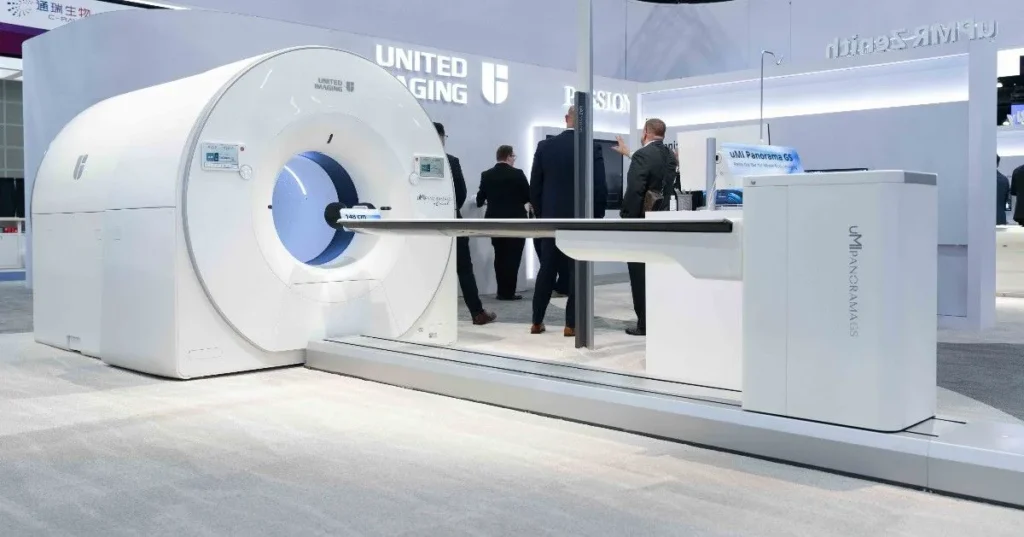
One less discussed detail appears in the company’s June 2025 molecular imaging announcement. Its uExcel platform shares critical components across systems, including the uMI Panorama and uMI Panvivo families. The company says this reduces cost and engineering complexity.
This platform approach offers a different way to understand product breadth. Common components can spread development work across several models and reduce the number of separate engineering problems. That is an inference from the design approach, rather than proof of a specific saving for customers.
Another 2025 disclosure describes substantial in-house development of core components. Together, component reuse and internal engineering suggest a route to controlling product complexity. They do not establish a universal price advantage over competitors.
It also creates a procurement question. A hospital should ask which detectors, reconstruction tools, and service parts its proposed configuration shares with other systems. Product families may simplify maintenance and upgrades, but the contract must make those benefits clear.
The useful comparison is the cost of delivering a suitable examination throughout the equipment’s working life.

The broader group includes United Imaging Intelligence, its medical AI developer. A February 2025 group announcement identifies it as a subsidiary of United Imaging Group. Readers should distinguish that organization from the listed equipment manufacturer.
At ECR 2026, the developer presented its uAI Clinical Portal, a platform with more than 60 applications. It also demonstrated uAI NEXUS models spanning images, language, speech, and video, plus tools that produce preliminary structured reports.
The announcement explicitly states that some presented applications lack CE marking or FDA clearance. Availability must therefore be checked by product and country.
The business significance of AI imaging lies in the work around interpretation: measurements, report preparation, and information retrieval. A useful evaluation should measure correction time and integration with healthcare IT, alongside model performance.
Deployment discipline also matters. In July 2026, United Imaging Intelligence co-CEO Zhou Xiang said that the company was resisting an aggressive internal rollout of AI tools, citing concerns about the technology’s maturity. His comments underscore the importance of evaluating AI adoption carefully, rather than treating rapid implementation as proof of success.
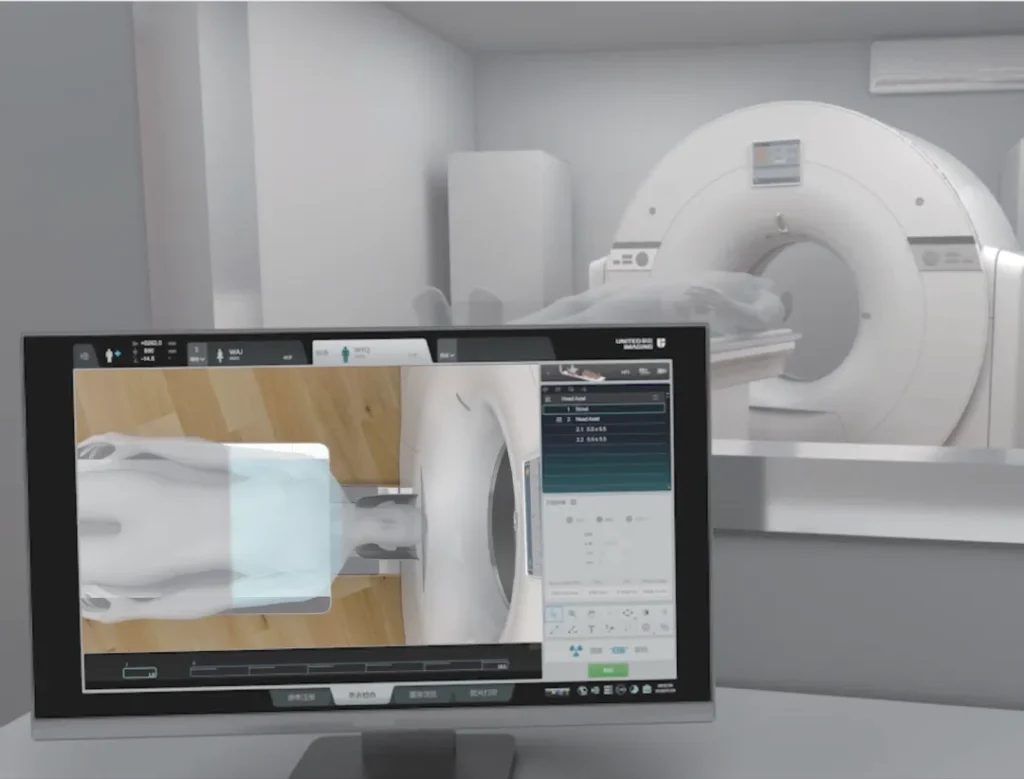
At ESTRO in May 2026, the company presented its CE-marked uRT-linac 506c. The system combines a diagnostic-quality scanner with a linear accelerator on one platform.
This arrangement connects imaging with treatment guidance and adaptive planning. The commercial logic concerns the workflow between diagnosis, planning, and delivery, rather than scanner sales alone.
Integration brings its own demands. Hospitals must evaluate staffing, quality assurance, and the time needed to check a revised plan. A combined platform may reduce handoffs, while also creating greater dependence on one supplier’s software and service arrangements.
That trade-off deserves attention alongside technical specifications.
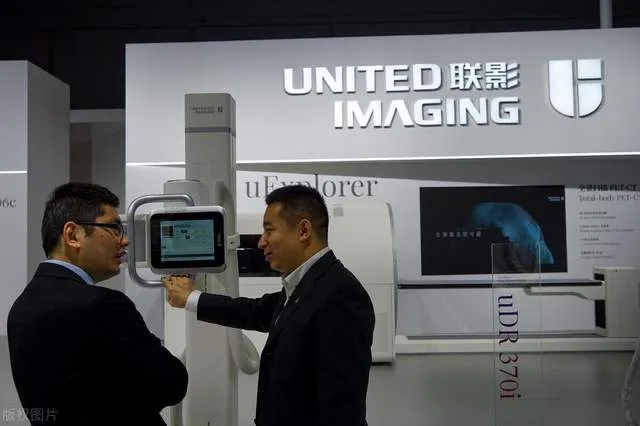
The latest earnings discussion reports that service revenue grew 20.11% in the first half of 2026 and represented 13.90% of total revenue.
Separately, the April 2026 results release reports 44 overseas service sites and 39 spare-parts warehouse locations globally. These disclosures show investment in the infrastructure behind installed medical equipment.
The practical test is local execution. Buyers should request response-time commitments, parts availability, and references from hospitals with comparable workloads.
Expansion also carries financial costs. Profit before tax fell 3.72% in the first half of 2026; management identified foreign exchange losses as a material factor.
The company’s next stage will depend on converting technical capabilities into dependable operations and repeat business across markets.
United Imaging offers a useful starting point for studying China’s approach to complex technology. ChoZan’s China research, digital transformation workshops, and innovation resources can help teams examine developments relevant to their own business.
Book a consultation to discuss a focused research or learning brief.
Yes. United Imaging Healthcare trades on the Shanghai Stock Exchange’s STAR Market under stock code 688271. Its filings provide financial and ownership information. Check the legal entity when researching other companies within the broader group.
The equipment manufacturer lists its address as 2258 Chengbei Road, Jiading District, Shanghai. Confirm the appropriate regional contact for sales, technical service, or research inquiries, since those functions may operate through different offices and teams.
A useful quotation must specify the model, configuration, installation requirements, software, and service terms. Request separate costs for site preparation and ongoing maintenance. A headline equipment price alone cannot establish the total cost of ownership.
Yes. The company introduced its uSONIQUE ultrasound family globally at RSNA 2025, covering several clinical application areas. Check the specific model’s current authorization and availability with the regional supplier before treating a displayed product as purchasable.
Compatibility depends on the product, version, and existing systems. Ask for documented interfaces, supported DICOM functions, and a demonstration using your actual workflow. Include image transfer, patient identity matching, and report exchange in acceptance testing.
Higher field strength does not make a system suitable for every department. The choice needs clinical and technical review of examination demand, protocols, patient requirements, staffing, and facilities. Request evidence for the applications your hospital expects to perform.
Axial field of view describes the length along the patient that the PET detector covers at one time. Compare it alongside examination protocols and performance data, since coverage alone does not establish suitability for a particular clinical task.
Treat each update as a defined change. Request version notes, validation results, and the applicable regulatory documentation. Test representative local cases, record errors, and agree on rollback arrangements before introducing revised software into routine clinical workflows.
Specify training for operators, clinical application teams, and biomedical engineers in the purchase agreement. Ask about initial instruction, refresher sessions, and staff turnover. Agree on competency checks and responsibility for training after substantial software changes.
Request written terms covering data ownership, storage location, remote access, retention, and deletion. Clarify what the supplier can access during maintenance and how access gets recorded. Have the hospital’s privacy and security teams review those arrangements.