CONTENT

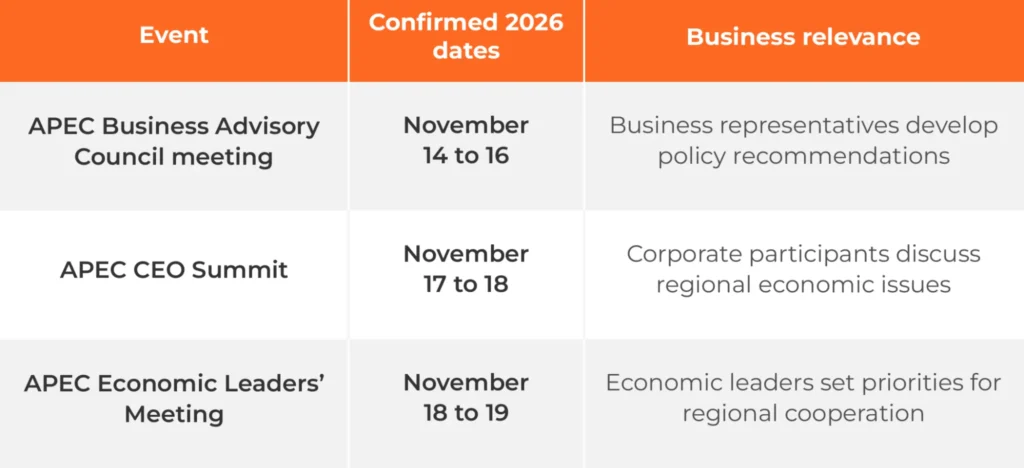
APEC China 2026 will bring the forum’s 21 member economies to Shenzhen for the Economic Leaders’ Meeting on November 18 and 19, 2026. The CEO Summit takes place on November 17 and 18, according to the official APEC calendar.
The business implications center on AI adoption, digital trade, and cross-market cooperation. Shenzhen also offers concrete examples of Chinese technology reaching commercial use. Companies can study these developments to assess potential partners, examine operating models, and identify practices worth testing in their own markets.
APEC’s November program includes separate meetings for economic leaders, corporate participants, and business advisers. Each serves a different purpose.
The organizer’s November administrative circular places the CEO Summit at Qianhai International Convention Center.
APEC operates through voluntary, nonbinding cooperation. Its statements indicate policy direction; any change affecting a commercial transaction needs separate confirmation from the relevant authorities.
China’s theme is “Building an Asia-Pacific Community to Prosper Together,” with three priorities: openness, innovation, and cooperation. APEC’s December 2025 agenda announcement connects these priorities to regional trade integration, connectivity, frontier technologies, and capacity building.
The proposed Free Trade Area of the Asia-Pacific (FTAAP) marks its 20th anniversary in 2026. Current APEC policy dialogues cover trade digitalization, competition policy, state-owned enterprises, and the relationship between trade and labor.
APEC ministers adopted the Chengdu Statement on July 23, 2026. It encourages stronger communication infrastructure and affordable, easy-to-deploy digital solutions for smaller businesses. The statement advances the APEC AI Initiative for 2026 to 2030, which leaders endorsed in 2025.
For a business assessment, this suggests examining the conditions required to deploy a service across markets. Relevant questions include how systems exchange information, how staff manage errors, and how suppliers demonstrate reliable performance.
These are areas to monitor as discussions progress. As of November 13, the leaders’ meeting has not yet taken place.
China announced plans for the China Center for APEC Cooperation on Cross-border Data Flows in Qianhai on July 24, 2026. Its planned work covers policy research, rules coordination, and industry services, according to the official announcement.
Separately, Qianhai’s existing cross-border data services center had served more than 190 companies, according to a July 23 authority update. These included businesses in finance, healthcare, technology, and advanced manufacturing.

Shenzhen’s relevance extends beyond hosting the summit. Recent independent evidence places its surrounding region among the world’s major concentrations of innovation activity.
WIPO’s 2026 innovation-cluster assessment ranks the Shenzhen, Hong Kong and Guangzhou cluster first by total innovation output. The assessment combines international patent applications, scientific publications, and venture capital deals.
Two qualifications matter. The ranking covers a regional cluster spanning three cities. Its position falls to 44th when WIPO measures innovation intensity relative to population.
The business interpretation is that the region offers substantial activity to investigate, while individual companies still need assessment on their own merits. A regional ranking cannot establish a supplier’s product quality, service capacity, or suitability for an overseas project.
Two current examples make the learning opportunity specific. Tencent illustrates AI integration within digital commerce, while BYD shows how product development connects with supporting infrastructure. The following lessons are an editorial analysis of their reported activities.

Tencent reported 22% year-over-year growth in marketing services revenue for the second quarter of 2026. Its quarterly results disclosure linked that growth to AI ad recommendations, upgrades to its AIM+ campaign system, and closer integration with Weixin commerce.
This is company-reported performance with several contributing factors. It does not isolate AI’s contribution or establish an equivalent return for each advertiser.
The useful lesson concerns workflow design. Assess how audience selection, campaign execution, purchase completion, and measurement connect. A relevant experiment would compare customer acquisition cost and incremental sales against an existing campaign, with a defined budget and evaluation period.

BYD’s March 2026 technology announcement introduced its second-generation Blade Battery and FLASH Charging system. The company described station-level energy storage that charges more slowly and supports high-power vehicle charging.
This creates a useful systems question: what supporting equipment makes a headline capability practical?
A charging project assessment should examine compatible vehicles, grid capacity, storage requirements, site costs, maintenance, and expected usage. Suppliers should provide operating evidence for comparable conditions. A launch specification alone provides limited information about a site’s commercial performance.

Cross-border document exchange is a less visible part of the agenda with direct operational relevance.
A March 2026 APEC policy brief, using 2025 UN survey data, reports average implementation scores of 89% for paperless trade and 71% for cross-border paperless trade.
APEC’s November 2026 briefing cites research suggesting that digitalizing trade documents could reduce trade transaction costs by 5.8%. Actual company savings would depend on the processes involved and implementation.
These scores measure implementation of surveyed measures, rather than the share of shipments processed digitally. Data were unavailable for Hong Kong, China, and Chinese Taipei.
The gap points to a specific problem: domestic digital systems need cross-border compatible processes.
APEC’s September 2026 paperless trade update describes work through its Centre of Excellence for Paperless Trade. Initial priorities include electronic bills of lading, certificates of origin, invoices, and customs bonds.
Companies can use this work to frame a narrow operational test. Select one shipping route, identify which parties accept electronic documents, and record every manual handoff. Measure processing time, corrections, and document-related delays before deciding what to expand.
Assess each announcement against the evidence needed for a business decision. The framework below is a recommended evaluation method.
Keep policy monitoring and procurement decisions on separate approval paths. A promising regional initiative may justify research before it supports a purchasing commitment.
For any proposed technology test, name an owner and define the problem first. Set a baseline, an acceptable cost, and a measurable success threshold. This makes a China learning visit easier to translate into a reviewable investment proposal.
Also identify the local conditions behind each operating model. Relevant factors include customer behavior, payment systems, supplier proximity, energy pricing, and available service partners. Record these dependencies beside the proposed use case. Then specify the changes an overseas trial would require, who would deliver them, and how they would affect the project budget.
Attendance requires organizer approval. The current delegate instructions require organizer-issued registration credentials, completed registration and payment, and approval before participants can download confirmation letters.
Companies considering attendance should check directly with the organizer for their current eligibility and application status. A separate business visit to Shenzhen requires its own company appointments and access arrangements.
Prepare those meetings around evidence requests: a working demonstration, a comparable customer deployment, implementation requirements, and ongoing support. Leave each discussion with enough detail to decide which opportunity deserves a follow-up assessment.