CONTENT
The latest BYD news is not just about cars. It is about a Chinese company rewriting the rules of global industry, and every business leader paying attention should take note.
BYD, whose name comes from the pinyin initials of its Chinese name 比亚迪 (Bǐyàdí) and whose marketing slogan is “Build Your Dreams,” surpassed Tesla in pure electric vehicle deliveries in 2025, cementing its position as the world’s top EV seller.
Its rise from a modest battery manufacturer in Shenzhen to a global automotive powerhouse is one of the most instructive business stories of this decade. For executives looking to understand how China-born innovation reshapes entire industries, BYD is the case study you cannot afford to miss.
BYD was founded in Shenzhen in February 1995 by Wang Chuanfu, a materials scientist and engineer who built his expertise in battery chemistry before most of the world knew what an electric vehicle was.
Shenzhen sits at the heart of the Greater Bay Area, China’s most concentrated innovation corridor, and remains one of the world’s most dynamic technology hubs.
What began as a manufacturer of rechargeable batteries, and would later supply Nokia and Motorola by the early 2000s, has grown into a full-spectrum energy and mobility company with record revenue of 803.96 billion yuan in 2025 and vehicles present in more than 110 countries and regions worldwide.
Today, BYD is not simply an automaker. It is an integrated technology ecosystem that produces everything from city buses and passenger EVs to energy storage systems and solar panels. In 2025, the company sold over 2.25 million battery electric vehicles (BEVs), a 28% year-on-year increase, marking a decisive shift in the global EV leadership landscape.
In 2008, Wang Chuanfu set a defining goal: BYD would become the leader in the Chinese automotive market by 2015, and the largest car manufacturer in the world by 2025. He stated publicly, “For new-energy cars, we believe we can become the global leader.
From the technology standpoint, 10 years should be enough.” At the time, it was a bold declaration. In hindsight, it was a roadmap.
The foundation of that ambition is BYD’s vertical integration model. Unlike most automakers who rely on third-party suppliers for batteries, chips, and motors, BYD develops and manufactures nearly every critical component in-house.
Its subsidiary, FinDreams Battery Co., is the world’s second-largest EV battery manufacturer, sitting just behind CATL. This structure gives BYD cost advantages, supply chain resilience, and the ability to roll out new technology faster than almost any competitor in the world.
BYD’s international expansion is not a reactive move. It is the result of deliberate, decade-long planning built on three interlocking pillars: vertical integration, localization, and relentless technology investment. Understanding these pillars is where the real insight for global leaders begins.
BYD controls nearly every element of the EV value chain, from raw material sourcing and battery chemistry to software development and final assembly. This is not standard practice in the automotive industry. Most legacy manufacturers depend on a web of external suppliers, creating vulnerabilities in cost, quality, and speed.
The commercial result of this model is the Blade Battery, a lithium iron phosphate (LFP) innovation that eliminates volatile cobalt and nickel, reducing both production costs and safety risks.
The next generation, Blade Battery 2.0, goes further, enabling a charge from 10% to 70% in approximately five minutes. This is not incremental improvement. It is a technology leap designed to eliminate one of the last major barriers to EV adoption.
For global executives, the message is clear. Supply chain ownership is a strategic asset, not just an operational preference.
One of the most instructive elements of BYD’s global strategy is its preference for building inside markets rather than exporting into them. The company currently operates or is actively constructing manufacturing facilities in:
Each facility is calibrated to local regulatory conditions, labor markets, and consumer preferences. This is not just a manufacturing strategy. It is political and commercial hedging executed at scale.
The most recent byd news, confirmed during an analyst briefing on March 30, 2026 following weaker-than-expected Q4 2025 earnings, is that BYD has raised its overseas sales target to 1.5 million vehicles for 2026, a 15% increase from the initial forecast of 1.3 million units set in January.
This revision reflects both accelerating international demand and a deepening strategic pivot as domestic market conditions continue to tighten.
BYD’s home market has come under significant pressure. The company’s combined January and February sales in China dipped roughly 36% year-on-year, driven by intensifying domestic price competition and the reinstatement of a 5% purchase tax on new energy vehicles at the end of 2025.
In response, international markets have become the company’s primary growth engine and financial buffer.
The export momentum is accelerating month by month. BYD exported 120,083 vehicles in March 2026, up 65.12% year-on-year, with first-quarter overseas sales reaching 321,165 units in total.
April pushed that momentum further: overseas sales of passenger vehicles and pickups hit a record 134,542 units in April, a 70.9% increase year-on-year, with exports accounting for approximately 42.8% of BYD’s total monthly volume, between January and April, cumulative overseas sales reached 455,707 units, up nearly 60% year-on-year.
In full-year 2025, BYD exported 1,046,083 NEVs, a 150% year-on-year increase and the first time annual overseas volume crossed the one-million-unit threshold. Overseas revenue reached RMB 310.7 billion, now accounting for 38.65% of BYD’s total revenue, making international markets a structural pillar rather than a supplementary channel.
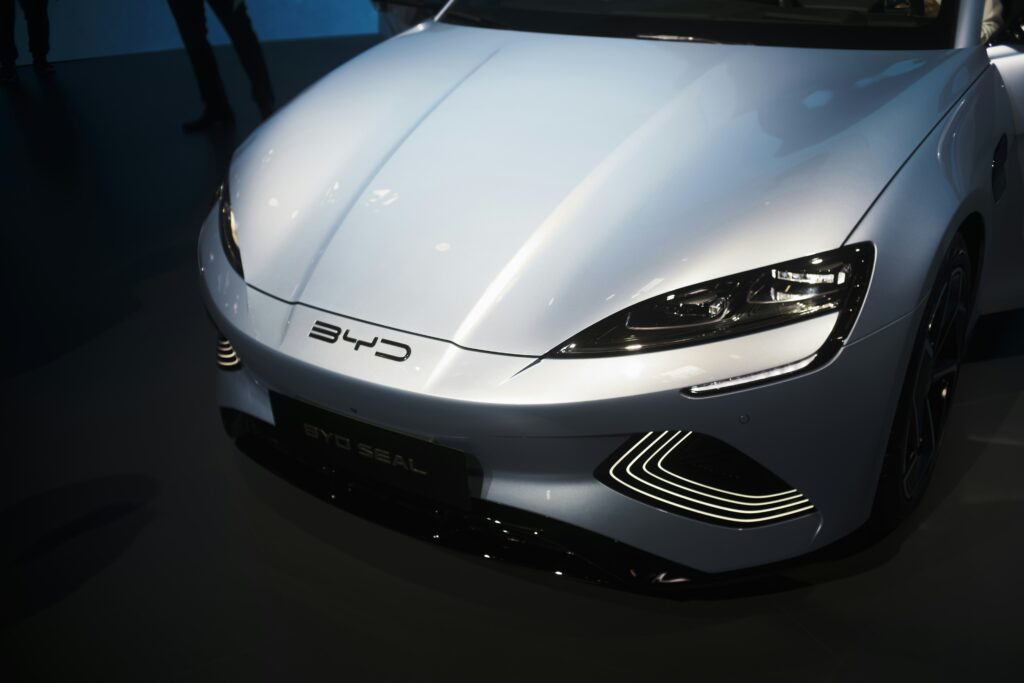
For any Chinese brand expanding into Western markets, trade policy is one of the most significant structural risks. In October 2024, the European Union imposed additional countervailing duties on Chinese-manufactured EVs, ranging from 17.4% for BYD to as high as 35.3% for SAIC on top of the EU’s existing 10% standard car import tariff.
Most companies respond to tariffs with lobbying, price adjustments, or market withdrawal. BYD responded by building factories inside Europe.
This approach reframes the tariff problem entirely. Instead of fighting the policy, BYD makes itself a local producer. It secures supply chain proximity, builds political goodwill, creates local employment, and positions itself as a European brand rather than a Chinese importer.
One of the most striking patterns in BYD’s trajectory is the velocity at which it innovates. In an industry where a new platform typically takes five to seven years to develop, BYD launches new models every few months, iterates on battery chemistry annually, and deploys over-the-air software updates to its entire fleet in real time.
This is not unique to BYD. It is a defining characteristic of how leading Chinese companies operate, and it represents one of the most important things global executives can observe firsthand.
BYD invested approximately $9.2 billion in R&D in 2025, maintaining its development budget even as net profit declined by 19%. The Song Ultra EV, unveiled in late March 2026 with Blade Battery 2.0 and five-minute fast-charging technology, attracted over 21,500 pre-orders within 20 days of launch. The God’s Eye intelligent driving system was generating 44 million kilometres of driving data daily by mid-2025, creating a machine-learning feedback loop that continuously improves autonomous capabilities.
BYD’s 7+4 Full Market Strategy, launched in 2015, mapped out seven conventional vehicle categories and four specialized ones across commercial and consumer segments. It was long-range vision with short-cycle execution built in.
Chinese companies institutionalize fast iteration by treating product development as a continuous process rather than a discrete project cycle.
New models are not launches. They are updates. New features are not product refreshes. They are data-driven responses to customer behavior. This mindset produces compounding advantages that are difficult for competitors to replicate at the speed required.
Current BYD news from 2026 highlights BYD’s next-generation technology rollout as central to its global competitive strategy. The company is deploying:
These are not standalone product features. They form an interconnected technology stack designed to make BYD vehicles increasingly difficult to replicate or displace over time.
BYD’s story carries direct, actionable lessons for executives across industries, not just automotive. ChoZan works with multinational leadership teams that are actively seeking to understand and apply what China’s most advanced companies are doing. Here is what BYD’s expansion reveals.
BYD’s vertical integration was not an accident or a cost-cutting measure. It was a deliberate, decade-long strategic build designed to create advantages that compound over time. Today, that integration allows BYD to respond to technology shifts, cost pressures, and market demands faster than competitors who depend on external supply chains.
Every executive should ask: which parts of your value chain are currently strategic vulnerabilities? The answer is where your next investment should be.
Many global companies localize their marketing. BYD localizes its manufacturing. Building inside a market signals long-term commitment, reduces exposure to trade policy risk, adapts the product to local conditions, and builds the kind of political and economic ties that protect a brand over the long term.
China-born companies are now leading on this front. The playbook exists. Global leaders need to study it. ChoZan’s digital transformation consulting helps multinational teams interpret and apply these shifts from China’s industrial leaders.
BYD’s domestic market share contracted significantly in early 2026. Its response was not to retreat. It was to accelerate international expansion with greater urgency and ambition. Domestic headwinds became the catalyst for a 15% upward revision in its global export target.
This is a leadership mindset that turns internal constraints into expansion momentum. It is the kind of strategic agility that separates companies that lead decades from those that lead quarters.
Understanding BYD from a distance is useful. Understanding it from the inside is transformative.
ChoZan’s China Learning Expeditions and Innovation Tours take executive teams directly into China’s most advanced innovation ecosystems.
Participants visit companies operating at the frontier of EV technology, smart manufacturing, AI integration, and supply chain engineering. They meet the people building these systems, see the factories running them, and return with insights that cannot be found in a report.
ChoZan also offers China Tech Trends research, expert dialogs with industry insiders, and consulting services tailored to multinational teams navigating China’s fast-moving landscape.
Whether your goal is to understand how Chinese companies are scaling globally, how to position against them, or how to partner with them, ChoZan provides the access, context, and expertise to make that learning actionable.
BYD is one of the only automakers in the world that manufactures nearly every critical component in-house, including batteries, semiconductors, electric motors, and vehicle software. This vertical integration gives it significant cost, speed, and technology advantages over competitors relying on third-party supply chains.
BYD is building factories in Europe, Southeast Asia, Latin America, and beyond primarily to navigate import tariffs, reduce trade policy risk, and get closer to high-growth consumer markets. Local production also allows BYD to tailor vehicles to regional regulations and customer preferences.
BYD demonstrates that supply chain ownership, local market commitment, and sustained R&D investment create compounding competitive advantages. Its response to domestic pressure, by accelerating global expansion rather than retreating, also offers a practical model for turning internal constraints into outward ambition.
ChoZan provides China Learning Expeditions, Innovation Tours, tech trend research, and expert consulting services that give executive teams firsthand access to China’s leading innovators. ChoZan helps global leaders move beyond surface-level analysis to ground-level understanding.
No. BYD’s strategic model, particularly its approach to vertical integration, localization, rapid iteration, and technology investment, offers lessons applicable across manufacturing, consumer electronics, energy, and logistics sectors. It is a case study in Chinese innovation at scale.