
CONTENT

When people outside China think of TikTok, they often picture viral dances, but the firm behind it, ByteDance, has evolved into a broad artificial intelligence company. Within China, ByteDance operates a family of apps, including the short-video leader Douyin, the news service Toutiao, the enterprise suite Feishu, and gaming and virtual-reality studios.
In 2025, the group refocused its strategy on treating personalized recommendations, content-led shopping, and cloud infrastructure as parts of a single operating system. In this framework, ByteDance AI is not an isolated feature; it powers how users find entertainment, how merchants sell, and how engineers build.
This article explores how this genre has evolved, compares leading platforms, and explains why MiniMax has become a model for global consumer distribution among Chinese tech innovators.
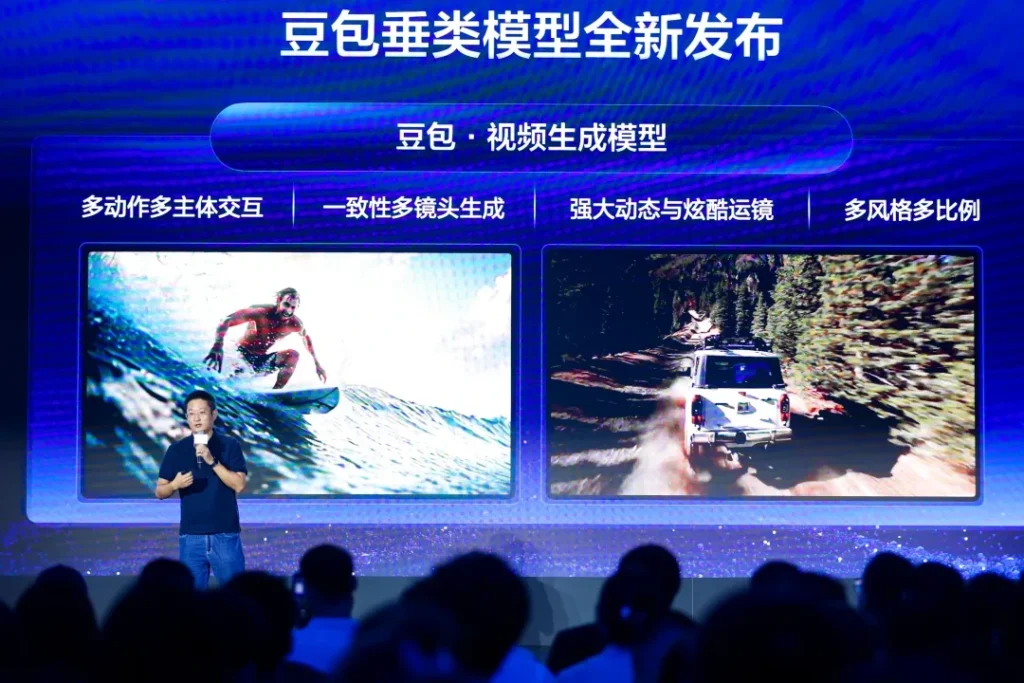
What is ByteDance beyond TikTok and Douyin? At its core, ByteDance is a recommendation algorithm company.
ByteDance’s success begins with its recommendation engines. In April 2025, Douyin’s Trust and Safety team described a wide-and-deep model that remembers common feature combinations and a two-tower retrieval model that matches users and videos based on mathematical similarity. Sharing this architecture signaled both a willingness to address algorithmic bias and confidence in the system’s ability to keep users engaged.
Scale magnifies the impact of these design choices. In 2026, researchers estimated that ByteDance captured roughly one-quarter of China’s digital advertising market and that Douyin served over 760 million daily users.
Douyin also pairs entertainment with commerce through in-app shops, livestream sales, and an integrated payment system, allowing viewers to watch and purchase within the same feed.
Conversation layers build on this recommendation core. In February 2026, TikTok introduced Tako, and soon after, it began testing AI Overviews that summarise a video and suggest related clips or products. A search bar invites follow-up questions. This feature transforms passive viewing into an interactive dialogue. These tools create new space for sponsored items and channel viewers toward purchases.
This evolution reflects a broader shift toward content-led discovery. Marketing strategist Ashley Dudarenok notes that young consumers often discover products through short videos, livestreams, and peer posts rather than through search boxes.
Douyin’s feed sparks desire, validates choices through social proof, and removes friction at checkout. As discovery replaces search, advertisers are rethinking how they launch and promote products.
What does ByteDance own in the commerce space? The answer is a complete shopping ecosystem inside Douyin and TikTok Shop. Unlike traditional e-commerce, where users search for products, ByteDance surfaces items inside entertainment content.
In 2025, Douyin generated roughly $ 720 billion in gross merchandise value, about a fifth of China’s online shopping. Short clips and livestreams act as shops, and AI tools help merchants improve their shows and customer support.
The platform now ranks fourth behind Taobao, JD, and Pinduoduo. During the 2025 Double 11 festival, over 41,000 merchants using AI tools saw livestream sales surge more than 500 percent. AI customer service agents achieved 90 percent accuracy in handling shopper inquiries.
ByteDance subsidiaries, such as TikTok Shop’s global operations, reached approximately $ 64.3 billion in GMV for 2025, a 94 percent increase from the previous year. The United States contributed $ 15.1 billion. Southeast Asia led with $ 45.6 billion.
Interest-based shopping changes how people buy. Dudarenok explains that Gen Z shoppers encounter goods through a series of exposures: short videos introduce products, live hosts answer questions, and links funnel buyers to checkout.
Douyin removes the need for search by demonstrating products in context and responding to doubts. TikTok’s AI Overviews and the Tako chatbot play a similar role. They shorten the journey from desire to purchase.
The third pillar is the technology base that supports discovery and commerce.
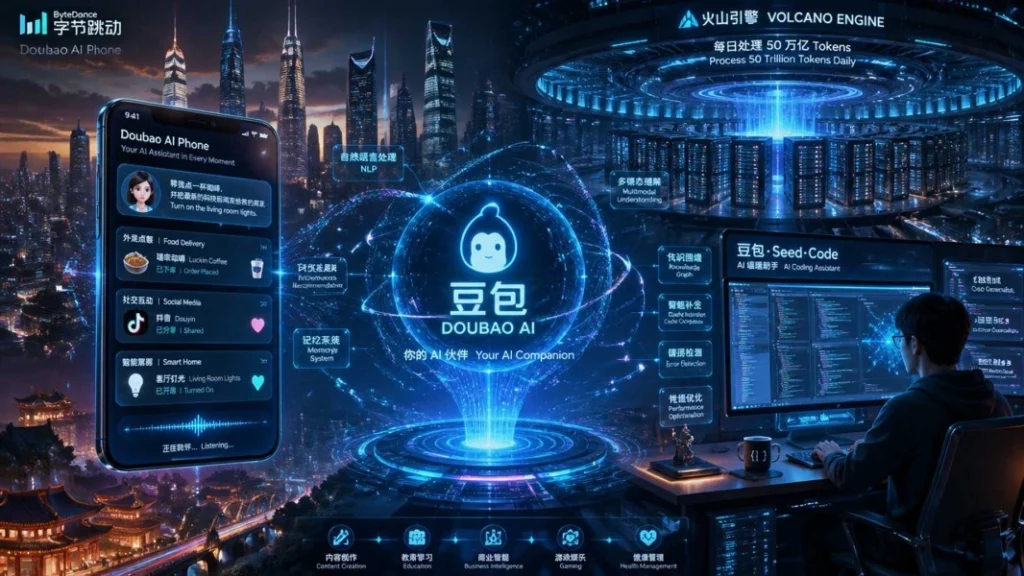
ByteDance operates Volcengine, a cloud platform for computing and machine learning. To supply this platform, the company buys and designs chips.
Reports from 2025 and 2026 describe plans to spend tens of billions of yuan on Nvidia hardware and to develop a custom processor called SeedChip with Samsung, targeting production of at least 100,000 units. These investments reveal a desire to control supply chains for future models.
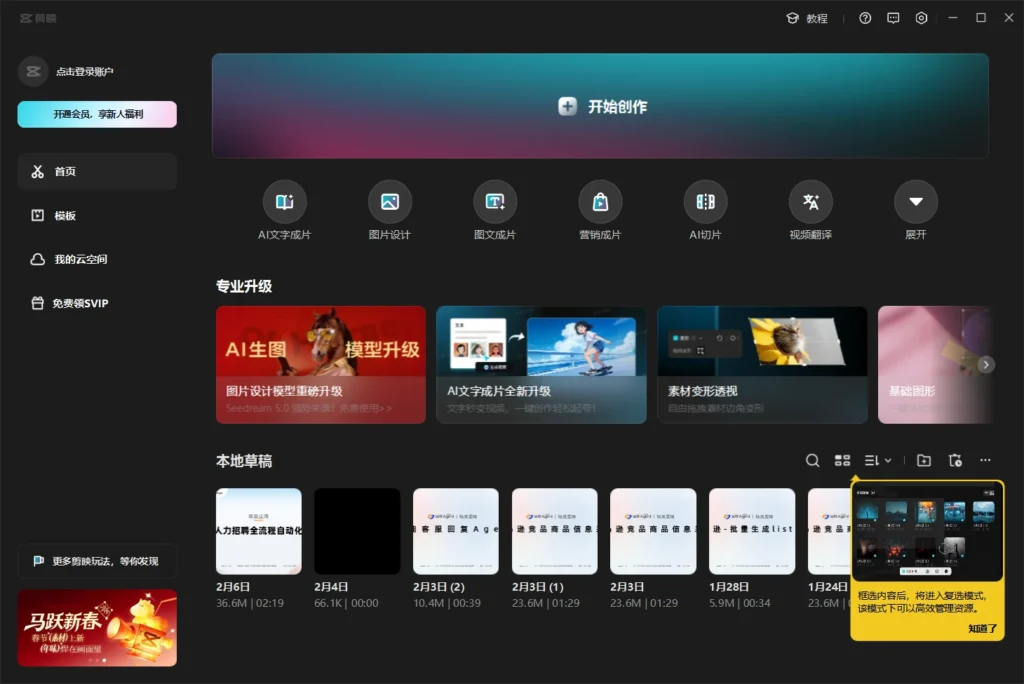
Software is the other side of infrastructure. In February 2026, ByteDance released Doubao Seed two point zero Code, a programming model trained on tens of trillions of tokens with a long context window. It reduces costs and ranks high on benchmarks for real-world coding tasks while integrating with the group’s development platform and agent frameworks.
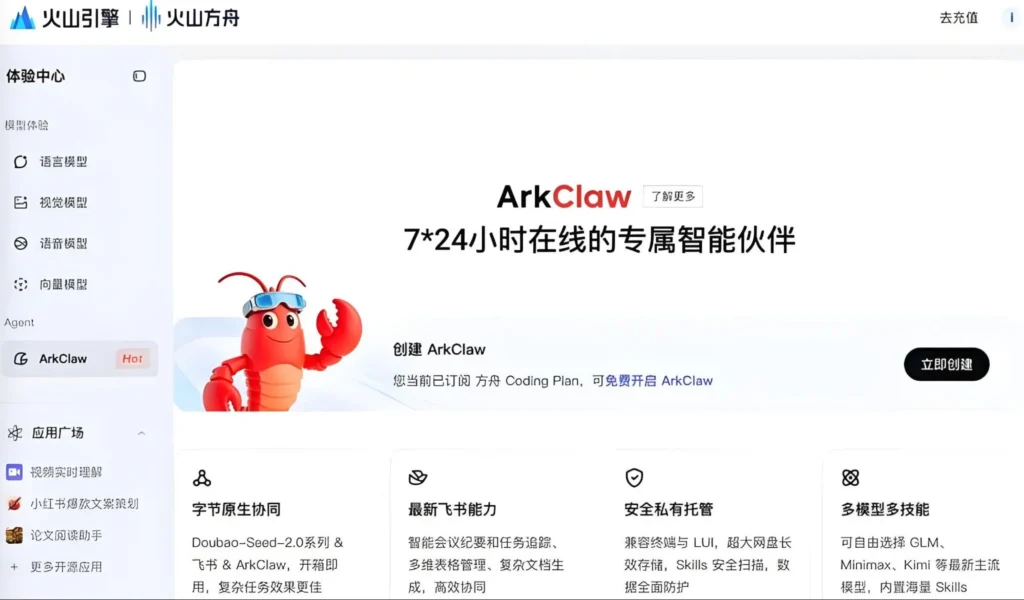
In March 2026, the company launched ArkClaw, a hosted service that runs AI agents on behalf of customers. ArkClaw connects with Feishu for scheduling and document creation and includes security scanning and storage. This service turns experimental agents into practical office assistants.
Another release is Seedance two point zero, a video generation model opened to developers in April 2026. Seedance accepts text, images, sound, and video and offers precise camera control and physical simulation. It improves motion and character consistency and is marketed for dramas, advertising, and film. Developers apply through the Volcengine console.
Finally, the company is experimenting with digital avatars. The OmniHuman project, introduced in 2025, can generate a lifelike video from a single photo and may one day support virtual customer service and education.
Content creators can produce personalized videos at scale without cameras or actors. Merchants can generate product demonstrations in multiple languages. The training data included over 18,700 hours of video, achieving lip sync precision of 1.2 millimeters and 94 percent accuracy.
ByteDance AI integrates discovery, commerce, and infrastructure into a single system. Douyin and TikTok surface content through AI recommendations. That content drives shopping through livestreams, product feeds, and TikTok Shop. Volcengine then turns the same AI capabilities into cloud, advertising, and enterprise tools.
This integration gives ByteDance its advantage. More content creates more engagement. More engagement creates more commerce data. More data improves recommendations, creator tools, ad targeting, and shopping conversion.
ByteDance is also expanding the system beyond video. The report highlights TikTok’s move toward text posts, local services, travel, food delivery, immersive media through Pico, and enterprise AI through Volcengine. These moves show how ByteDance is building a broader digital services platform rather than a single-app business.
Competitors can copy individual features. They can add short videos, livestream commerce, or AI tools. ByteDance is harder to copy because its strength stems from the interplay among user attention, transaction data, creator workflows, and AI infrastructure.
That is why ByteDance AI matters. It turns content discovery, commerce, and infrastructure into one operating system for consumer technology.
Understanding ByteDance AI from the outside gives you a framework. Seeing China’s AI, commerce, and platform ecosystems firsthand gives your team sharper strategic judgment.
ChoZan helps global leaders decode China’s innovation systems through learning expeditions, executive briefings, custom research, and expert dialogues. The focus is practical: what Chinese tech companies are building, why it works, and what your business can learn from it.
For leadership teams exploring AI commerce, content discovery, platform strategy, or China’s next-generation tech companies, ChoZan connects research with direct access to the ecosystem.
Book a tailored ChoZan session to understand how China’s AI operating systems are changing global competition.
No, ByteDance is still privately held. Its private market valuation remains closely watched because investors continue to price it as one of the world’s most valuable technology companies.
ByteDance was founded in 2012 by a team led by Zhang Yiming and Rubo Liang. The company first launched Toutiao before expanding into Douyin, TikTok, and other platforms.
BytePlus is ByteDance’s international enterprise technology arm. It offers AI tools, analytics, media solutions, recommendation technology, and cloud-based services for companies outside ByteDance’s own consumer platforms.
Yes, businesses outside China can access selected ByteDance AI capabilities through BytePlus. Its services include video understanding, AI knowledge search, digital avatars, and enterprise agent tools.
ByteDance Seed is the company’s AI research team. It was established in 2023 to explore new approaches to general intelligence and develop advanced models across language, video, and multimodal AI.
Doubao is one of China’s leading AI apps. Reuters reported that it reached over 100 million daily active users during the 2026 Lunar New Year holiday.
Doubao still offers free access, but ByteDance has started testing paid subscription tiers. Reported plans include standard, advanced, and professional options for heavier AI users.
ByteDance AI is more closely tied to consumer platforms, commerce, video, and advertising workflows. OpenAI focuses more on general-purpose AI models and enterprise assistants.
Brands should monitor data transfer rules, local compliance, and platform governance. TikTok has faced major scrutiny in Europe over data protection and China-related access concerns.
Generative video tools can create likeness, character, and rights issues. Hollywood groups criticized Seedance two point zero over alleged copyright and likeness risks, which shows the need for careful governance.