CONTENT

AI video is no longer a marketing experiment. In 2026, it’s becoming an operational layer — used for product education, e-commerce conversion, internal enablement, multilingual campaigns, and executive communication. What started as flashy generative demos is now embedding itself into workflows.
And China is accelerating this shift faster than most Western markets. The reason isn’t just model quality. It’s ecosystem design.
Chinese platforms combine:
When a company like ByteDance builds a model, it isn’t just releasing an API. It’s integrating AI into an already scaled commercial machine.
That’s what makes Seedance Pro strategically interesting. It signals that AI video in China is moving from “creator novelty” to enterprise-grade production infrastructure.
Seedance Pro is ByteDance’s advanced AI video generator, designed for multi-shot, high-realism video creation with professional workflow controls. It builds on Seedance 1.5 Pro and the newer Seedance 2.0, enabling businesses to generate structured, cinematic AI-generated video content at scale for commercial use cases.
Most AI video tools released between 2024 and 2025 were built as technical showcases. They demonstrated longer clips, improved motion, and better rendering. But they weren’t designed around production workflows or enterprise reliability.
Seedance Pro feels different because it was built inside a company that already operates one of the world’s largest video ecosystems, within a competitive landscape shaped by leading Chinese high-tech companies building integrated AI and commerce systems.
That context matters.
ByteDance doesn’t develop models in isolation. It builds for environments where video is already infrastructure — not just content, but commerce, education, and conversion.
Seedance is designed to plug into that reality.
At the model level, Seedance is a multimodal bytedance video model capable of generating video from text, images, and structured prompts.
What makes Seedance 2.0 notable is not just realism, but coherence.
Earlier AI video systems often struggled with:
Seedance’s newer iterations show meaningful progress in multi-shot sequencing and visual continuity. For enterprises, that’s the threshold between novelty and operational viability.
A four-second surreal clip is interesting.
A structured, brand-consistent, multi-scene product demo is deployable.
That’s the shift.
The “Pro” designation is not cosmetic.
In the Chinese SaaS context, Pro typically signals alignment with professional use cases — longer output capacity, stronger style persistence, higher resolution, and integration with team workflows.
In other words, it moves beyond creator experimentation and toward enterprise production.
For businesses evaluating a seedance video generator, the real question isn’t whether it can produce something impressive.
The question is whether it can produce something controllable.
Seedance Pro appears designed with those constraints in mind.
This is where the analysis usually becomes shallow.
Seedance is not just another bytedance AI video generator competing in a vacuum. It sits inside an ecosystem where short-form video drives commerce at scale.
In China, video is not a marketing add-on. It’s a transactional interface embedded in the broader digital retail ecosystem in China, where discovery, decision, and conversion happen inside the same loop.
Product discovery, influencer sales, brand storytelling, and customer education all take place in short-form and livestream environments. That means AI video isn’t solving a theoretical creative problem. It’s addressing a real production bottleneck.
If a brand manages thousands of SKUs, and each SKU requires localized video, variant testing, and rapid iteration, production economics become a strategic issue.
AI video reduces marginal content cost.
Inside ByteDance’s ecosystem, that reduction has immediate commercial impact.
That’s why Seedance Pro should be read as infrastructure, not experimentation.
Seedance 1.5 Pro established that ByteDance could produce usable AI video output.
Seedance 2.0 moves further into cinematic realism and scene coherence. That raises two simultaneous signals for leadership teams:
First, enterprise viability is increasing.
Second, governance complexity is increasing.
As realism improves, the potential for IP overlap, stylistic mimicry, and likeness ambiguity grows. That doesn’t make the technology problematic. It makes executive oversight necessary.
This isn’t a China issue.
It’s what happens when generative systems mature.
When leaders evaluate tools like Seedance Pro, they need to separate technical novelty from enterprise viability. The model’s raw capability matters — but where business impact happens is in structured use cases that either reduce cost, unlock speed, or extend capability that legacy solutions simply can’t deliver.
Below are enterprise scenarios where Seedance’s real capabilities — as demonstrated in the 2.0 release cycle and its broader ecosystem — align with genuine operational value.
For high-volume creators, Seedance Pro is in a league of its own. It can render a 5-second 1080p video in approximately 41 seconds, slashing typical generation times from the 2–3 minutes required by rivals like Veo 3.
This speed translates directly to an unmatched cost-to-value ratio. For roughly $0.28 per generation, it offers approximately 90% of the quality of top-tier models. Professional studios are taking note, with 68% now using a dual-track strategy—leveraging Seedance to build base visuals and supplementing with other tools for specific audio-enhanced sequences.
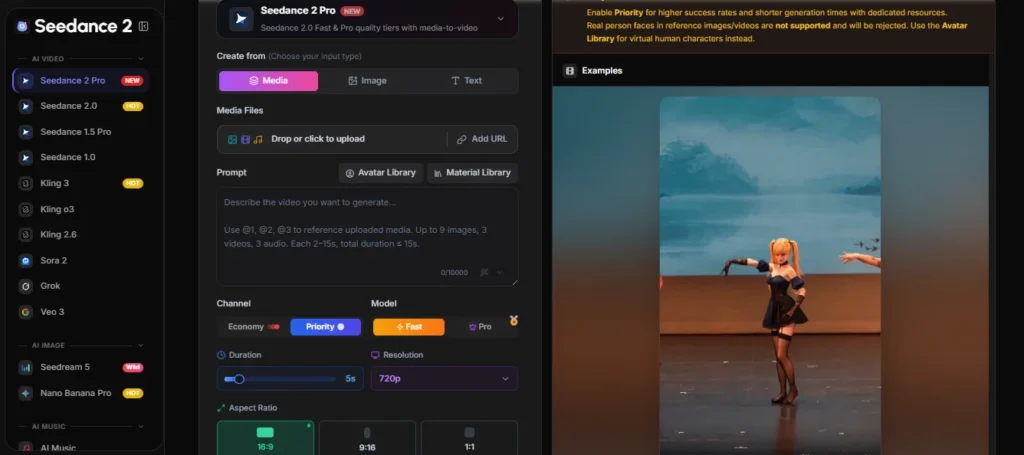
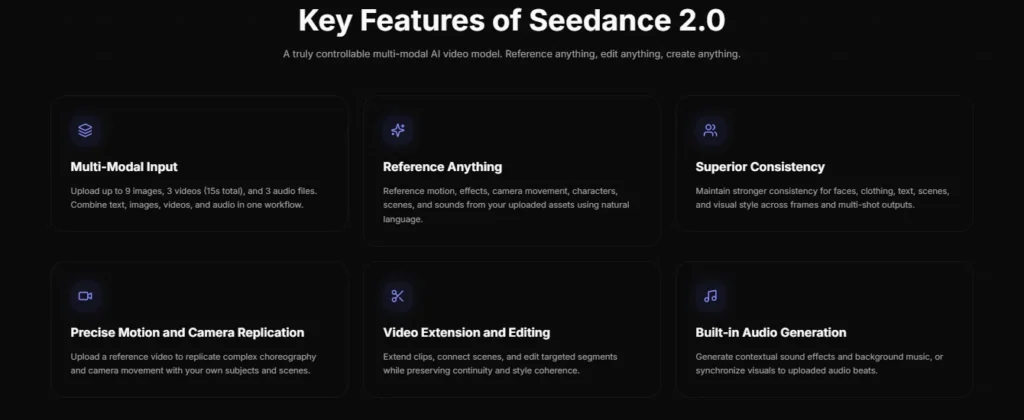
While many AI video tools make you a prompt writer, Seedance 2.0 makes you a director. Its multimodal “Director Mode” is a game-changer for creative control. It accepts up to 12 assets simultaneously—up to 9 reference images, 3 video clips, and 3 audio files—using a revolutionary @-symbol tagging system to precisely anchor every element. This system drastically reduces the random “hallucinations” and unpredictability common with text-only models.
In practical terms, this means:
Reliability is the unsung hero of professional video work. In a head-to-head test, Seedance Pro was noted as the “most stable shot, few glitches”. It leads the market in visual consistency, delivering more structured, visually reliable outputs from text prompts than rivals.
This stability is especially critical for production. It results in cleaner motion with less “shimmer,” making its footage more editing-friendly and less likely to fight typography or other elements in post-production.
To put this all into perspective, here is a summary comparison with the other top AI video models in 2026.
| Model | Core Strength | Best Use Case | Cost Tier / Access |
|---|---|---|---|
| Seedance 2.0 Pro | Stability, control, and speed. Excels at multi-shot consistency and prompt adherence, with industry-leading render speeds for a low cost. | High-volume content: Social media ads, product explainers, quick prototypes, and visual storytelling where reliability is key. | Budget-Friendly: Plans start at $9/month. |
| Kling 3.0 | Motion quality and duration. Superior at clean camera movements and generating very long clips (up to 2 minutes). | Long-form narratives: Music videos, short films, and content requiring extended, unbroken sequences. | Mid-Range: Offers a strong freemium model. |
| Google Veo 3.1 | Cinematic quality and audio integration. Top-tier for physics-aware realism, natural motion, and native audio generation. | Cinematic projects: High-end commercials, YouTube vlogs with critical audio, and projects where visual polish is paramount. | Premium: Enterprise tier at $249.99/month. |
| Sora 2 Pro | Cinematic aesthetics. Generates stunning, film-school-quality footage from simple text prompts, with exceptional lighting and mood. | Concept art & pitch videos: Producing beautiful, standalone cinematic shots from minimal direction. | Premium: Text-only input, high cost per generation. |
| WAN 2.6 (Alibaba) | Reliable image-to-video. Preserves visual identity from a reference image with very little drift, making it safe for character consistency. | Character animation: Projects where a specific designed look must be maintained across frames. | Low-Cost (Lite Tier). |
| Runway Gen-4.5 | Rapid experimentation. A flexible tool for quickly testing ideas and iterating on concepts in a production workflow. | Ideation & prototyping: Quickly visualizing different creative directions before committing to final renders. | Professional (Project-based pricing). |
| Pika 2.2 | Speed and accessibility. Optimized for ultra-fast generation, trading some quality for near-instant results. | Fast-paced social content: Short, eye-catching clips where speed of creation is more important than high fidelity. | Freemium with a generous recurring allowance. |
| Minimax Hailuo 2.3 | Physics and natural motion. Excels at complex physical interactions, such as water, fog, and realistic human movement. | Dynamic action scenes: Clips involving running water, weather effects, or complex body mechanics. | Mid-Range with a strong freemium option |
As Seedance Pro moves into enterprise workflows, the question shifts from capability to control: can it be deployed responsibly at scale? The risks are already visible in IP disputes, regulatory responses, and misuse scenarios. These are not China-specific. They are structural to high-fidelity generative systems. The right approach is controlled adoption, not avoidance.
AI video does not introduce new risks. It amplifies existing ones through speed and scale. Weak governance fails faster. Strong governance compounds efficiency.
The mistake is treating risk as a reason not to adopt. The smarter approach is recognizing that Seedance Pro’s realism and scalability increase the need for executive oversight — not eliminate its value.
In fact, the companies that move early with strong governance often build internal capability advantages before slower competitors catch up.
The decision is not:
“Is this safe?”
The decision is:
“Do we have the policy maturity to match the technology?”
That’s the leadership test.
In 2026, Seedance Pro is being evaluated in a world where high-fidelity AI video has already triggered public IP disputes and calls for stronger safeguards. ByteDance itself has said it will strengthen protections to prevent unauthorized use of intellectual property and likeness.
So the decision isn’t “Is it impressive?” It’s “Can we deploy it in a way that survives legal, brand, and platform scrutiny?”
Seedance Pro is most rational when the video is a repeating operational input, not a one-off creative event.
If your organization produces high volumes of short-form product narratives, frequently updates training/enablement content, or constantly introduces localization variants, then reference-driven multi-scene generation (the core Seedance 2.0 capability base) can compress cycle times in ways traditional production can’t. The key is that you have enough repeat demand for the time compression to matter.
If video output is low-volume, highly bespoke, or centrally tied to signature brand authorship, Seedance is more likely to be a prototyping layer than a production engine.
A Seedance pilot should be designed to answer one thing: Can you keep outputs inside constraints?
ByteDance’s own positioning around multimodal referencing is the technical reason this is plausible: the system is meant to generate from structured instructions while referencing supplied materials rather than purely “imagined” output.
A strong pilot, therefore, tests three practical realities: whether your brand style stays consistent across multiple generations, whether product or policy details remain accurate (no “creative drift”), and whether review cycles stay manageable once legal/compliance is included. If any of those fail, scaling won’t be a bigger win—it will be a faster way to create rework.
Seedance Pro earns its place by reducing total friction, not just creation time.
If generation is fast but review becomes heavier, or outputs cause brand inconsistency, or provenance can’t be managed, your costs simply move downstream. The organizations that win with AI video in 2026 are the ones that treat it as a controlled production system—aligned with labeling expectations, auditability, and platform norms—rather than as a fast content faucet.
bytSeedance Pro is not just another AI tool. It’s a signal. It reflects how China’s AI ecosystem is moving from experimentation to operational deployment, embedding multimodal models into commerce, distribution, and content infrastructure at scale.
For leadership teams outside China, the challenge isn’t access to tools. Its interpretation.
What does this shift mean for your industry?
How mature is China’s AI vendor landscape?
Which capabilities are hype — and which are structurally ahead?
What governance patterns are emerging before they become global standards?
ChoZan is a China digital transformation consultancy focused on helping global leaders understand how innovation scales inside China.
Through executive briefings, in-depth China innovation research, expert dialogues, and curated learning expeditions, ChoZan helps organizations understand how technologies like AI video evolve inside China — and what that means for global strategy.
Whether you’re assessing AI vendors, designing a controlled rollout, or benchmarking governance models, ChoZan provides structured, on-the-ground insight to inform decisions by real ecosystem dynamics, not headlines.
For organizations that need direct insight into how these systems operate inside real environments, explore ChoZan’s China innovation tour.
Seedance Pro refers to the enterprise-oriented version of ByteDance’s advanced AI video system. Built on Seedance 1.5 Pro and Seedance 2.0, it focuses on multi-shot video generation, reference-based control, and higher-quality outputs suitable for commercial workflows.
No. Seedance 2.0 is the core model release that introduced improved realism and multi-scene generation. “Seedance Pro” generally refers to professional-grade workflows built on top of the model, designed for higher-resolution output and structured use in business environments.
The Seedance video generator emphasizes multi-reference conditioning and multi-shot coherence. Rather than producing isolated clips, it can generate structured sequences grounded in supplied assets, making it better suited to repeatable commercial production.
Access models vary. ByteDance typically deploys new AI capabilities first within its domestic ecosystem before expanding selectively. Enterprises outside China may access similar capabilities through partnerships, APIs, or enterprise channels depending on regulatory and commercial frameworks.
The most viable enterprise applications include product catalog video generation, campaign localization, onboarding and training updates, creative prototyping, and asset extension workflows. High-volume, repeatable content environments see the strongest ROI.
As realism increases, so does the risk of generating content that resembles copyrighted characters, artistic styles, or recognizable likenesses. Organizations should implement prompt restrictions, review workflows, and documentation standards before scaling deployment.
Governance should include defined IP boundaries, human approval layers, synthetic media disclosure policies, and prompt logging. AI-generated content should pass through the same compliance processes as traditionally produced material.
No. In most enterprise environments, AI video supports prototyping, scaling, and operational efficiency. High-concept brand storytelling and flagship campaigns still rely heavily on human creative direction and production expertise.
Seedance reflects a broader trend in China toward integrating multimodal AI directly into commerce and distribution ecosystems. Rather than existing as standalone tools, AI systems are embedded into high-frequency content platforms, accelerating operational adoption.
Executives should assess strategic fit, controllability, workflow integration, governance readiness, and measurable economic impact. Adoption should be structured and piloted before full-scale deployment.