
CONTENT

The EHang eVTOL has achieved what no other urban air mobility (UAM) company has: full type certification from a major civil aviation authority. In early 2025, the Civil Aviation Administration of China (CAAC) granted EHang the world’s first production certificate for an unmanned eVTOL, moving the sector from prototype speculation to commercial reality.
Its EH216-S holds CAAC type, production, and airworthiness approvals, while two operators gained service approval in March 2025. Yet commercialization remains controlled.
EHang was still completing added safety, training, and operating work before open public ticketed flights in its June 2026 update. The program has crossed from prototype to certified product, but it has not reached a broad urban air-taxi network.
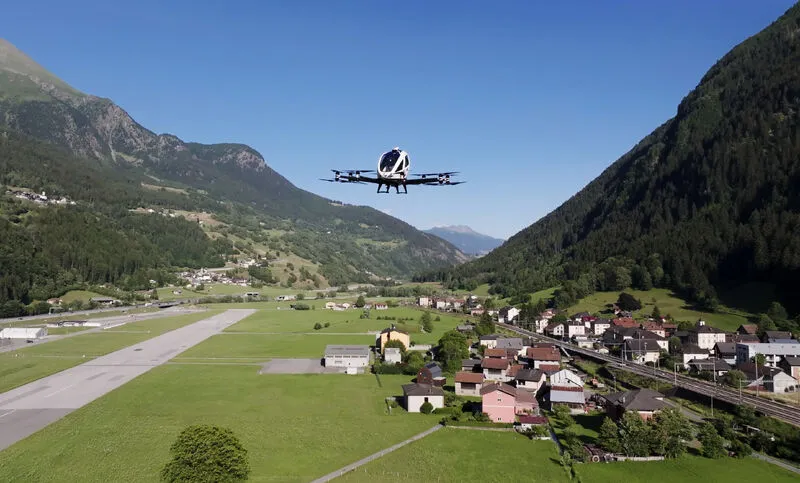
The EHang eVTOL is an autonomous electric vertical takeoff and landing aerial vehicle designed for urban air mobility, cargo logistics, and emergency response. Unlike manned helicopters or multicopters requiring pilots, the EHang system operates under a centralized command-and-control model.
The flagship model, the EHang EH216-S, is a fully electric, two-seater aircraft with 16 rotors arranged in an octagonal coaxial configuration.
Key specifications from EHang’s official technical datasheets (2025) include:
The aircraft eliminates the pilot cockpit, replacing it with passenger seating and a simplified cabin interface. This design reduces weight, mechanical complexity, and operational costs, enabling point-to-point autonomous transport without expensive pilot training programs.
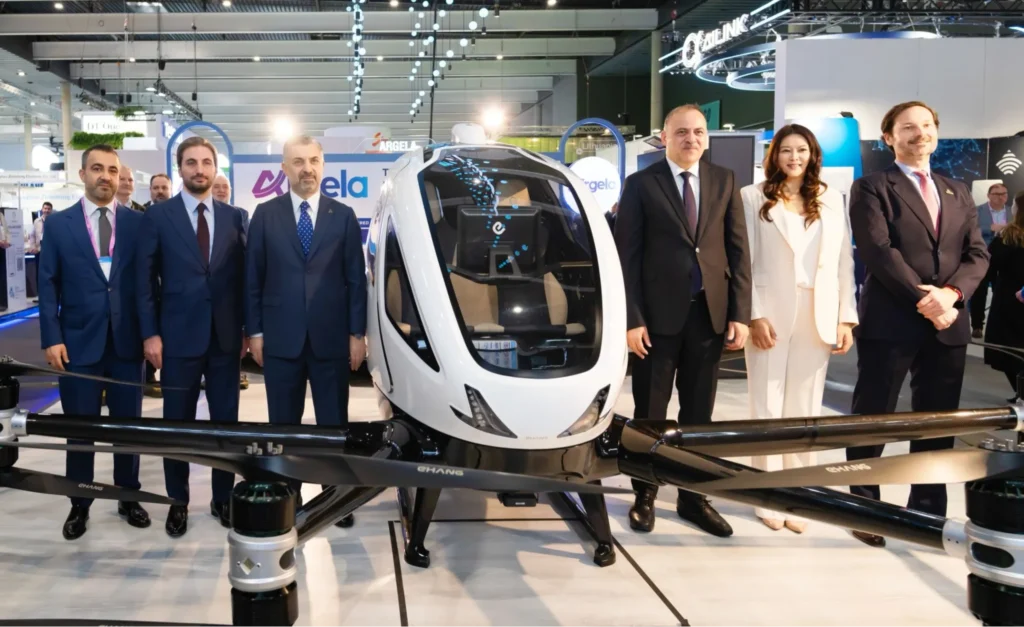
In practice, four different approvals support the aircraft, production system, individual units, and operator.
| Approval | What it establishes | Commercial significance |
| Type Certificate, or TC | The EH216-S type design meets CAAC airworthiness requirements | Establishes the approved aircraft design |
| Production Certificate, or PC | The manufacturing quality system can produce aircraft that conform to the approved design | Allows continued production under regulatory oversight |
| Standard Airworthiness Certificate, or AC | An individual aircraft conforms to the approved design and is airworthy | Applies approval at aircraft level before operation |
| Air Operator Certificate, or OC | The named operator has the people, procedures, equipment, and safety systems required for its approved service | Allows that operator to conduct paid human-carrying activity within the certificate’s scope |
The decisive 2025 step was the OC. The CAAC granted the first certificates to Guangdong EHang General Aviation and Hefei Heyi Aviation.
EHang’s OC explanation says the initial authorization covers human-carrying sightseeing and experience flights that take off and land at the same site. It does not yet represent scheduled point-to-point passenger transportation.
An OC does not create unrestricted permission to fly anywhere. Chinese rules still require approved airspace, operating sites, flight plans, qualified ground personnel, maintenance processes, and emergency procedures.
The 2025 annual report also notes that operator certificates generally remain valid for 24 months and that controlled-airspace flights require approval.
This layered process explains China’s cautious sequence. The national strategy supports the low-altitude economy, but the regulator continues to prioritize safety and orderly operations.
In May 2026, the CAAC described the sector as an emerging pillar industry under the 2026 Government Work Report while stressing healthy, regulated development.
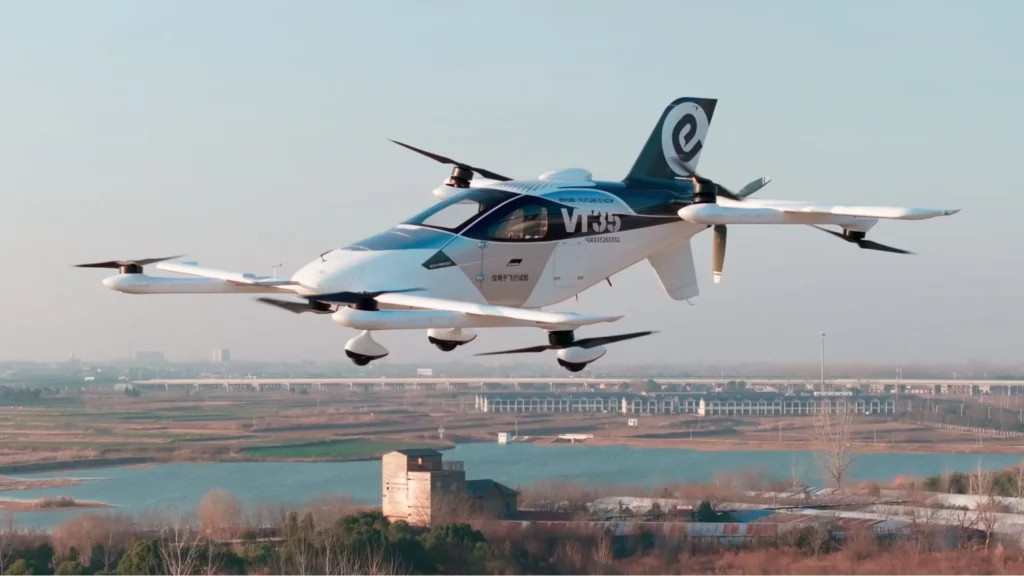
EHang now presents a tiered aircraft portfolio rather than a single air-taxi product.
| Aircraft | Role | Current position |
| EH216-S | Two-seat urban passenger and tourism service | Certified in China and used in controlled commercial trials |
| EH216-F | High-rise and emergency firefighting | The first unit from EHang’s Beijing Fangshan assembly line rolled off in December 2025 |
| EH216-L | Pilotless logistics with a 250-kilogram payload | Part of the current EH216 series in EHang’s audited filing |
| VT35 | Two-seat lift-and-cruise aircraft for intercity, cross-sea, and mountain routes | Entered the CAAC type-certification process and completed its first public flight in December 2025 |
The VT35 is the strategic extension. Its fully loaded design range is about 200 kilometers, and EHang designed it to share existing EH216-S vertiports.
No official 2025 or 2026 source reviewed for this article publishes a new EH216-S list price. Several search results repeat figures announced before the evidence window, so they should not be presented as a current quotation.
A serious purchase assessment needs a direct proposal covering aircraft configuration, command-and-control equipment, charging, training, maintenance, insurance, local approvals, delivery, and site infrastructure.
The VT35’s RMB6.5 million ($930,000) announced price applies to that longer-range model, not the EH216-S.
Hardware price also reveals little about passenger economics. Route permissions, daily cycles, weather, staffing, battery management, maintenance reserves, and seat occupancy determine if an operation can support itself.
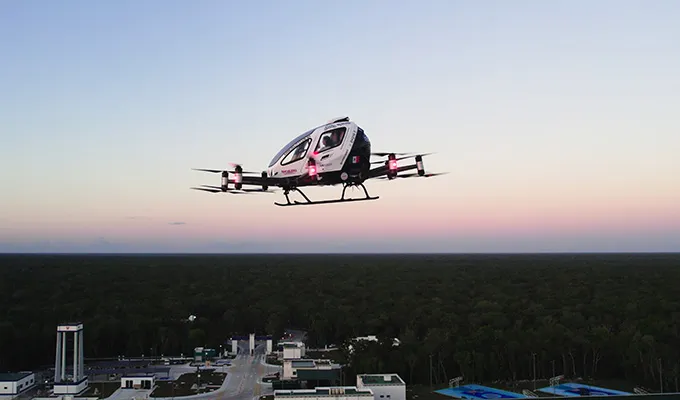
EHang’s operating evidence has grown. The company reported more than 90,000 cumulative EH216-S flights as of May 2026.
It also reported more than 40 operating sites across China and over 3,000 missions by its two OC holders, with zero accidents or violations. These company-reported totals include testing, demonstrations, training, and trial activity. They should not be interpreted as 90,000 paid passenger journeys.
The audited financial record reinforces that point. EHang sold 169 EH216-series aircraft and six VT35 units in 2025.
Revenue reached RMB 418.0 million (US59.8million),while net loss was RMB 276.4million(US39.5 million). The filing says many delivered aircraft operated on a limited trial basis in tourism locations.
In the first quarter of 2026, EHang delivered four EH216-series aircraft and recorded RMB 25.7 million (US$3.7 million) in revenue, while aerial media contributed about 40% of quarterly revenue.
These figures show a real hardware market and an early service platform, but not a mature passenger network. The next proof points are public ticket availability, repeatable route approvals, aircraft utilization, maintenance performance, revenue from flight services, and additional operators securing OCs.

EHang said the EH216-S flight footprint reached 23 countries after a human-carrying demonstration in Kazakhstan in August 2026. It also completed pilotless human-carrying flights in Mexico in May 2026.
Such flights help validate use cases and build relationships with regulators. They do not mean China’s type approval automatically authorizes regular passenger service abroad. Each market still requires its own approval, validation, or operating framework.
EHang’s first permanent commercial base commenced operations in Hefei’s Luogang Central Park in April 2025, following a city-level agreement signed in Q4 2024. The base offers aerial sightseeing tours over the park and the adjacent Swan Lake area. As of December 2025, the Hefei base had completed over 1,200 revenue-generating flights with no safety incidents.
Wuhu, another city in Anhui province, launched its commercial UAM corridor in July 2025, connecting Wuhu Xuanzhou Airport to the city’s central business district. This route covers 22 km and reduces ground travel time from 45 minutes to 10 minutes.
Ticket booking is integrated into Alipay’s city services mini-program, achieving an 82% average load factor in its first quarter of operation.
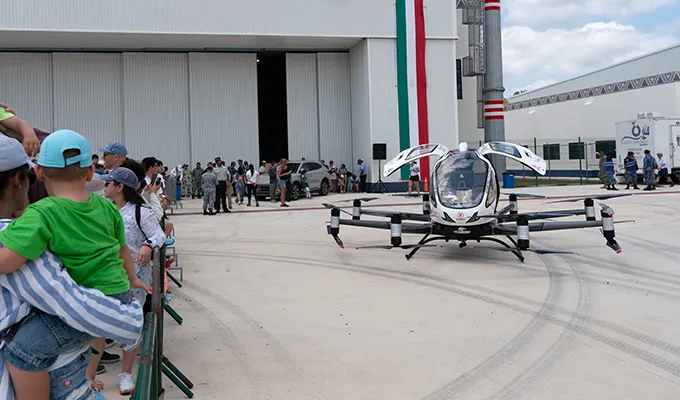
EHang’s lead comes from the system around the aircraft. China has linked certification, local government use cases, manufacturing, tourism sites, digital fleet control, and operator development. That coordination can shorten the distance between a certified product and repeated field learning.
The harder phase starts after certification. Commercial value now depends on safe daily operations, public acceptance, route density, service consistency, and credible unit economics.
Teams assessing China’s low-altitude economy should track operating data separately from orders, demonstrations, and policy announcements. EHang offers one of the clearest tests of how China turns a strategic technology category into a regulated service industry.
The EHang eVTOL story becomes clearer when you view aircraft, vertiports, policy, and operating sites as one system.
ChoZan’s China innovation tours and tailored learning expeditions connect international teams with China’s applied technology hubs, local experts, and real-world deployment models.
Explore how China’s companies test, commercialize, and scale emerging technologies on the ground.
Yes. EHang is the company’s official brand spelling. The spaced phrase e hang is a common search variation, but it refers to EHang Holdings, the Guangzhou-based developer of the EH216-S and other pilotless aircraft.
EHang sells aircraft primarily into managed aviation use cases, but ownership alone does not authorize flight. The buyer still needs registration, an approved site, airspace permissions, trained ground personnel, maintenance support, and a compliant operating structure.
The EH216-S has no onboard pilot and follows preset routes. Commercial operations still require qualified ground personnel and approved procedures. China’s May 2026 training requirements created a framework for remote pilots of large civil unmanned aircraft systems.
No. Aircraft and operator certificates do not grant unrestricted access to cities. Each operation remains subject to approved airspace, routes, sites, flight plans, weather limits, ground support, and the conditions attached to the operator’s authorization.
The EH216-S is better described as a pilotless eVTOL aircraft. It takes off and lands vertically but does not drive on public roads. The flying-car label helps consumers understand the concept, though it is technically imprecise.
Operators hold approval for paid sightseeing and flight experiences at designated sites. However, EHang’s June 2026 disclosure still separated routine internal commercial trials from public ticketed service, so travelers should confirm current availability directly.
No. CAAC certification can support discussions with foreign regulators, but it does not create automatic operating rights abroad. Each jurisdiction may require type validation, special flight permission, local registration, operator approval, or a dedicated trial framework.
A practical site needs a suitable takeoff and landing area, charging, passenger handling, communications, weather monitoring, maintenance access, emergency procedures, and connection to fleet-control systems. Local airspace and route approvals remain equally important.
The EH216-S operates within approved weather limits. Wind, rain, visibility, temperature, and battery conditions can affect dispatch. Operators need clear cancellation rules because its approved sightseeing services do not follow guaranteed airline schedules.
Look for recurring public ticket sales across several approved routes, high aircraft utilization, disclosed service revenue, reliable maintenance performance, more certified operators, and a strong safety record. Aircraft deliveries alone do not prove a scaled transport network.