CONTENT
China is scaling electric VTOL aircraft because it treats the category as one part of a coordinated low-altitude economy. National policy supports controlled applications. Aviation regulators are creating certification paths. Cities supply test sites, routes, and operating data. Manufacturers draw on strong drone, battery, electric-vehicle, and advanced-manufacturing capabilities.
As of 2026, China had approved limited pilotless human-carrying operations and certified a large autonomous cargo model, while other passenger designs remained in testing or approval.
The key business signal is clear: China is building the operating system around the aircraft, rather than waiting for a perfect urban air taxi market to appear.
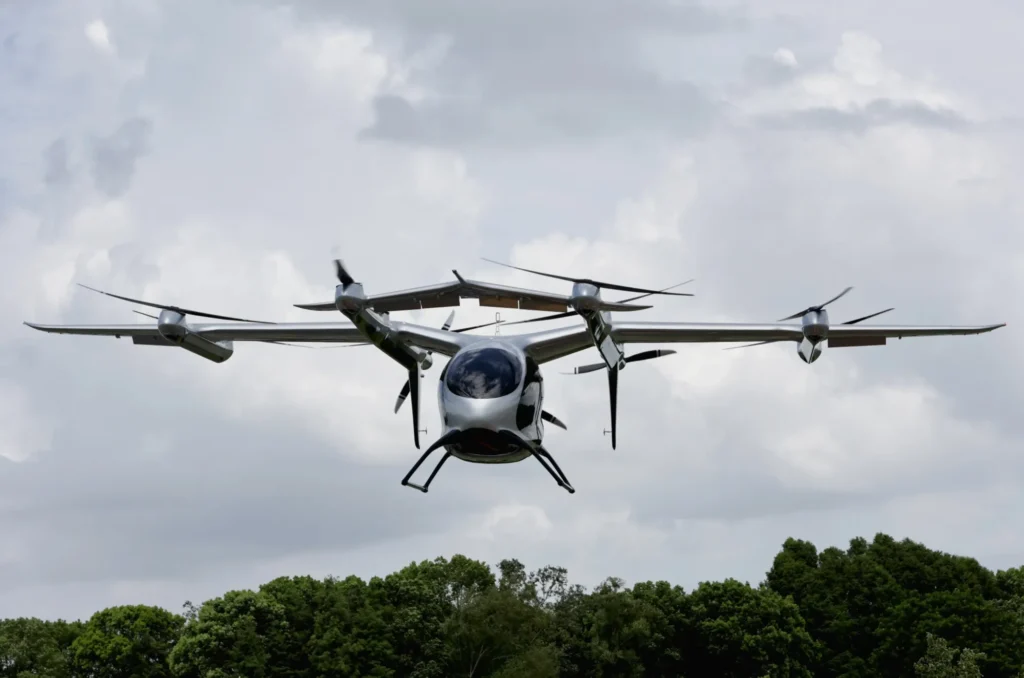
Electric vertical takeoff and landing technology lets an aircraft rise and land without a runway, using electric propulsion for some or all flight phases. Designs vary. Multicopters suit shorter trips and simpler missions. Lift-and-cruise or tilt-rotor designs add wings for more efficient forward flight, as the Vertical Flight Society’s 2025 directory explains.
This distinction matters because electric VTOL is not one market. Passenger sightseeing, airport transfer, offshore logistics, emergency response, tourism, and personal flight require different ranges, payloads, certification paths, and ground systems. China’s eVTOL development reflects this mix.
China’s 2025 Government Work Report called for large-scale application demonstrations and safe development of the low-altitude economy. This framing links aircraft manufacturing with airspace management, logistics, tourism, public services, and infrastructure.
The Civil Aviation Administration of China estimated that the wider low-altitude economy could reach 1.5 trillion yuan ($211.4 billion) in 2025, according to an October 2025 central government report. That figure covers far more than eVTOL sales.
It includes drones, helicopters, services, infrastructure, and related activities. The figure would overstate current commercial demand if presented as the size of the China eVTOL market.
Aircraft approval alone does not create a transport service. China has started building a fuller regulatory chain covering design, production, individual aircraft, and operators.
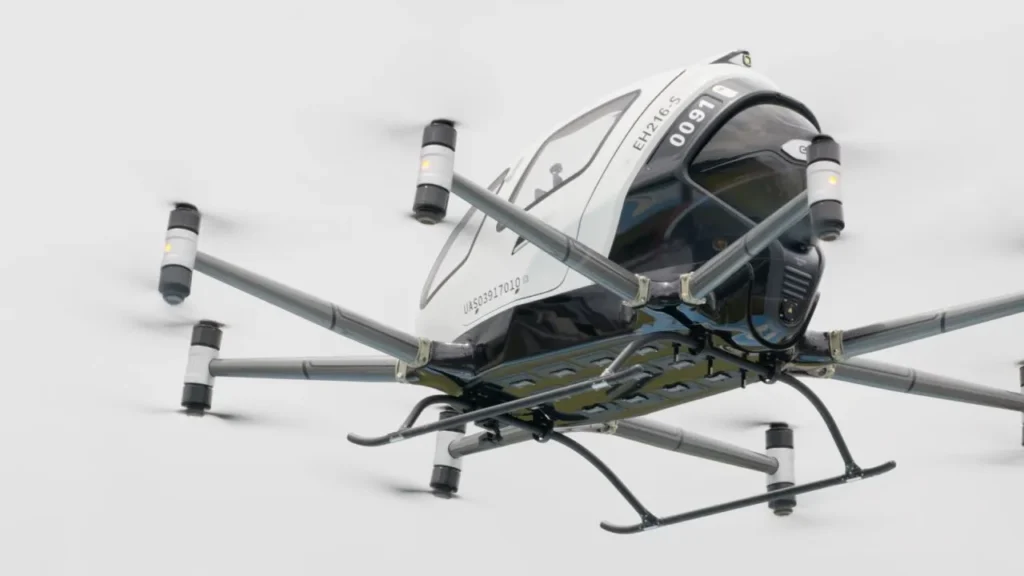
In March 2025, CAAC granted the first Air Operator Certificates to two EH216-S operators. The certificates authorize paid human-carrying tourism and flight experiences, but their scope remains narrow.
Flights must follow Point A-to-A routes, with takeoff and landing at the same site. Circling and return flights are allowed, but scheduled Point A-to-B passenger transport and urban commuting are not yet authorized.
The certificates do not provide blanket permission to open routes or vertiports. Proposed flight activities require additional aviation-authority approval, which may cover one operation or remain valid for a limited period.
CAAC added a national powered-lift airworthiness standard in February 2026. China’s revised Civil Aviation Law, effective from July 2026, also requires airworthiness approval for most unmanned-aircraft design, production, maintenance, import, and flight activities. It requires manufacturers to assign each aircraft a unique product identification code.
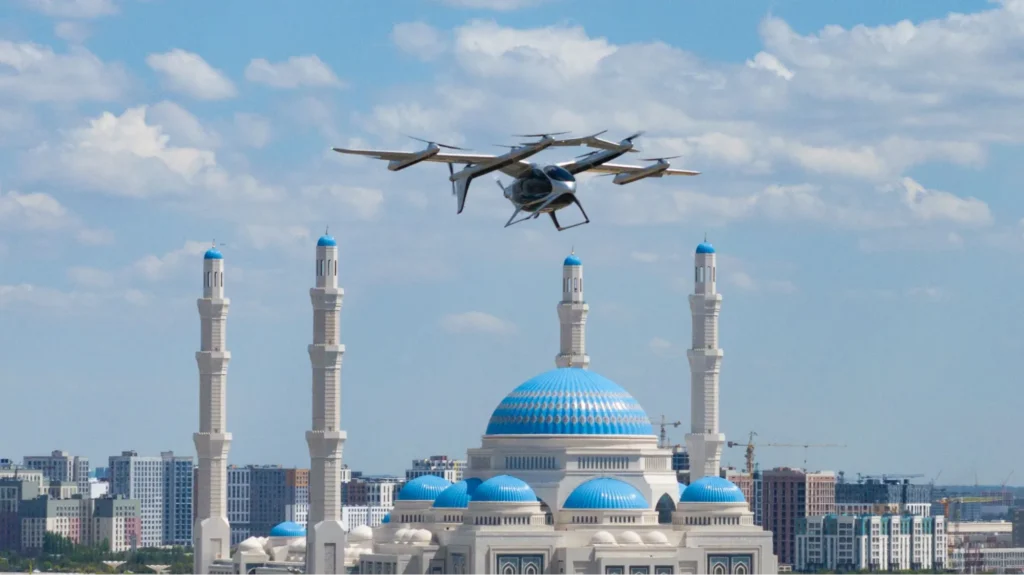
The strongest near-term cases have a clear customer, controlled route, and expensive existing alternative. That makes cargo, tourism, emergency response, and offshore supply more practical starting points than dense urban commuting.
AutoFlight’s autonomous CarryAll received its type, production, and individual airworthiness approvals before the company delivered a certified aircraft in July 2025. The two-ton model later completed a 150-kilometer offshore supply flight in 58 minutes and a 120-kilometer mountain tea delivery in 37 minutes. Those offshore and agricultural logistics trials provide measurable operating data.
This approach turns Chinese eVTOL development into an operating learning cycle. Revenue potential can be tested in contained missions while passenger networks mature.
Shenzhen shows why the wider ecosystem matters. The city produced 2.75 million civilian drones in the first half of 2025. It had opened 306 drone logistics routes, while 630,000 delivery flights took place in the first three quarters.
Those are drone figures, not passenger eVTOL figures in China. Still, they show supporting capabilities for advanced air mobility: flight coordination, communications, route design, maintenance, public familiarity, and city-level rules. Shenzhen also reported eVTOL sightseeing tests and 15 designated passenger-carrying sites in Luohu.
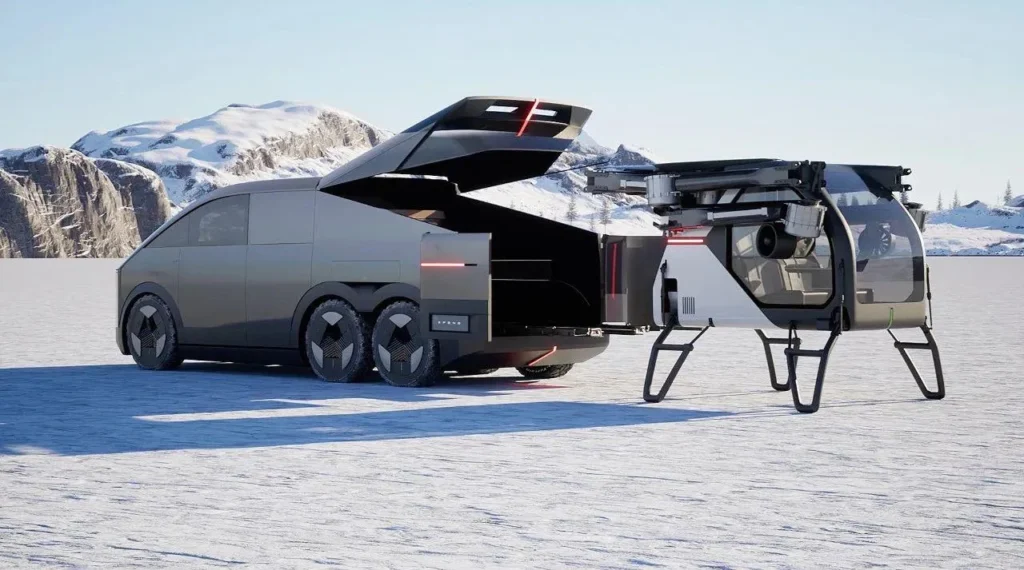
China’s electric vehicle model has shaped expectations around cost, iteration, and production speed. XPeng affiliate ARIDGE began trial production at its 120,000-square-meter Guangzhou flying-car factory in November 2025. The plant was designed to produce 10,000 detachable aircraft modules annually, with an initial capacity of 5,000.
Capacity is not the same as output, delivery, or regulatory approval. In April 2026, XPeng told Reuters that early deliveries were expected late in 2026 and large-scale production in 2027. The aircraft still required aviation approval. China can prepare capacity early, but certification and usable airspace still determine timing.
The table separates certification, operation, and production claims. This is a more useful measure of progress than prototype counts or announced orders.
| Aircraft | Intended role | Verified 2025 to 2026 status | What it proves |
| EHang EH216-S | Two-seat pilotless sightseeing and short urban flight | Operators received CAAC approval in March 2025 for paid, unscheduled A-to-A human-carrying flights | China has crossed from aircraft approval into tightly limited passenger-facing operations |
| AutoFlight CarryAll | Autonomous heavy cargo | A certified unit was delivered in July 2025 and completed offshore and mountain logistics trials | Large electric vertical takeoff and landing aircraft can address high-value routes before air taxis scale |
| ARIDGE Land Aircraft Carrier | Personal modular aircraft carried by a road vehicle | Trial production began in 2025; aviation approval remained in progress in April 2026 | Automotive production methods can accelerate readiness, but factories cannot replace certification |
| AutoFlight Matrix | Ten-seat passenger or heavy-cargo platform | The five-ton prototype completed a public transition flight in February 2026; its cargo variant entered airworthiness certification | Chinese developers are expanding from short-range multicopters into larger regional concepts |
China’s approach reveals three strategic patterns.
China’s model reveals three strategic patterns.
First, aircraft scale depends on coordination among regulators, operators, insurers, energy providers, air traffic systems, and landing-site owners. An approved aircraft has limited value without permitted routes and operating infrastructure.
Second, early adoption works best where time, access, or experience can justify premium pricing. A 2025 study found that eVTOL operating costs remain higher than car travel. Separate 2025 research found that commercial viability depends on production scale, aircraft use, passenger loads, and autonomous operation. Current evidence does not support the claim that eVTOL costs exceed helicopter costs.
Offshore supply, mountain logistics, emergency response, and tourism therefore offer stronger early cases than daily commuting. Mass urban transport requires more flights, fuller aircraft, fewer empty trips, and lower production and infrastructure costs.
Third, Chinese certification does not guarantee overseas access. AutoFlight’s Indonesian validation matters because it shows progress beyond domestic approval.
Revenue also needs context. EHang’s 2025 filing identifies aircraft deliveries as its main revenue source, while most aircraft are operated in tourism locations for trials, training, and demonstrations. Track certificates, permitted routes, repeat operations, paying customers, and revenue sources before treating production capacity or order values as evidence of commercial scale.
China still faces difficult aviation economics. Batteries must provide adequate range while preserving payload and safety reserves. Cities need approved landing sites, charging, maintenance, weather monitoring, emergency procedures, and low-altitude traffic management.
Operators also need insurance, trained ground teams, and repeatable demand. Associated Press reported in February 2026 that route and landing infrastructure remained under development.
The biggest near-term gap is the move from controlled A-to-A flights to routine A-to-B transport. EHang’s operator approvals show regulatory progress, but their initial scope remains sightseeing and flight experiences. AutoFlight’s cargo record does not automatically settle passenger certification. ARIDGE’s factory does not make its aircraft commercially flyable before approval.
China may reach scale sooner because it can coordinate these pieces across policy, cities, and industry. Safety evidence, route economics, and public acceptance will still decide how large the category becomes.
China is scaling Electric VTOL Aircraft through a portfolio of controlled use cases, regulatory steps, and manufacturing bets. The market has moved beyond pure prototypes, but it has not reached mass urban transport. The next decisive signals will be point-to-point passenger approvals, sustained commercial flight volumes, and verified operating economics.
Electric VTOL Aircraft show how China connects policy, manufacturing, city pilots, and commercialization. ChoZan’s China research and tech trend work help teams identify which signals matter, what remains unproven, and how China’s innovation systems may shape decisions elsewhere.
Explore ChoZan’s China reports for further insight into the country’s technology and innovation system. Book a consultation to explore what China’s progress could mean for your organization.
Not always. eVTOL describes an aircraft’s propulsion and takeoff method. A flying car may also travel on roads, as ARIDGE’s modular design does. Many air taxis and cargo eVTOLs have no road-driving function.
No. EHang’s EH216-S and AutoFlight’s CarryAll operate without an onboard pilot, while other Chinese designs include manual or piloted modes. Autonomy depends on the aircraft, mission, certification basis, and operating approval.
They do not need conventional runways, but they still need approved takeoff and landing areas, safe approach paths, charging, communications, maintenance access, weather controls, and authorization for each type of operation.
Range varies sharply with design, payload, reserves, and conditions. AutoFlight lists up to 200 kilometers for CarryAll, while short-range multicopters serve smaller operating areas. Published maximum range should never be treated as usable route range.
They produce no direct exhaust during all-electric flight. Their full environmental impact still depends on electricity generation, battery materials, manufacturing, maintenance, vehicle life, and the transport mode replaced on a specific route.
No. Aircraft certification does not grant unrestricted airspace access. The operator, route, takeoff site, mission, and flight plan must comply with aviation rules and local permissions. Personal ownership and legal operation are separate questions.
A vertiport is a site designed for vertical-flight aircraft operations. Each service model may require landing pads, passenger handling, charging, maintenance, fire protection, weather systems, communications, and links to ground transport.
Potentially, but the comparison is model-specific. Electric motors remove engine combustion noise, while rotors still create sound. Regulators will assess measured levels, route frequency, flight phase, time of day, and local exposure.
Check if the order is binding, refundable, or merely an intention. Then review deposits, delivery conditions, certification status, buyer operating rights, financing, and aircraft production. A large headline number may represent limited committed revenue.
No. e vtol, e-vtol, and eVTOL refer to electric vertical takeoff and landing. The compact form “eVTOL” is the standard industry spelling, while the spaced and hyphenated forms mainly appear as search variations.