CONTENT
Supply chain innovation is no longer a competitive advantage. It is a survival requirement. From pandemic-era factory shutdowns to geopolitical trade tensions and climate disruptions, the vulnerabilities in global supply chains have never been more visible.
Boardrooms that once treated supply chain management as a back-office function are now treating it as a strategic priority.
AI is reshaping how goods are produced, stored, moved, and delivered. No country is deploying it faster or at greater scale than China.
The past five years exposed just how fragile traditional supply chain models are. The COVID-19 pandemic triggered simultaneous supply and demand shocks across every major industry. Trade tensions between the US and China pushed multinationals to rethink sourcing strategies.
Climate events disrupted ports, roads, and rail corridors that had functioned reliably for decades.
These pressures are not temporary. They are structural. According to McKinsey Global Institute research, companies face a supply chain disruption lasting a month or more every 3.7 years on average. The cumulative financial impact can amount to 45% of one year’s profits over a decade.
The response has been a decisive shift toward digital and AI-powered supply chain innovation. Organizations that have invested in intelligent supply chains show greater resilience, faster recovery times, and lower operational costs.
China, more than any other economy, has made this shift at speed and scale.
The phrase “supply chain innovation” has evolved significantly. It no longer refers simply to lean manufacturing or just-in-time inventory. Today it describes the integration of:
A modern AI-driven supply chain can sense demand shifts before they materialize and reroute shipments around disruptions in real time. It can run fully automated fulfillment centers around the clock. In China, this is already standard practice among leading operators.
Traditional supply chains were built to execute. When something went wrong, teams responded. The model was inherently reactive. In a world of constant disruption, that is no longer sufficient.
AI shifts supply chains from reactive to predictive. Machine learning models analyze historical sales data, seasonal trends, macroeconomic signals, and social media sentiment to generate far more accurate demand forecasts. Companies using AI-driven demand sensing report inventory reduction of 20 to 30% while simultaneously improving product availability.
AI systems can also monitor weather patterns, port congestion, supplier financial health, and geopolitical risk indicators at the same time. They flag potential breakdowns weeks before they materialize, giving supply chain teams time to activate contingency plans rather than scramble in crisis mode.
Automation is the physical expression of supply chain innovation. In warehousing, autonomous mobile robots (AMRs) navigate fulfillment centers without fixed tracks or human direction. They adapt dynamically to changing floor layouts and order priorities.
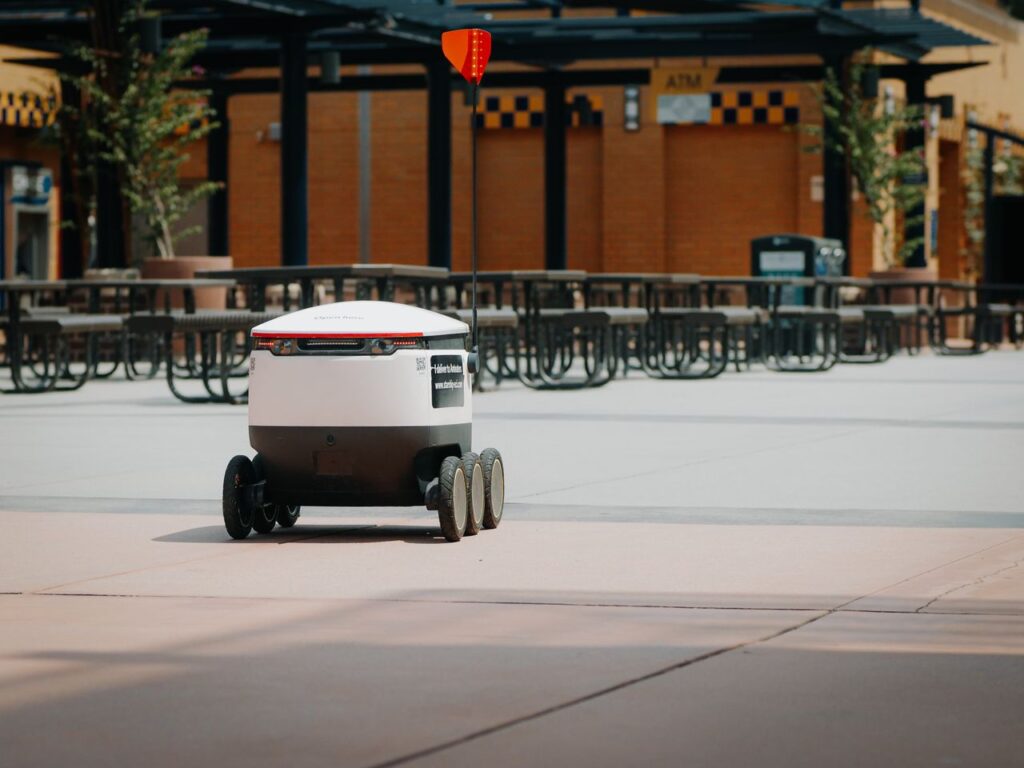
In last-mile logistics, autonomous delivery vehicles and drones are moving from pilot programs to operational infrastructure. This is especially visible across China’s dense urban zones and sprawling rural geographies. On manufacturing lines, collaborative robots (cobots) handle repetitive or high-precision tasks with consistent accuracy.
The IFR’s April 2026 update places China’s robot density at 166 robots per 10,000 manufacturing employees. That is a 17% year-on-year increase, using revised NBS workforce data. China’s operational stock stands at approximately 2 million industrial robots. That is the world’s largest, roughly 4.5 times more than Japan, which ranks second.
Chinese robot manufacturers outsold foreign suppliers in China for the first time. Domestic market share reached 57%, up from roughly 28% a decade ago (IFR, April 2026). Global robot installations are forecast to reach 575,000 units in 2025. The IFR projects the market will surpass 700,000 units annually by 2028. China is expected to maintain 10% average annual growth through 2028.
China is the world’s most advanced live laboratory for supply chain innovation. No other market combines the manufacturing scale, digital infrastructure, government alignment, and competitive intensity that drives supply chain ideas from concept to industrial scale faster than anywhere else.
The most recent Global Supply Chain Promotion Report, released at the China International Supply Chain Expo (CISCE) in Beijing, introduced a comprehensive index matrix measuring global supply chain development against a 2018 baseline. Four metrics were recorded: a promotion index of 2.71, a connectivity index of 1.56, an innovation index of 2.16, and a resilience index of 1.22.
The innovation index represents a 116% rise from baseline, confirming AI as the dominant driver across 17 tracked product categories, from electric vehicles and semiconductors to drones and agricultural goods. The resilience index, at 1.22, remains the lowest of the four, signaling that stability across global supply chains is still a work in progress even as innovation accelerates.
An updated edition of the Global Supply Chain Promotion Report, alongside a new Global Supply Chain Resilience Index Matrix, is expected to be released at the 4th CISCE in Beijing in late June
Beijing has also released a Digital Supply Chain Action Plan targeting 100 AI-powered supply chain leaders by 2030, using blockchain, AI, and advanced analytics across manufacturing and agriculture.
China’s supply chain transformation is not happening by accident. It is being driven by coordinated industrial policy at national and local levels. Key programs include:
These policies compress timelines. Regulatory approvals move faster. Government subsidies reduce adoption risk. The result is an ecosystem where supply chain innovation moves from pilot to scale in months, not years.
Of the World Economic Forum’s globally recognized lighthouse factories, more than 40% are located in China. The Global Lighthouse Network has grown to 201 sites worldwide as of 2025, with China holding the largest national share according to the WEF.
South Korea leads the world in robot density with 1,220 robots per 10,000 manufacturing employees, followed by Singapore at 818 and Germany at 449, according to the IFR World Robotics 2025 report released in April 2026.
China’s density figure has been revised by the IFR to reflect its full manufacturing workforce of approximately 37 million workers, one of the largest of any economy. Under this corrected methodology, China ranks lower in density terms but holds an operational stock of over 2 million industrial robots, approximately 4.5 times more than Japan in second place.
China accounts for 54% of all industrial robots installed globally, with 295,000 units representing the highest annual total ever recorded by any single country, per the IFR World Robotics 2025 Report. Its operational robot stock has crossed 2 million units, approximately 4.5 times the total held by Japan, the world’s second largest.
China’s domestic robot manufacturing output grew 28% year-over-year in the most recent period tracked, double the growth rate of the prior year. China now produces 57% of its industrial robots domestically, up from roughly 28% a decade ago.
China’s 15th Five-Year Plan, launched in 2026, places robotics at the heart of its modern industrial system, with a strategic pivot toward AI-powered physical applications and robots as a primary driver of economic growth.
The scale of deployment, the speed of domestic production growth, and now the weight of national policy behind it make China’s manufacturing automation story unlike anything happening elsewhere in the world.
The best way to understand supply chain innovation in China is to look at what its leading companies are actually doing on the ground.
JD.com has built one of the most technically advanced logistics networks in the world. Its fulfillment centers operate with AMRs, AI-powered robotic sorting systems, and drone delivery infrastructure reaching rural communities across China.
By the end of 2025, JD had deployed more than 50,000 AI agents across its internal systems, automating supply chain workflows, demand forecasting, and operational decision-making. Its self-developed LangzuTech automated warehousing solution has scaled to over 20 cities nationwide, with the first overseas LangzuTech facility launched in the United Kingdom.
JINGDONG Logistics now operates over 3,600 warehouses and 19,000 delivery stations, delivering 95% of first-party orders within 24 hours across China.
JD.com was named to Gartner’s Global Supply Chain Top 25 for the second consecutive year in 2025, the only Chinese retailer on the list. Its logistics arm has also expanded into Saudi Arabia, Europe, and Southeast Asia under the JoyExpress brand, bringing same-day and next-day delivery infrastructure beyond China’s borders.
Alibaba’s Cainiao Smart Logistics network operates autonomous vehicles and robotic infrastructure across fulfillment and delivery. Its Accio platform functions as a B2B AI sourcing engine, matching global buyers with Chinese suppliers using AI-driven filtering.
Alibaba Cloud also announced a strategic partnership with SAP to integrate its Qwen AI model into SAP’s supply chain management systems in China. Alibaba’s pilot smart manufacturing factory in Hangzhou has been recognized as a WEF lighthouse facility.
BYD’s factories represent some of the most autonomous manufacturing environments in the world. Its Xi’an facility operates at approximately 97% autonomy, using AI-powered robotics, automated guided vehicles, and intelligent warehousing systems.
BYD has also built digital twins of its battery production environments, allowing engineers to simulate and optimize production parameters without physical testing.
On the factory floor, BYD has deployed UBTECH Walker S humanoid robots alongside autonomous tractor systems for material handling and logistics. This deployment, spanning 100 to 200 units, is recognized as the world’s largest commercial humanoid installation as of 2025. BYD is targeting a scale-up to 20,000 humanoid robots by 2026, per IDTechEx.
BYD’s vertical integration is equally significant. The company now manufactures approximately 75% of its vehicle components in-house, including its Blade Batteries, electric motors, and power electronics. This gives BYD direct control over its supply chain from raw materials to finished vehicles, a structural advantage few EV manufacturers can match.
Midea’s Guangzhou factory is one of the most cited examples of AI-driven manufacturing in China. Recognized by the WEF as a global lighthouse facility, it achieved verified results across three key metrics:
Assembly line workers have been reskilled to operate and maintain robotic systems. Midea now holds multiple WEF Lighthouse designations across factories in China and beyond.
Meituan has taken a broad approach to supply chain robotics, investing in more than 30 robot-related companies spanning delivery, service, cleaning, and medical care. Its AMR fleet handles last-mile delivery across campuses and urban zones with minimal human intervention.
CEO Wang Xing described Meituan’s ambition as acting as a “bridge” between the online world and physical supply chain reality. With AI accelerating robotic capability, Meituan is positioning its logistics network as a productivity engine across retail and local services.
CATL, the world’s largest EV battery manufacturer, runs AI-optimized production lines that monitor quality and throughput in real time. Every stage, from raw material sourcing to cell production and global delivery, is instrumented with sensors and governed by AI decision systems.
This level of control allows CATL to maintain quality consistency at a production scale no manual oversight system could match. It also enables rapid ramp-up when customer demand spikes.
Huawei is not just a supply chain operator. It is a supplier of the underlying infrastructure that powers smart supply chains across China. Its CloudMatrix 384 AI system, built around 384 Ascend 910C processors, delivers approximately 300 petaFLOPs of computing power for large-scale industrial AI workloads.
Through its 5G, IoT, and cloud platforms, Huawei provides the connectivity backbone for smart factories and AI-driven logistics networks. It is also developing humanoid robots using its own AI models, targeting factory and logistics applications.
Siasun Robot and Estun Automation are two of China’s most important domestic industrial robot manufacturers. Siasun has co-developed automotive-grade force-control robots with BYD, designed for EV battery assembly. Estun’s welding robots incorporate AI-based weld seam tracking, now deployed across automotive and electronics manufacturing lines.
A decade ago, China relied on imports for nearly three-quarters of its industrial robot demand. Today, China produces 57% of its industrial robots domestically, with Siasun and Estun leading that shift.
The companies above are not outliers. They represent a systemic approach to supply chain innovation that global businesses need to understand, whether or not they operate in China. Four lessons stand out:
The competitive baseline is being reset by what is happening in China. For global executives, understanding it is not optional.
Reading about China’s supply chain transformation is one thing. Seeing it in person, at the factories, logistics hubs, and AI labs where these innovations are live, is a different level of insight entirely.
ChoZan’s China Learning Expeditions and Innovation Tours give business leaders direct access to the companies, facilities, and people shaping China’s supply chain future. Programs are fully customized for executive teams across manufacturing, retail, logistics, and technology sectors.
Beyond expeditions, ChoZan offers China research, trend consulting, and executive briefings tailored to supply chain and operations teams. Whether you need to benchmark your automation strategy against China’s lighthouse factories or understand the next wave of supply chain AI, ChoZan provides the expertise and access to make it possible.
It is the use of machine learning, predictive analytics, robotics, and real-time data to optimize how goods are produced, stored, and delivered. It shifts supply chains from reactive to intelligent, adaptive operations.
Key leaders include JD.com in fulfillment, Alibaba in procurement and smart manufacturing, BYD and CATL in factory automation, Midea in lighthouse manufacturing, Meituan in delivery robotics, Huawei in AI infrastructure, and Siasun and Estun in industrial robotics.
Through “Made in China 2025,” the AI+ Initiative, and a Digital Supply Chain Action Plan, Beijing is funding AI infrastructure and targeting 100 AI-powered supply chain leaders by 2030.
Direct exposure is the most effective route. ChoZan’s China Learning Expeditions connect business leaders with factories, logistics hubs, and tech operations at the frontier of supply chain innovation.
ChoZan designs customized innovation tours with visits to lighthouse factories, automated warehouses, and AI-driven logistics operations, complemented by expert briefings and consulting support.