CONTENT

Industrial automation in China has become central to the country’s next manufacturing upgrade. Robotics, controls, smart factory software, and AI-assisted production now support China’s push for higher productivity, stronger quality control, and more resilient supply chains.
In March 2026, the National People’s Congress reviewed the outline of the 15th Five-Year Plan for 2026 to 2030. The plan placed robotics, embodied intelligence, and advanced manufacturing inside China’s wider economic modernization agenda.
This policy direction builds on a major industrial scale. China installed 295,000 industrial robots in 2024, representing about 54 percent of global installations. Its operational robot stock reached roughly 2 million units, giving Chinese manufacturers the world’s deepest automation base.
The market for industrial automation in China is expanding because manufacturers need faster production, tighter quality control, and more resilient operations. A 2026 forecast estimates China’s factory automation and industrial controls market at USD 118 billion, with projected growth to USD 175.1 billion by 2031.
Demand remains strongest in automotive, electronics, battery production, machining, logistics, and precision assembly. These sectors need repeatable output, cleaner inspection, and faster line changes. As a result, factory automation equipment now supports both productivity upgrades and supply chain resilience.
EVs and battery manufacturing now show why China’s automation demand is becoming more flexible. Producers need lines that can handle model changes, cell format changes, shorter product cycles, and stricter inspection standards.
Because of this pressure, automation budgets increasingly support flexible robotics, visual inspection, digital production scheduling, and precision motion control. These tools help manufacturers adjust production faster without sacrificing consistency.
This matters for global manufacturers because China is not only scaling automation volume. It is also compressing deployment costs through dense supplier networks, local component substitution, and faster integration cycles. For leadership teams, China now signals where future manufacturing cost curves and supplier expectations may move.
China’s 15th Five-Year Plan provides automation with a stronger policy framework by linking factory competitiveness to AI adoption, technological security, and domestic supply chain resilience.
Reuters reported that China’s new five-year blueprint promotes AI adoption across the economy. Focus areas include humanoid robots, quantum computing, biomedicine, 6G, and an AI Plus action plan. The plan also directs AI into manufacturing, healthcare, education, and logistics.
For manufacturers, the key signal is coordination. Robotics now links ministries, provincial governments, state capitals, research labs, and local industrial parks. That structure can accelerate pilot projects, procurement support, testing zones, and factory adoption.
China has also created a 60-billion-yuan national AI industry investment fund. This funding environment supports AI models, robotics hardware, sensors, controls, and industrial software.
Localization remains important because Chinese manufacturers still rely on foreign suppliers for some high-precision components. These include reducers, advanced bearings, ball screws, and premium servo systems. As a result, domestic substitution will shape advances in robotics, motion control, and machine tool technology.
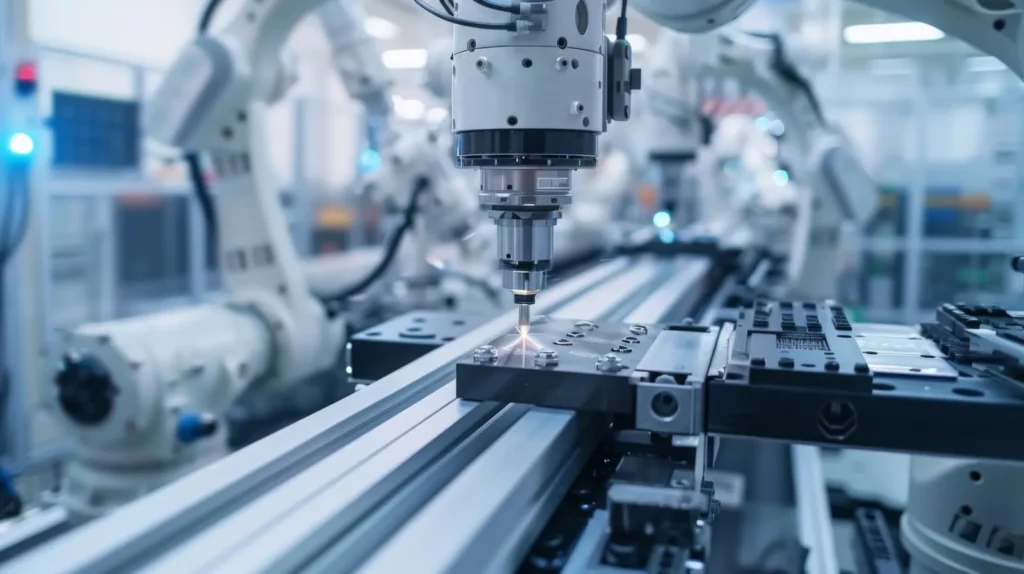
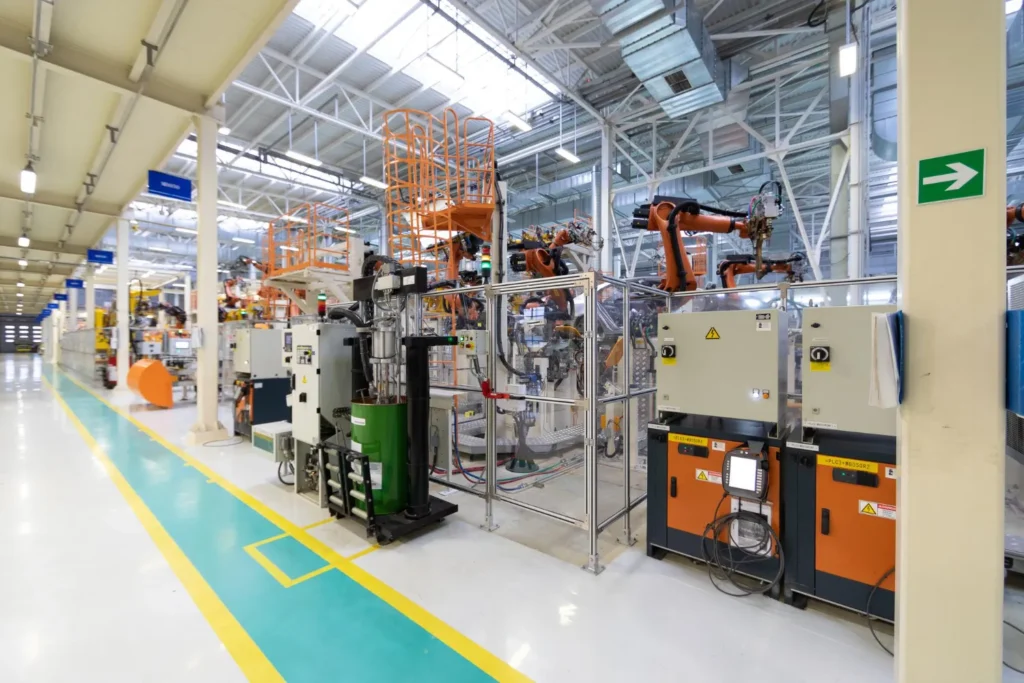
Robotics sits at the center of industrial automation in China, but the real value comes from connected industrial automation systems. In 2025, China produced 773,074 industrial robots, up 28 percent year-on-year. December output alone reached 90,116 units, showing how quickly domestic robot production capacity is scaling.
Traditional six-axis robots, SCARA robots, and collaborative robots still carry most factory deployments. Automotive, electronics, machining, battery, and logistics plants use them for welding, handling, assembly, palletizing, packaging, and visual inspection.
Humanoid robots attract attention, but most still sit behind specialized industrial robots in factory reliability. In 2025, China produced 12,800 humanoid robots, about 90 percent of the global total. Most units served research labs, training centers, logistics trials, and bounded manufacturing pilots.
Servo systems control motor position, speed, and torque. In advanced lines, they help robots move with precision across assembly, cutting, packaging, and inspection tasks. As factories demand tighter tolerances, motion control becomes a core layer of automation performance.
PLCs provide the control logic behind automated lines. In practical PLC industrial automation workflows, controllers coordinate sensors, drives, motors, robot cells, safety systems, and machine sequences across the production floor.
PLCs accounted for 32.24 percent of China’s factory automation and industrial controls market in 2025. That share shows why PLCs remain central to reliable production, even as factories adopt AI tools, cloud platforms, and advanced analytics.
China’s industrial automation companies increasingly compete on full-line capability, local service, and application engineering. The strongest players now support drives, servo systems, PLCs, robotics, sensors, software, and sector-specific integration.

Shenzhen Inovance Technology clearly shows this shift. In 2025, the company reported revenue of 45.10 billion yuan, up 21.77 percent. Its industrial automation and digitalization business reached 22.25 billion yuan, showing how central automation remains to its growth strategy.
Inovance supplies AC drives, servo drives, motors, motion controllers, CNC systems, PLCs, and HMI products. It serves sectors such as semiconductors, logistics, packaging, elevators, and SMT production. Its portfolio reflects how Chinese suppliers compete through faster customization, local service, and full-line integration.
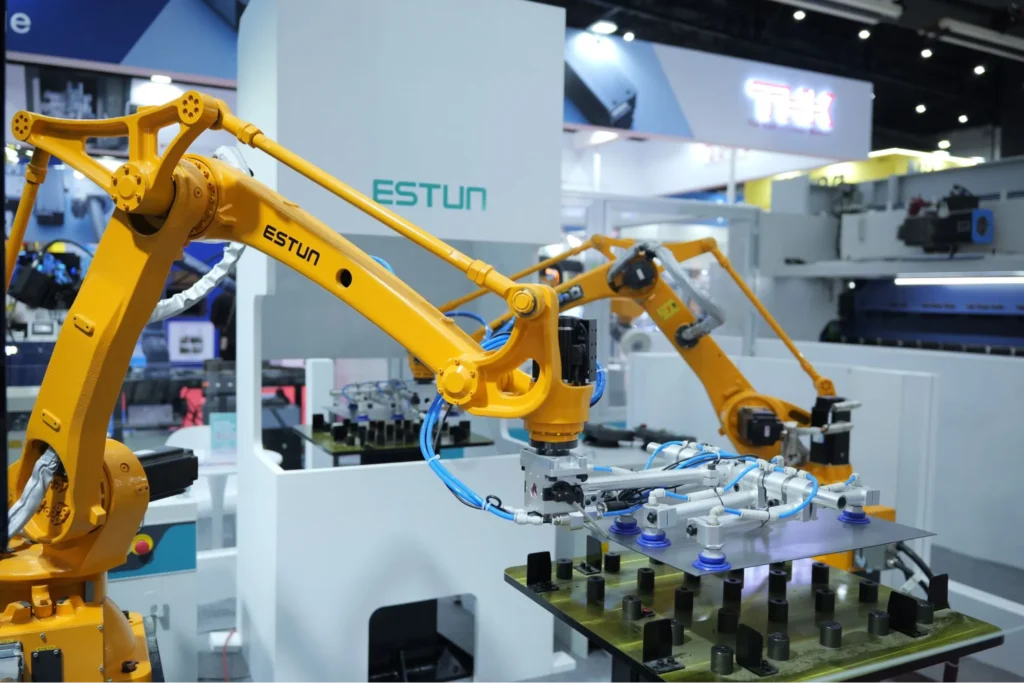
Estun Automation also remains important in robotics and motion control. In February 2026, Estun said its robot shipments ranked first in China’s industrial robot market in 2025, based on MIR Databank data. This strengthens its position in welding, handling, battery, photovoltaic, and general manufacturing applications.
Global suppliers still matter. In 2025, ABB launched three robot families for China’s mid-market customers and said China accounted for about 30 percent of its robotics business. Siemens, Schneider Electric, FANUC, Yaskawa, and Mitsubishi Electric also remain important in premium PLCs, safety systems, servo reliability, and industrial automation software.
For buyers, the supplier decision now depends on application risk, service depth, lifecycle support, software compatibility, and total integration cost. Domestic suppliers often win on speed and price. Global suppliers still lead where plants need proven uptime and advanced controls.
Smart factories show how China is moving beyond hardware deployment into data-driven production management. In 2025, China had built more than 30,000 basic smart factories, 1,200 advanced smart factories, and 230 excellence-level smart factories.
Industrial automation software connects machines, production teams, quality systems, and enterprise planning tools. MES platforms manage scheduling, traceability, production reporting, quality records, and workflow control across the shop floor.
IIoT platforms add another layer by connecting robots, PLCs, sensors, cameras, drives, and energy systems. This gives manufacturers cleaner factory data and faster visibility into equipment status, output quality, and production bottlenecks.
Machine vision has become especially valuable in smart factories. AI-based inspection systems can detect defects, measurement errors, surface flaws, and assembly issues faster than manual checks. This matters in electronics, batteries, automotive parts, medical devices, and precision manufacturing.
As Chinese factories connect more machines, software platforms, and data systems, cybersecurity becomes a larger operational risk. Legacy OT cybersecurity gaps can constrain market growth because many plants still run outdated control systems with limited authentication and encryption.
The digital talent shortage, estimated at more than four million workers, compounds that risk. Factories need engineers who understand both production uptime and secure industrial networks.
To address this, companies are deploying edge AI predictive maintenance and real-time anomaly detection. These systems can spot cyber or mechanical failures earlier. On-premises 5G private networks also support low-latency control while reducing exposure to external threats.
The next stage of industrial automation in China will depend on practical deployment in factories. AI adoption, smart factory expansion, robotics localization, and stronger supplier evaluation will shape how manufacturers upgrade their production processes.
China’s 2026 policy direction gives automation a larger role across factories, logistics, healthcare, education, and advanced manufacturing. However, manufacturers will measure progress through uptime, inspection accuracy, line flexibility, and lower integration costs.
Manufacturing pressure also supports continued investment. In May 2026, China’s official manufacturing PMI slowed to 50, while high-tech manufacturing and equipment manufacturing stayed stronger than the wider factory sector.
China’s industrial automation market is moving from factory upgrades to business model change. ChoZan helps leadership teams understand what this means through China research, strategy advisory, expert briefings, workshops, and curated learning expeditions.
Our team connects policy signals, technology adoption, supplier ecosystems, and real market execution, so you can assess China’s smart manufacturing shift with clearer context. From robotics and AI deployment to smart factories and industrial software, ChoZan helps you turn fast-moving trends in China into practical decisions.
Book a consultation with ChoZan to explore how China’s automation, robotics, and smart manufacturing developments can shape your next strategic move.
Start with application fit, service coverage, integration history, and reference sites. Strong industrial automation companies in China should explain their lifecycle support, access to spare parts, software compatibility, safety testing, and how they handle production interruptions.
Yes, many older factories can be retrofitted gradually. Industrial automation solutions may start with sensors, gateways, barcode tracking, machine vision, or upgraded controls, then expand after teams confirm stable data quality and measurable production gains.
The first step is process mapping, not equipment selection. Buyers should identify bottlenecks, defect sources, labor pain points, takt-time limits, and integration constraints before choosing factory automation equipment for a Chinese production line.
PLC industrial automation supports quality control by making machine actions repeatable and traceable. Controllers can trigger inspections, reject faulty parts, record process conditions, and stop lines when sensors detect abnormal temperatures, pressures, speeds, or positions.
Local integrators help reduce execution risk. They understand plant layouts, Chinese supplier ecosystems, commissioning timelines, operator training needs, and after-sales service expectations, which often matter as much as hardware specifications in automation projects.
Calculate ROI from avoided defects, labor redeployment, reduced downtime, faster throughput, energy savings, and reduced scrap. For industrial automation systems, the best business case links each metric to one production constraint.
Teams need data literacy, maintenance discipline, process knowledge, and basic troubleshooting skills. Industrial automation software only creates value when operators, engineers, and managers understand dashboards, alarms, production records, and workflow changes.
Yes, small manufacturers can start with narrow use cases. Common entry points include inspection, packaging, labeling, material handling, and production tracking, as these areas often offer faster payback and lower integration complexity.
Industrial control systems affect compliance by creating traceable production records and safer machine behavior. Better controls can support audit readiness, quality documentation, equipment maintenance records, and evidence that safety procedures operate consistently.
Yes, green manufacturing will make automation more energy-aware. Future projects will likely integrate production scheduling, equipment monitoring, carbon tracking, and energy management, enabling factories to improve output while controlling energy use and emissions.