CONTENT

China reached a new milestone in early 2025. The country now operates more than 500 industrial robots per 10,000 manufacturing workers. That number puts China ahead of Germany and Japan for the first time.
This shift changes how robotics in manufacturing works on a global scale. Factory owners no longer ask if they need automation. They ask which industrial robot configuration delivers the fastest payback. The answer depends on your product type, batch size, and existing floor layout.
Industrial robotics has moved from heavy automotive welding to delicate electronics assembly. Today, a single six-axis robot can switch from CNC tending to quality inspection within minutes.
Robot density measures the number of operational robots per 10,000 manufacturing workers. In 2024, the European Union averaged 231 robots per 1,000 people, North America 204, Asia 131, and China 166.
Although China trails countries such as South Korea (1,220) and Singapore (818), it operates roughly 2 million industrial robots, more than four times Japan’s total.
China has rapidly increased automation intensity. Robot density reached 470 robots per 10,000 workers by 2023, effectively achieving the target set under the country’s 14th Five-Year Plan.
The market continues to expand. China’s robotics market was worth about $47 billion in 2024 and is forecast to grow around 23% annually through 2028. Industrial robot output reached approximately $33.4 billion in 2024, up 14% year over year, with growth accelerating to 28% in 2025.
Meanwhile, the industrial robots market is projected to grow from $6.31 billion in 2024 to $20.33 billion by 2032.
Electronics and automotive manufacturing remain two of the biggest drivers of industrial robot adoption. In electronics, robots are widely used for high-speed pick-and-place, CNC tending, semiconductor production, inspection, and precision assembly. Looking ahead, the IFR expects global industrial robot installations to rise by 6% in 2025, reaching around 575,000 units.
Automotive manufacturers also continue to rely heavily on robots for welding, painting, engine assembly, chassis production, and quality control. In China, automation is especially visible in advanced vehicle factories.
Changan’s Digital Intelligence Factory in Chongqing uses connected production systems, AI, 5G, automated logistics, and robotic arms to support highly automated NEV production, with a new vehicle rolling off the line every 60 seconds.
China is expected to remain the world’s largest industrial robotics market, with robot installations projected to keep growing at an average annual rate of about 10% through 2028.
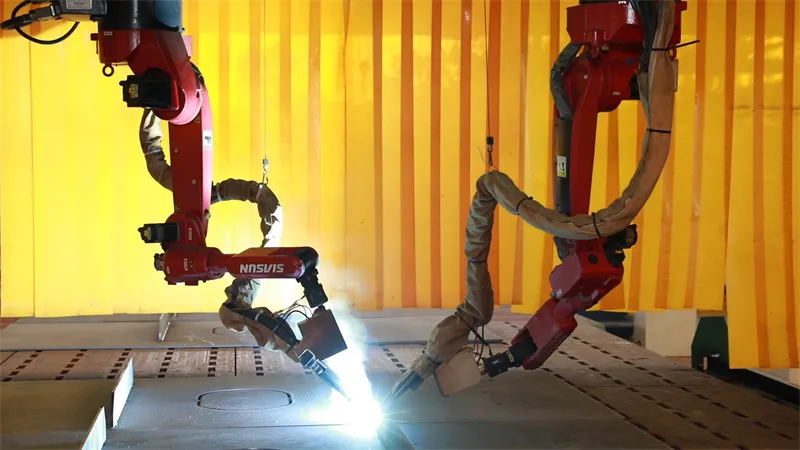
Robotics growth in China is moving beyond heavy manufacturing into food and beverage, textiles, agriculture, and warehouse logistics.
In food and beverage, robots handle packaging, palletizing, inspection, and hygienic handling. In textiles, automation now supports fabric cutting, sorting, recycling, and material movement. In 2025, an AI textile-sorting system in China reportedly processed up to 2 tons of clothing per hour.
Agriculture and logistics are also expanding fast. Farms are adopting drones, autonomous tractors, harvesting robots, and crop-monitoring systems. Meanwhile, e-commerce warehouses use autonomous mobile robots to move goods, reduce walking time, and speed fulfillment.
This shift reflects a broader change in China’s robotics market. Lower-cost, easier-to-deploy robots are making automation practical for sectors that previously relied heavily on manual labor. In 2025, ABB launched new mid-market robot lines in China, targeting the food and beverage and basic manufacturing sectors.
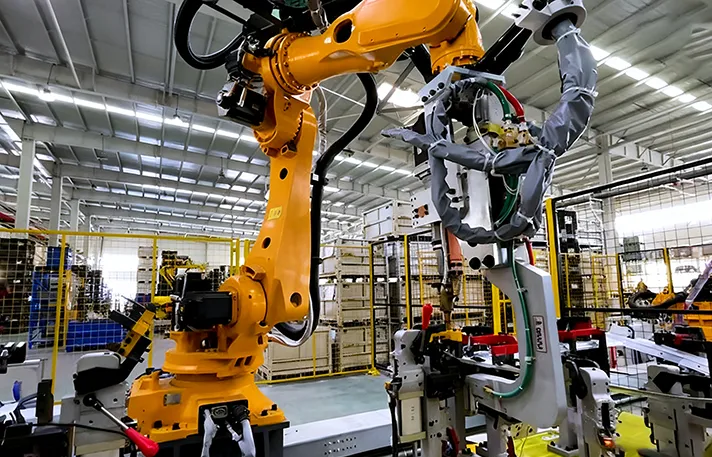
China’s industrial robot market is shifting toward local suppliers. In 2025, IFR reported that Chinese manufacturers sold more industrial robots domestically than foreign vendors did. Domestic suppliers reached 57% market share, up from about 28% a decade earlier.
Local strength varies by sector. Chinese suppliers provide around 80% of food and beverage robots and nearly all textile and apparel robots. However, foreign vendors remain stronger in high-precision sectors. Domestic firms supply about 31% of automotive robots and 59% of electronics robots.
Established players such as Estun and Siasun supply articulated robots, six-axis systems, welding robots, and assembly solutions. Inovance and EVS Robot are also growing through cost-effective SCARA and welding robots for mid-sized manufacturers.
Newer firms are expanding into humanoid, quadruped, and collaborative robotics. Unitree, Agibot, and UBTech are especially visible. Reuters reported that Unitree shipped more than 5,500 humanoid robots in 2025, giving it 32.4% of the global market.
Foreign vendors still matter. ABB, FANUC, KUKA, and Yaskawa remain strong in high-precision automotive and electronics applications. However, Chinese buyers increasingly prefer domestic partners for lower costs, customization, faster integration, and after-sales support.
Robotics remains a core priority in China’s industrial policy. It was part of Made in China 2025 and continues under the 2021 Robotics Industry Development Plan and the 2023 Robot+ Application Action Plan.
China has not yet fully met its local supply target. However, adoption continues to accelerate, with industrial robot stock growing by 29.5% in the first three quarters of 2025.
Funding has also accelerated. In March 2025, the National Development and Reform Commission announced a guidance fund to direct $137 billion into AI and robotics start-ups over 20 years. Beijing and Guangzhou each launched $1.4 billion robotics funds, while Shenzhen and Shanghai introduced similar support.
Local governments also use subsidies and tax incentives to lower adoption costs. Guangzhou subsidizes purchases of robots from local manufacturers, Tianjin supports first-time buyers, and Beijing has launched programs for humanoid robots.
State-owned enterprises are helping create early demand. In 2025, China Mobile purchased $17 million worth of humanoid robots from Unitree, Agibot, and other suppliers, supporting early-stage scale for domestic firms.
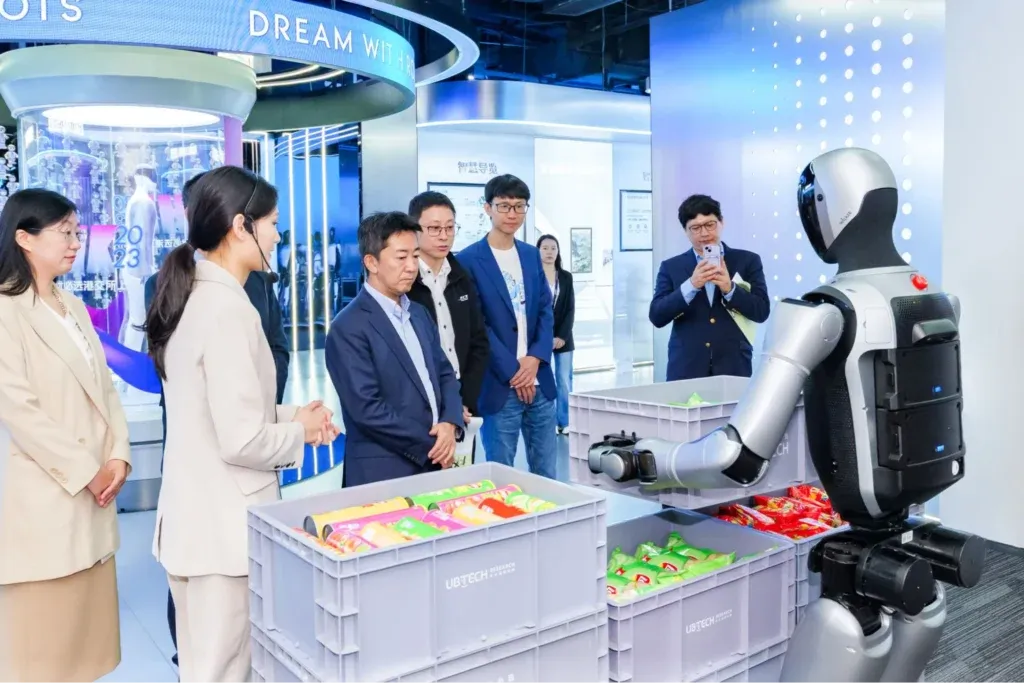
China is advancing quickly in humanoid robots, quadruped robots, wheeled robotic arms, and lightweight factory robots. In 2025, China accounted for more than 80% of roughly 16,000 humanoid robot installations worldwide.
Most humanoids remain in early-stage use. Companies deploy them mainly for data collection, research, logistics pilots, manufacturing trials, and automotive applications rather than broad commercial rollout.
Commercial viability still depends on better dexterity, reliability, real-world decision-making, and physical AI software. Because full humanoids remain complex and costly, Chinese firms are also scaling practical alternatives for inspection, transport, picking, and material handling.
China’s humanoid robotics market is projected to grow from $0.40 billion in 2025 to $2.80 billion by 2030.
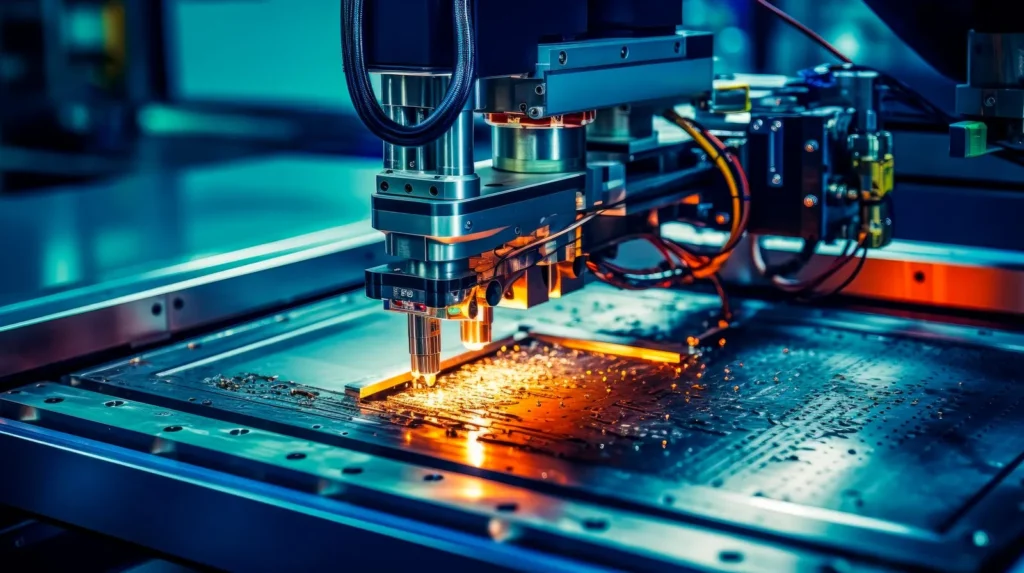
Manufacturers should start with a readiness assessment. High-volume, repetitive processes such as electronics assembly, CNC tending, welding, and inspection usually present the clearest case for automation. For smaller or customized production, collaborative robots or lower-cost domestic systems may provide more flexibility.
Supplier choice should balance cost, precision, support, and integration needs. Domestic players such as Estun, Siasun, Inovance EVS, and Han’s Robot offer cost-effective systems with local service and subsidy advantages. International suppliers such as ABB, FANUC, and KUKA remain strong for high-precision production.
A phased rollout reduces risk. Manufacturers can begin with one pilot cell, measure productivity and payback, then scale into multi-robot lines. Over time, proven processes can move toward lights-out production, as seen at Chang’An Automobile’s highly automated factory.
Workforce training is also critical. Operators need skills in programming, maintenance, safety, and troubleshooting. Supplier partnerships, universities, and government-backed training centers can help factories build these capabilities.
Finally, automation should continue to improve after installation. IoT sensors, predictive maintenance, vision systems, force control, and path-planning software can reduce downtime and improve long-term performance.
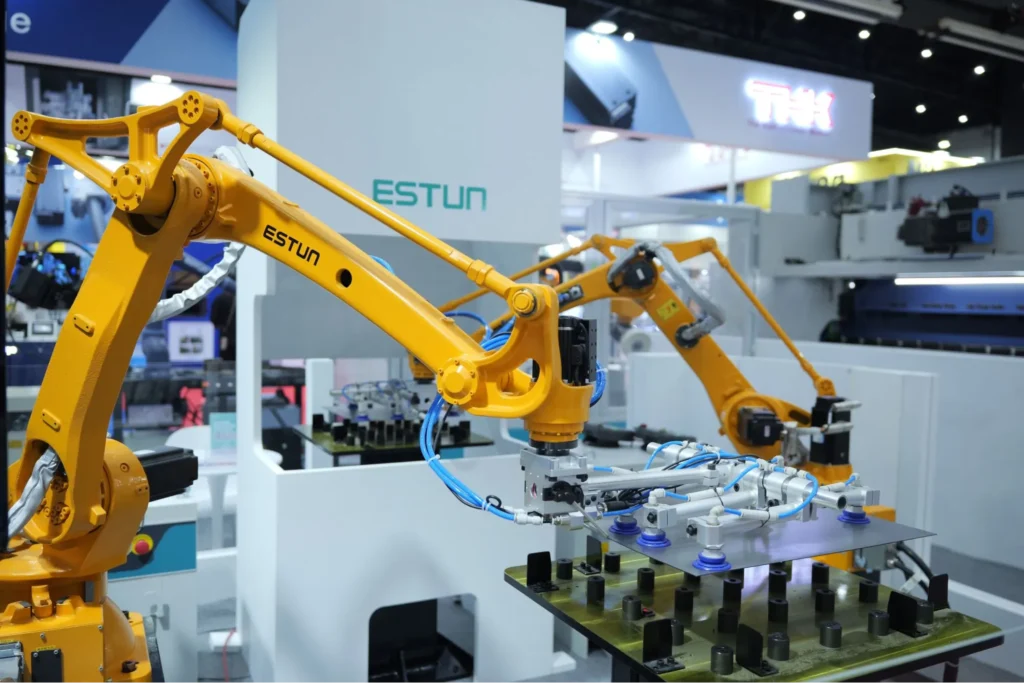
China’s industrial robotics growth is likely to continue through 2028. IFR projects about 10% annual growth in robot installations, driven by rising wages, labor shortages, an aging population, and competition from Southeast Asia.
Domestic suppliers are also expected to gain more share. Their current 57% market position gives them scale, while policy support and local integration advantages strengthen their competitiveness.
Policy will remain important, especially as China prepares its next Five-Year Plan for 2026. However, commercial pressure may matter more. Chinese manufacturers increasingly see automation as essential to productivity, quality control, and cost competitiveness.
Foreign companies will still play a key role. Global suppliers can support high-precision applications, while local partners can help with customization, compliance, integration, and after-sales service.
China’s industrial robot market is moving fast, and real insight comes from seeing how factories, suppliers, and innovation hubs operate on the ground.
ChoZan helps global executives understand China’s manufacturing transformation through curated learning expeditions, innovation tours, expert briefings, and research led by China specialists. Our team connects technology trends with practical business implications, so leaders can turn market observation into a clearer strategy.
If your organization wants to understand China’s robotics, factory automation, and smart manufacturing ecosystem, ChoZan can help you explore the companies, cities, and deployment models shaping the next phase of industrial innovation.
Contact ChoZan to plan a China learning expedition or executive briefing tailored to your strategic priorities.
The electronics and automotive sectors remain leading users, but food and beverage, textiles, agriculture, and logistics are currently the fastest-growing segments. Autonomous mobile robots in warehouses and robots for food processing and packaging will expand quickly.
Costs vary by payload, brand, application, tooling, and integration scope. Buyers should budget beyond the robot body, as grippers, safety systems, programming, fixtures, training, spare parts, and support can significantly affect the final investment.
Industrial robots should follow ISO 10218 for robot and cell safety, as well as local machinery rules. Collaborative applications also need risk assessment, speed limits, separation monitoring, and validated safeguards before workers share space with robots.
Most industrial robots can run for 10 to 15 years with proper maintenance. Harsh environments, heavy payloads, poor lubrication, and inadequate technician training can shorten service life and increase the risk of downtime.
Factories should service industrial robots according to the manufacturer’s manual, application intensity, and operating environment. Routine checks usually include lubrication, cable inspection, brake testing, calibration review, controller backups, and worn part replacement.
Cobots are designed for closer human interaction after proper risk assessment. Traditional industrial robots usually deliver higher speed, payload, and reach, so they often need fencing, scanners, or controlled access.
Yes, small manufacturers can start with one targeted robot cell. CNC loading, packaging, inspection support, and simple material handling often offer practical entry points because they limit disruption and create measurable production data.
Industrial robots connect with MES platforms through controllers, PLCs, sensors, and production software. This connection helps managers track cycle time, downtime, quality events, energy use, and maintenance alerts across automated cells.
Manufacturers should match payload and reach to the real part weight, tool weight, working envelope, and process path. A robot that barely meets the requirement can lose speed, accuracy, and reliability.
AI-controlled robots still face limits in industrial settings because factories require predictable motion, traceable decisions, safety validation, and low downtime. Current progress is strong, but many advanced systems remain task-specific.
Industrial robotics creates demand for robot programmers, maintenance technicians, automation engineers, quality specialists, safety officers, and data analysts. The strongest factories retrain operators so people can supervise cells and improve process performance.