CONTENT

China’s warehouse sector has become one of the clearest places to see how digital infrastructure turns into a commercial advantage. Warehouse automation solutions matter now because China’s retail, parcel, and industrial supply chains must process more orders with tighter accuracy, faster replenishment, and better cost control.
In 2025, China’s online retail sales reached approximately US$2.35 trillion, with online sales of physical goods accounting for 26.1 percent of total retail sales of consumer goods. The postal industry processed 216.5 billion delivery items in 2025, while the courier sector alone handled 199 billion parcels.
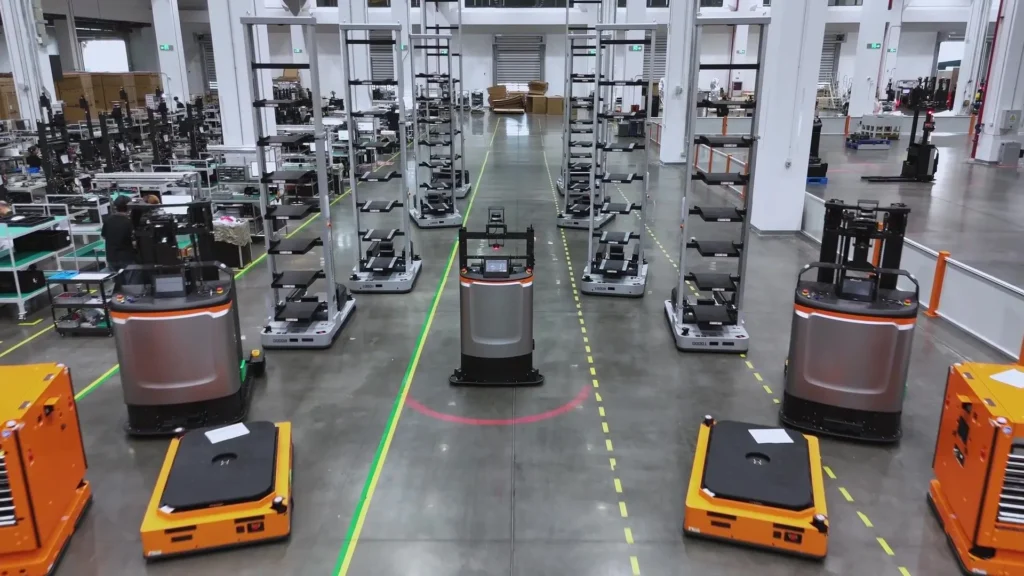
The most advanced projects combine AMRs, AGVs, ASRS, WMS, WES, picking automation, and system integration to build smart logistics systems designed for high SKU complexity and short delivery promises.
China’s logistics modernization is being driven by policy, platform competition, and consumer expectations simultaneously. In May 2025, China rolled out an action plan for digital and intelligent supply chains.
The plan calls for the adoption of artificial intelligence, the Internet of Things, and blockchain, with deeply embedded intelligent systems across major industries and key fields by 2030. It also targets about 100 national leading enterprises in digital and intelligent supply chains by 2030.
In June 2026, official AI-plus consumption measures stressed smart retail, deeper ecommerce and AI integration, improved smart logistics networks at the county, township, and village levels, and wider delivery coverage in remote areas.
From January to March 2026, China’s postal sector generated approximately US$66.04 billion in revenue, while China’s total social logistics value reached approximately US$14.17 trillion. Scale like this change the business case for warehouse automation systems. Automation becomes less about replacing labor and more about controlling variability across thousands of daily operating decisions.
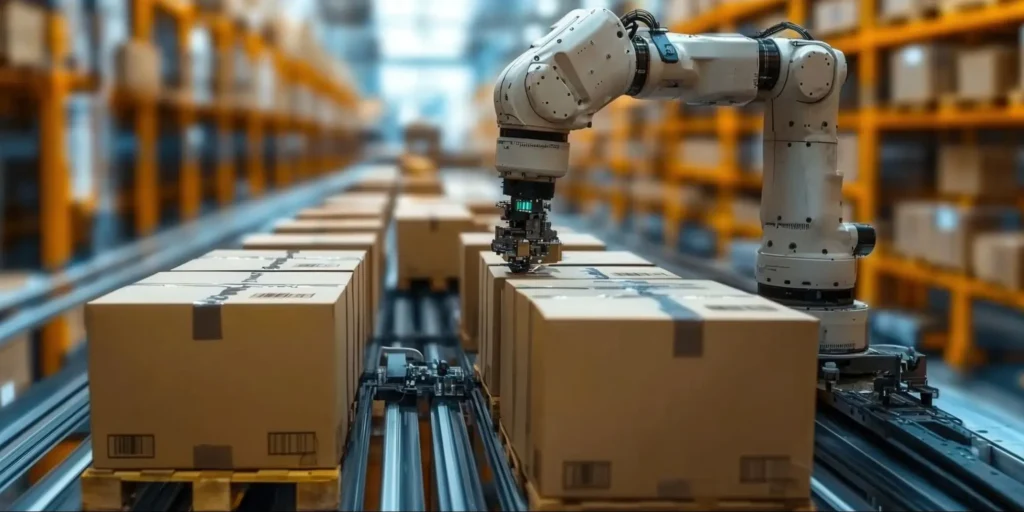
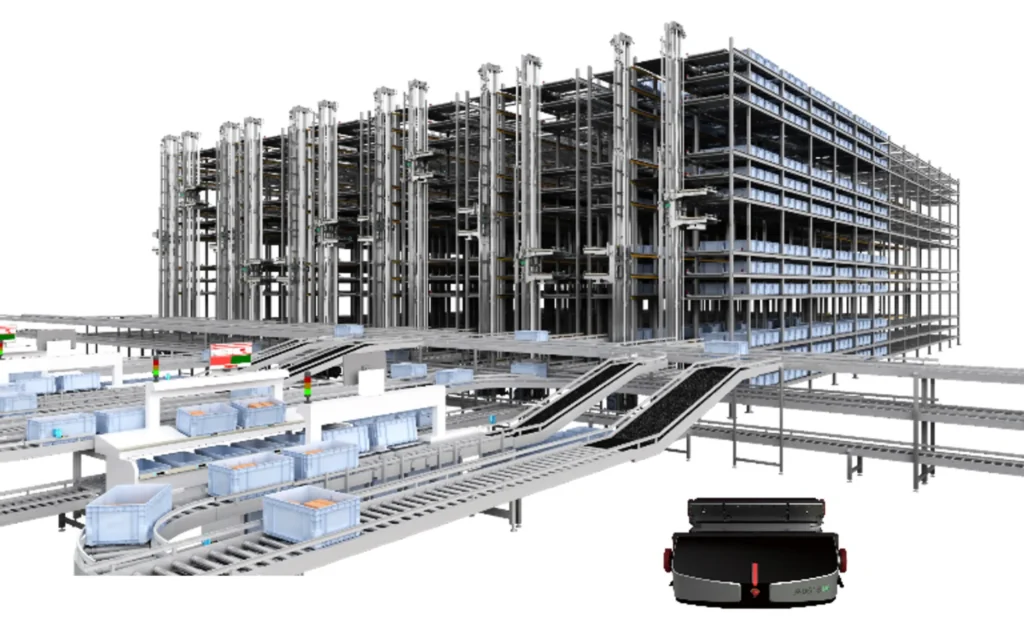
A modern automated warehouse may include ASRS, AMRs, AGVs, robotic arms, conveyors, and vision systems. The facility becomes valuable when these assets work as one flow.
Warehouse automation robotics in China is broad because operational needs are broad. Ecommerce fulfillment centers need high speed for each picking. Apparel warehouses need SKU flexibility and returns handling. Grocery, healthcare, and manufacturing sites need traceability, temperature control, line feeding, and parts sequencing.
Hai Robotics positions HaiPick as an ASRS family for goods-to-person automation across apparel, retail, 3PL, healthcare, automotive, ecommerce, electronics, and grocery use cases. Its site also describes HaiPick Climb as a 2026 upgrade focused on faster fulfillment and higher storage density.
Geekplus offers a broader robotics stack, including shelf-to-person, tote-to-person, pallet-to-person, robot-arm picking, sorting, and intralogistics, supported by software and integration tools.
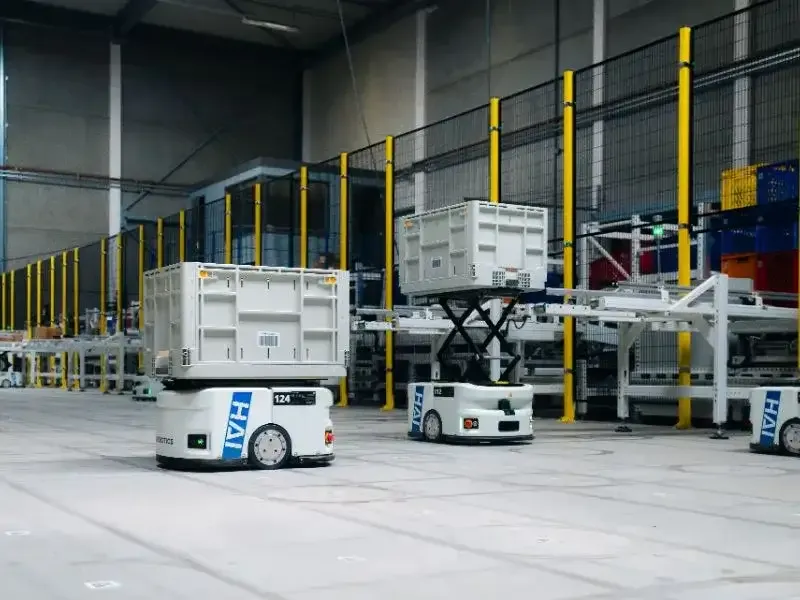
Warehouse automation software is the part that many companies underestimate. A WMS records inventory, locations, inbound receipts, orders, and exceptions. A WES converts demand into executable tasks. An RCS or fleet control layer assigns robots, routes, charging, traffic rules, and recovery actions.
Hikrobot’s platform architecture centers on iWMS 1000 and RCS 2000. The company says iWMS connects to upper-level systems, while RCS builds map models and dispatches robots throughout the logistics process.
Quicktron describes a software stack of WES, RCS, WCS, and fleet control that integrates with WMS and upstream systems, with routing, slotting, charging, and human-robot coordination built into the operating layer.
Geekplus lists WES, RMS, and IOP as core platforms, with ERP, WMS, and MES integration through open APIs.
The strongest warehouse automation systems are designed around process integration rather than isolated machines. A robot that moves shelves faster has limited value if inventory logic, replenishment rules, order batching, and labor planning remain fragmented.
This is why WMS and WES choices must be evaluated with hardware choices. A low-cost AMR fleet can become expensive when traffic rules, lift interfaces, safety zones, and order logic require heavy customization.
China’s warehouse automation companies are moving in two directions. Large logistics platforms are building proprietary systems for internal and merchant networks. Robotics specialists are packaging hardware, software, deployment, service, and partner support into more complete offerings.
JD Logistics gives the clearest example of platform scale. During 2025, JD Logistics said its self developed LangzuTech goods to person automated warehousing solution entered nationwide replication.
As of December 31, 2025, more than 20 LangzuTech automated warehouse sites had started operation in nearly 20 Chinese cities. JD also launched its first overseas LangzuTech warehouse in the UK in the fourth quarter of 2025.
Cainiao shows the global version of the same logic. In 2026, Cainiao said it would establish a large scale robot warehouse network in Hong Kong, the United States, and Europe to support local delivery and distribution for cross border ecommerce platforms and merchants. The company said these warehouses would use next generation robots and AI powered scheduling systems.
Specialist vendors are also moving beyond robot sales. Geekplus debuted its Geekplus Brain embodied intelligence platform and RoboShuttle V5 in the US market at MODEX 2026. The company said new signed orders in the Americas grew more than 50 percent year on year in 2025, led by the US. Hai Robotics focuses on modular ASRS.
Hikrobot combines machine vision, mobile robots, iWMS, RCS, and simulation. Quicktron emphasizes AMRs, WES, RCS, WCS, and fleet control. Together, they show how robotic warehouse automation in China is becoming a software-and-integration market rather than a pure equipment market.
The ROI logic in China is pragmatic. Operators care about labor, but the stronger cases usually come from storage density, fewer touches, faster outbound cycles, lower error rates, and better peak capacity.
For investors and strategy teams, automation ROI should be modeled at the workflow level. A brand may need automated picking for slow-moving SKUs, AMRs for replenishment, ASRS for dense reserve storage, and a WES layer that sequences orders before the floor becomes congested.
China’s retail calendar punishes weak fulfillment design. Singles Day, 618, livestream spikes, flash sales, and local community buying can shift demand within hours. A manual warehouse can add labor for a short period, but error rates and congestion can rise quickly. A well-designed automated warehouse can maintain service quality more consistently because task allocation, travel paths, and batching rules adjust more quickly.
Many companies do not have the budget or land for a new flagship warehouse. This is why AMRs, modular ASRS, simulation, and API based warehouse automation software matter. Brownfield sites need flexible layouts, staged deployment, and integration with existing ERP, WMS, OMS, MES, elevators, conveyors, and safety procedures.
For global companies entering China or sourcing from China, brownfield maturity is a serious procurement filter. The strongest vendor can map the workflow, simulate the bottleneck, connect the systems, train the team, and support the site after launch.
China’s lesson is clear: warehouse automation solutions should be evaluated as operating infrastructure. For retail leaders, automated fulfillment supports narrower delivery windows and more reliable stock availability.
For technology leaders, WMS, WES, RCS, ERP, OMS, and robot fleets must exchange clean data. For investors, the most valuable automated warehouse systems can be replicated across sites and upgraded through software.
Chozan helps global leaders understand China’s smart logistics, retail technology, automation ecosystems, and supplier innovation with strategic clarity. For teams evaluating warehouse automation solutions, Chozan can support learning expeditions, executive workshops, custom research, expert calls, advisory, and digital transformation consulting.
Book a consultation with Chozan to assess how China’s warehouse automation model affects your market, partners, and growth strategy.
Warehouse automation solutions are technologies that reduce manual warehouse work through robots, software, storage systems, and data. They help teams move goods, manage inventory, pick orders, and coordinate fulfillment with greater speed and accuracy.
An automated warehouse needs detailed planning around order profiles, SKU mix, storage rules, workforce design, peak demand, safety, and software integration. Strong planning reduces rework and gives vendors clearer performance targets before installation starts.
A WMS manages inventory records, locations, receipts, and order status. A WES sequences work on the warehouse floor, assigns tasks to people or robots, and helps balance flow across picking, replenishment, packing, and dispatch.
AMRs suit changing layouts because they can navigate more flexibly. AGVs suit predictable routes and stable material movement. The better choice depends on facility design, traffic density, payload, safety needs, and integration requirements.
Retail, ecommerce, apparel, grocery, healthcare, electronics, automotive, 3PL, and manufacturing are strong adopters. These sectors face SKU complexity, labor pressure, traceability needs, delivery speed demands, or repetitive movement that automation can address.
Warehouse automation companies usually assess ROI through labor savings, storage density, picking productivity, error reduction, throughput, energy use, and peak capacity. Strong models also include downtime risk, integration cost, training, maintenance, and future expansion.
Robotic warehouse automation can work in older facilities when floor quality, ceiling height, WiFi coverage, safety routes, charging areas, and system interfaces are checked early. Modular AMRs and staged deployment can reduce disruption.
ASRS improves dense storage, location control, and goods to person picking in facilities with many SKUs. It can reduce walking, improve retrieval discipline, and support faster replenishment when software logic is properly configured.
Foreign companies should review deployment references, local service coverage, software openness, cybersecurity controls, spare parts availability, safety certification, integration experience, and post launch support. A live site visit can reveal more than a showroom demo.
After warehousing automation, teams need skills in system monitoring, exception handling, data analysis, preventive maintenance, safety management, and process improvement. The best operators combine warehouse experience with software literacy and vendor management discipline.