CONTENT

China’s food delivery robots are moving from novelty to serious commercial infrastructure. In 2025, the story is no longer about cute machines rolling through shopping malls. It is about cost pressure, instant retail competition, labor intensity, urban logistics, and platform companies trying to protect margins in one of the world’s most demanding delivery markets.
China’s on-demand economy has trained consumers to expect speed, visibility, and low delivery fees. That creates a difficult equation for platforms and merchants. Human couriers remain essential, yet rising operational complexity is pushing companies to test delivery robots, drones, AI dispatch, and unmanned vehicles as part of a broader automation stack.
Meituan’s 2025 annual report states that the company will expand investment in AI, unmanned aerial delivery, and autonomous delivery vehicles as part of its “Retail + Technology” strategy.
China offers the right mix of dense cities, high order frequency, digital payment maturity, and platform scale. These conditions make robot food delivery more commercially viable than in many Western markets, where lower order density can undermine the economics.
The market pressure is also sharper. Reuters reported in November 2025 that Meituan posted its first quarterly loss since 2022 after aggressive competition in instant delivery from Alibaba and JD.com. That price war matters because automation becomes more attractive when subsidy-led growth hurts profitability.
For China platforms, food robot delivery is not a single product bet. It is part of a system that links merchant software, rider networks, warehouse operations, autonomous vehicles, drones, and dispatch algorithms.
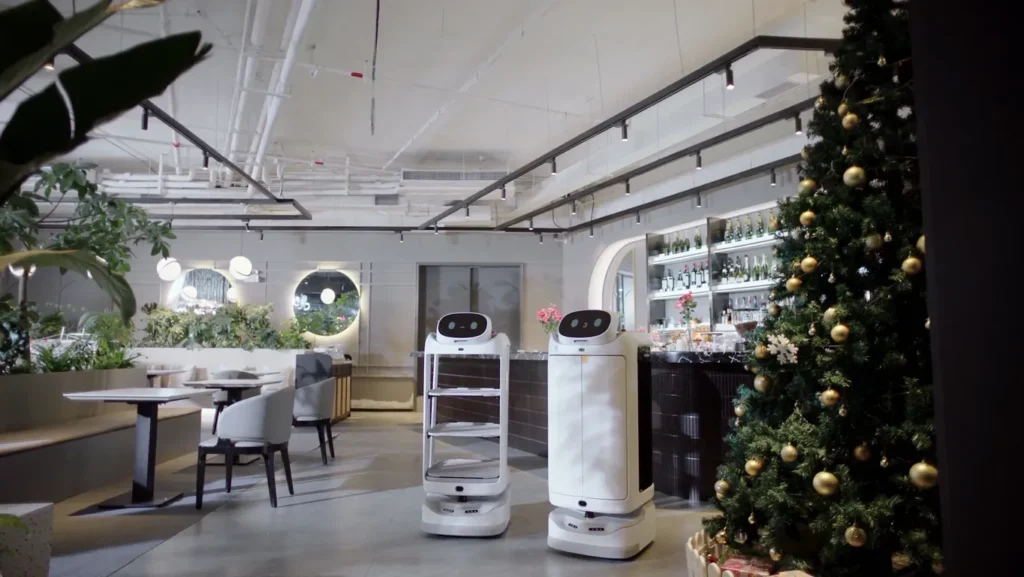
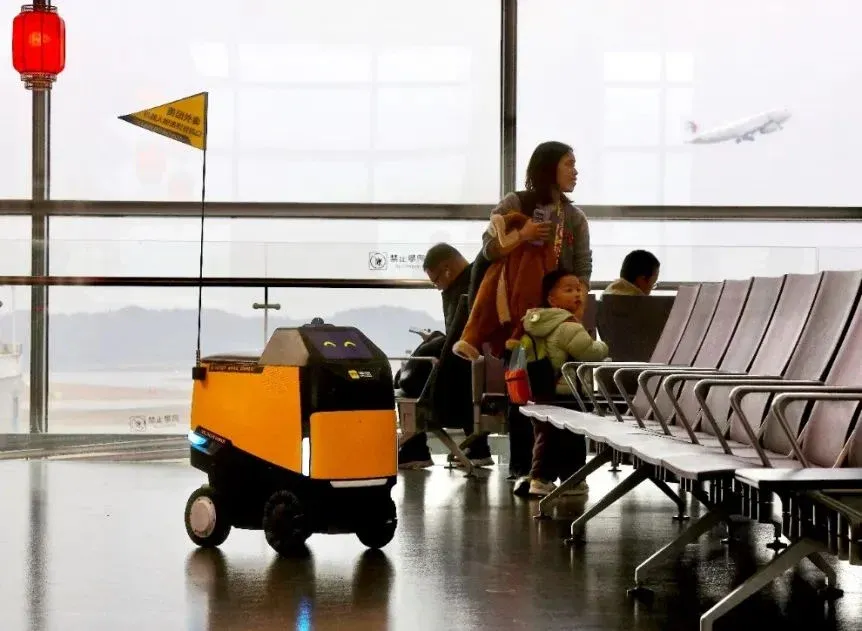
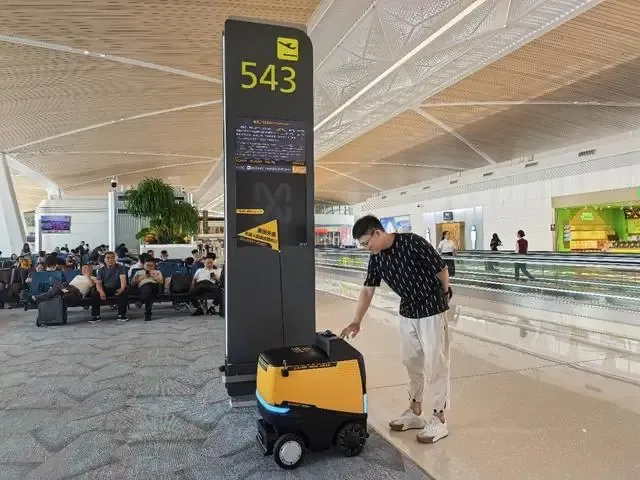
Restaurant delivery robots already make the most sense in controlled environments such as airports, malls, campuses, hotels, and office parks. These spaces have repeatable routes, clearer boundaries, and easier service training.
Restaurant delivery robots now operate in diverse commercial settings. Meituan’s Little Yellow Bee handles deliveries in shopping complexes and office towers. The company’s “Long Cat” large language model, released and open-sourced in September 2025, provides the AI backbone for smarter dispatch and route optimization. The model enables faster computational reasoning and more efficient intelligent agent applications at lower cost.
A robot that delivers food in an airport is not trying to replace the whole city’s courier network. It solves a specific friction point with high foot traffic and clear commercial value.
China’s instant retail market now includes groceries, convenience store items, drinks, medicine, electronics, and daily necessities. These categories often have better batching potential than restaurant meals.
For Laiyoupin alone, over 100 stores in Hefei now use Cainiao’s无人车 for restocking, with plans for further expansion. The solution reduces overall distribution costs by more than 15% compared to traditional manned-vehicle 配送.
Campus delivery represents another significant frontier. JD Logistics partnered with Renmin University of China to launch a smart express service center at the Tongzhou campus, deploying sixth-generation无人车 and indoor delivery robots in a “1+N” service model. Cainiao’s “Little Mule” robots operate across hundreds of Chinese university campuses, providing last-three-kilometer delivery services.
Perhaps the most striking example of innovation came from Shenzhen, where delivery robots began autonomously riding the city’s subway to deliver goods to 7-Eleven convenience stores inside stations.
Three robots, each capable of carrying 130 kilograms, use AI调度 algorithms, panoramic lidar, and mechanical底盘 systems to autonomously navigate trains, board elevators, and deliver to designated stores. According to projections, just 41 such robots could cover all of 7-Eleven’s Shenzhen metro station stores during peak seasons
The pilot, involving Shenzhen Metro Group and VX Logistics, used AI scheduling and multi-sensor navigation. The same report said Shenzhen’s metro network had more than 100 7 Eleven stores serving about 9 million commuters daily.
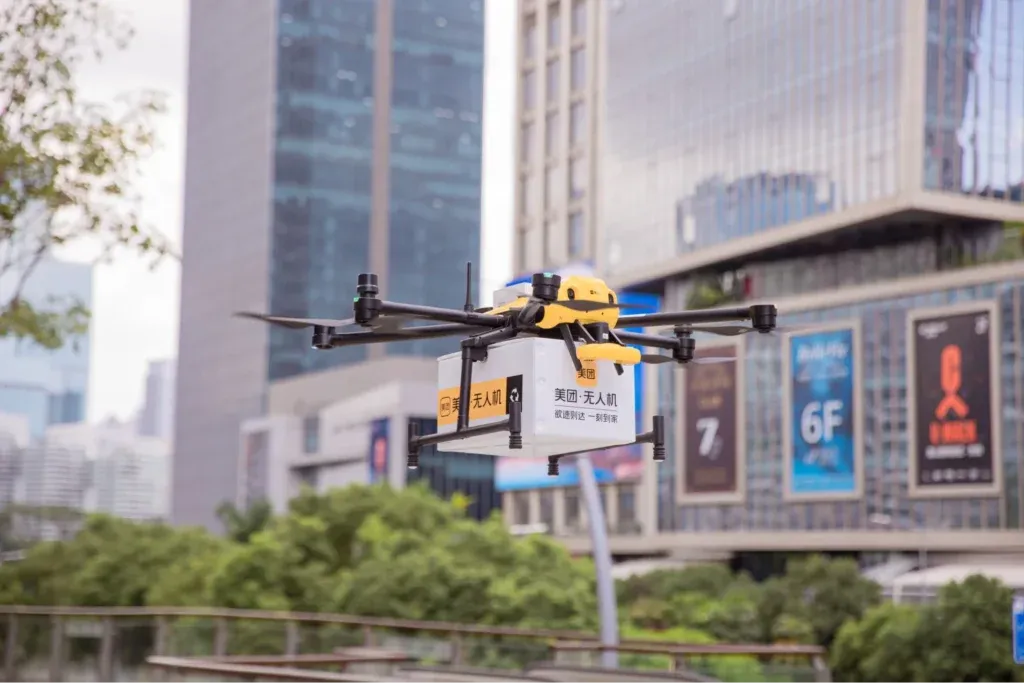
Meituan remains the most visible name in China’s automated local delivery conversation. Its core strength is not only hardware. It sits in demand prediction, order routing, merchant relationships, and consumer habit formation.
In April 2025, China Daily reported that Meituan’s self-developed fourth-generation drone passed a regulatory review by the Civil Aviation Administration of China and obtained the country’s first operating certificate for nationwide low-altitude logistics operations.
Although drones are different from sidewalk robots, the strategic message is the same: Meituan wants automation to cover more delivery scenarios across food, retail, and local commerce.
In December 2025, the company operated 65 routes across Shenzhen, Shanghai, Beijing, Hong Kong, and Dubai, completing 740,000 commercial orders. The company’s latest M-Port3 airport features a tree-shaped design with a robotic arm capable of millimeter-precision grasping (within ±1mm误差), enabling fully automated handoff from drone to pickup cabinet.
On the ground, Meituan’s autonomous delivery vehicles reached 5 million orders in Shenzhen alone by October 2025, with autonomous driving mileage exceeding 15 million kilometers and autonomous driving accounting for over 99% of total mileage.
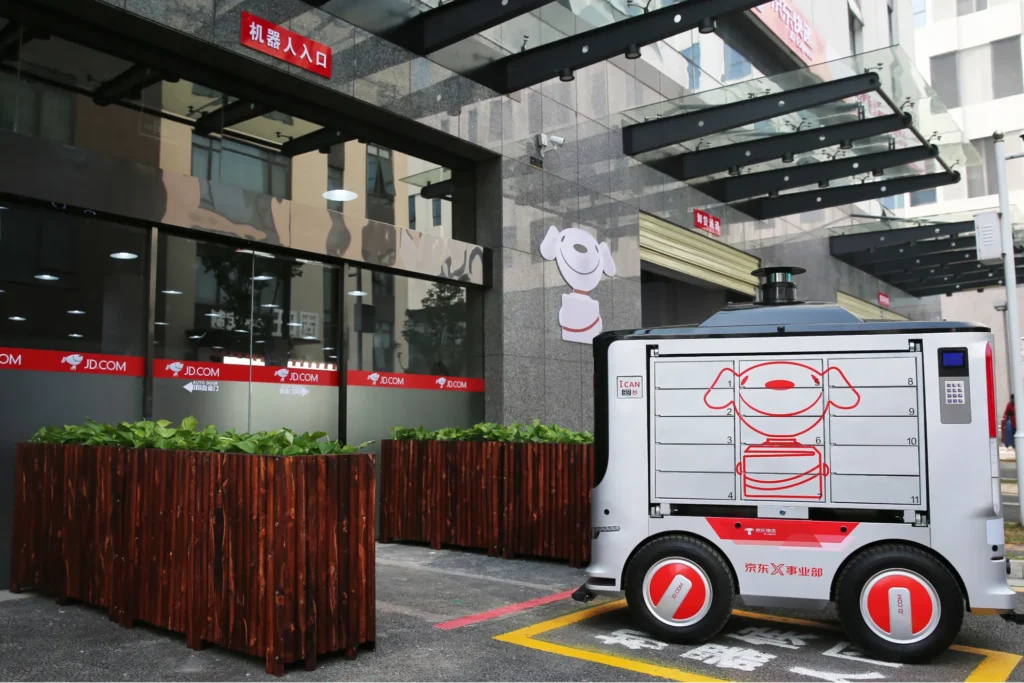
JD Logistics approaches automation from a supply chain angle. Its advantage lies in warehousing, parcel flow, fulfillment stations, and last-mile infrastructure.
In October 2025, TechNode reported that JD Logistics announced plans to procure 3 million robots, 1 million autonomous vehicles, and 100,000 drones over five years. The report said JD’s “Wolf Pack” robot series had been deployed in more than 20 Chinese provinces and over 10 countries.
JD’s sixth-generation “Lone Wolf” autonomous delivery vehicle features L4-level autonomous driving, a 200-kilometer range, and the ability to operate continuously for over 12 hours
This is relevant to food delivery robots because food delivery and retail logistics are converging. A platform that can move parcels, groceries, and prepared meals through shared automation assets may gain better utilization.
The winner is unlikely to be the company with the flashiest vehicle. The winner will be the operator who keeps assets busy across multiple order types.
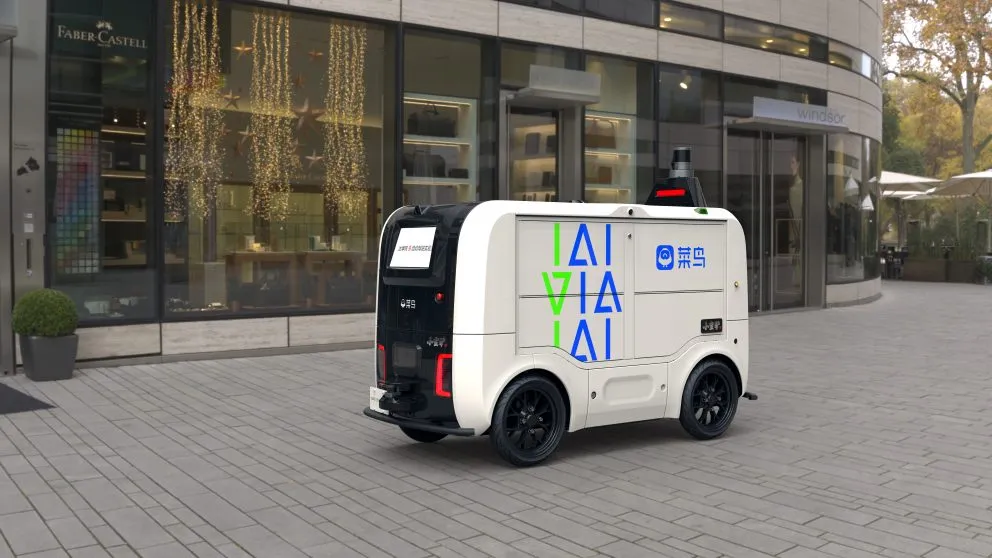
Alibaba’s local services and logistics ecosystem adds another layer to China’s automation race. The company is active across Ele.me, instant retail, Cainiao, and broader e-commerce infrastructure.
Alibaba Local Services has deployed a three-tier autonomous delivery system through its Ele.me and Cainiao units. The company’s “Green Bee” drone has completed 3,200 orders, the “Jade Lion” autonomous vehicle has completed 65,000 orders with a daily peak of 400 deliveries, and the “Red Rabbit” robot has delivered nearly 500,000 orders.
Reuters reported in January 2026 that Alibaba’s logistics arm planned to merge its autonomous driving unit with Chinese robovan company Zelos Technology, forming a new entity valued at around $2 billion, according to a Wall Street Journal report. The combined operation was expected to involve Cainiao’s autonomous vehicle activities and Zelos’ delivery solutions.
The strategic takeaway is clear. China’s delivery robots market is moving toward scale, specialization, and consolidation. Hardware alone is too narrow. Fleet dispatch, maintenance, route density, merchant integration, and regulatory access determine commercial durability.
China’s urban delivery environment is rich but unforgiving. Sidewalks are crowded. Residential compounds have gates. Restaurants face peak-hour pressure. Consumers expect accurate arrival times. A robot delivering food must handle all of this without turning service into a burden.
Three capabilities matter most:
| Capability | Business relevance |
| Obstacle avoidance | Reduces service interruptions in crowded public spaces |
| Fleet dispatch | Matches orders, routes, and vehicle availability in real time |
| Human handoff design | Keeps pickup simple for merchants and consumers |
The best deployments will avoid overpromising. Robots work best where routes are repeatable, pickup points are clear, and delivery density is high. That is why campuses, airports, industrial parks, hospitals, metro systems, and commercial districts are often better starting points than open-ended citywide service.
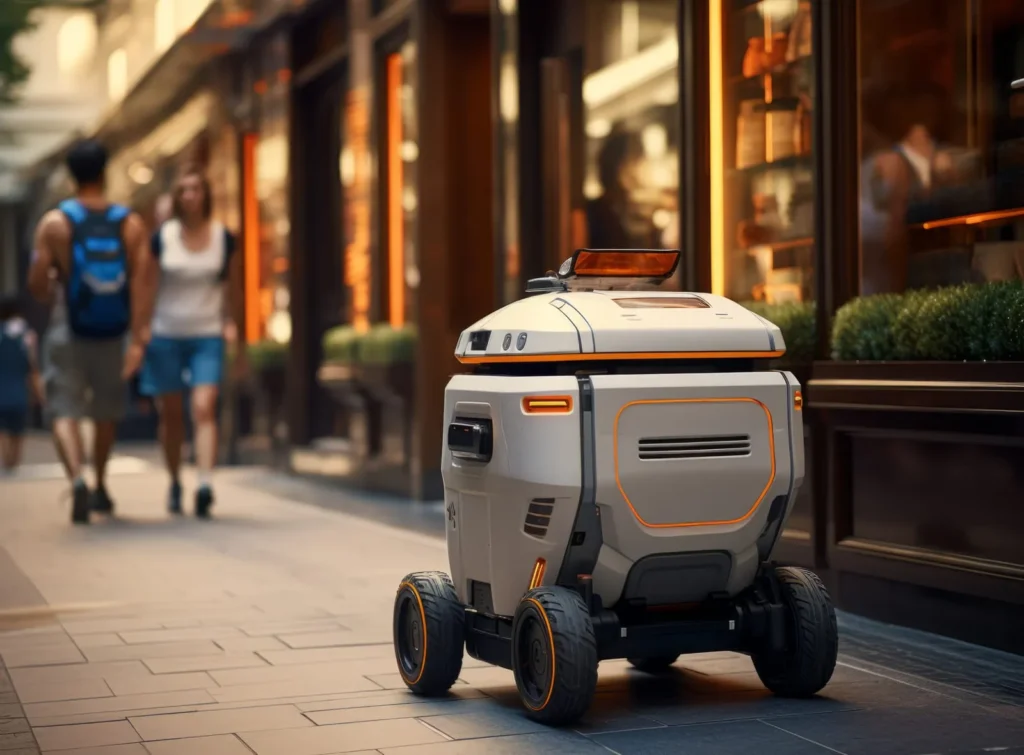
The point of food delivery robots is not only labor substitution. The real value comes from redesigning delivery cost structures. Robots can support off-peak replenishment, short-distance food delivery, indoor transport, and retail restocking. They can free human couriers for complex routes, apartment access, and customer service issues.
This matters in China because delivery platforms are under pressure from three sides: consumer demand for low prices, merchant demand for traffic, and investor demand for healthier economics. Automation offers a way to protect service speed without relying only on subsidies.
China shows that robot food delivery becomes commercially meaningful when it is linked to platform scale. A standalone robot is easy to copy. A robot integrated into payment, ordering, dispatch, merchant operations, and customer service is much harder to replicate.
The strongest lesson is practical: start with the use case, not the robot. Airport gate meals, campus delivery, metro retail replenishment, hotel room service, and office park lunch delivery each need different hardware and operating rules. China’s advantage lies in its ability to rapidly test across many dense commercial environments.
Chozan provides strategic intelligence and market entry support for global companies seeking to understand and participate in China’s rapidly evolving autonomous delivery and logistics technology sectors. Our team combines deep local market knowledge with global business perspective to help you identify opportunities, assess competitive dynamics, and build effective China strategies. Contact us to learn how we can support your business in China’s delivery automation market.
Food delivery robots are autonomous machines that transport meals, groceries, or retail goods over short distances. They often use sensors, cameras, mapping, fleet dispatch, and obstacle avoidance to move through controlled public or semi-public spaces.
Delivery robots are increasingly visible in China, especially in airports, campuses, industrial parks, hotels, and retail logistics pilots. Broad open city deployment remains selective because access, safety, density, and handoff design still affect performance.
A food delivery robot can reduce staff walking time, support operations in high-traffic zones, and extend service reach within large venues. Restaurants benefit most when routes are predictable and pickup behavior is easy for customers.
Robot delivery of food can lower costs in specific routes with high density and repeat orders. It is less effective when buildings are complex, routes are long, or customer handoff requires frequent human support.
Food robot delivery works best in airports, campuses, office parks, hospitals, malls, and gated communities. These locations offer clearer routes, repeat demand, and safer operating conditions than open urban streets.
Drones fly along low-altitude routes, while food delivery robots usually move on sidewalks, in indoor corridors, on roads, or along controlled pathways. In China, leading platforms often test both as part of one automation strategy.
A robot delivering food can replace some repetitive short-distance tasks. Human couriers still matter for complex buildings, customer support, flexible routing, and exceptions that require judgment or fast problem-solving.
China had over 6,000无人配送 vehicles by mid-2025, a 50% increase from 2024. These operate across 103 cities and have completed over 100 million deliveries
Leading autonomous food delivery robots use L4-level autonomous driving with multi-sensor fusion, lidar, and camera systems. Meituan reports that autonomous driving accounts for over 99% of vehicle mileage.
Over 30 unmanned delivery vehicle policies have been issued across 20 cities in 2025, with 103 cities now granting road rights. Policy direction has shifted from pilots to规模化 implementation