CONTENT

China’s market for surgical robots has entered a decisive commercial phase. Hospitals are no longer evaluating these systems mainly as experimental technology. Purchasing decisions now center on clinical value, approved indications, surgeon training, system reliability, instrument costs, and local technical support.
Public tender activity offers a useful view of this shift. According to MedChina’s analysis of publicly disclosed 2025 hospital tenders, Chinese hospitals awarded contracts for 90 laparoscopic robotic systems across nine manufacturers. Domestic brands secured 47 awarded systems. The Da Vinci platform remained the leader by awarded units and disclosed contract value, while Edge Medical ranked first among Chinese manufacturers by awarded volume.
These results point to a more complex competitive environment. Chinese manufacturers are gaining procurement access through broader product portfolios, local service, and competitive operating economics. Imported systems retain strong clinical recognition at many leading hospitals.
A company now needs more than regulatory approval or a successful demonstration. Sustainable adoption depends on repeatable clinical performance, trained hospital teams, responsive service, and enough procedures to support regular system use.
China’s surgical robotics sector covers several distinct clinical categories. Laparoscopic platforms receive the most attention because they can support procedures across urology, general surgery, gynecology, and thoracic surgery.
Orthopedic systems follow a different workflow. They support surgical planning, navigation, and precise instrument positioning. Neurosurgical, bronchoscopic, and vascular robots serve narrower clinical applications.
Each category has its own buyer groups, regulatory requirements, and operating economics. Treating the market as a single equipment sector can lead to weak commercial assumptions.
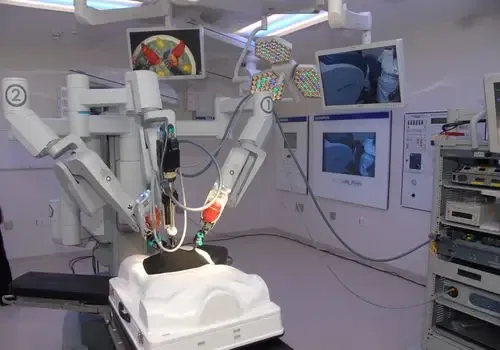
Intuitive Surgical’s Da Vinci platform remains the main international reference for multiarm robotic surgery. Hospitals compare domestic alternatives against their instrument control, visualization, clinical use, training structure, and surgeon familiarity.
Chinese laparoscopic robots are competing through local engineering, service responsiveness, procurement pricing, and remote operating functions. Some manufacturers are also developing multiple access configurations rather than relying on a single platform.
The competitive question has therefore changed. Hospitals are not comparing a single imported leader to a single domestic substitute. They are assessing an expanding group of local platforms with different clinical scopes, service models, and cost structures.
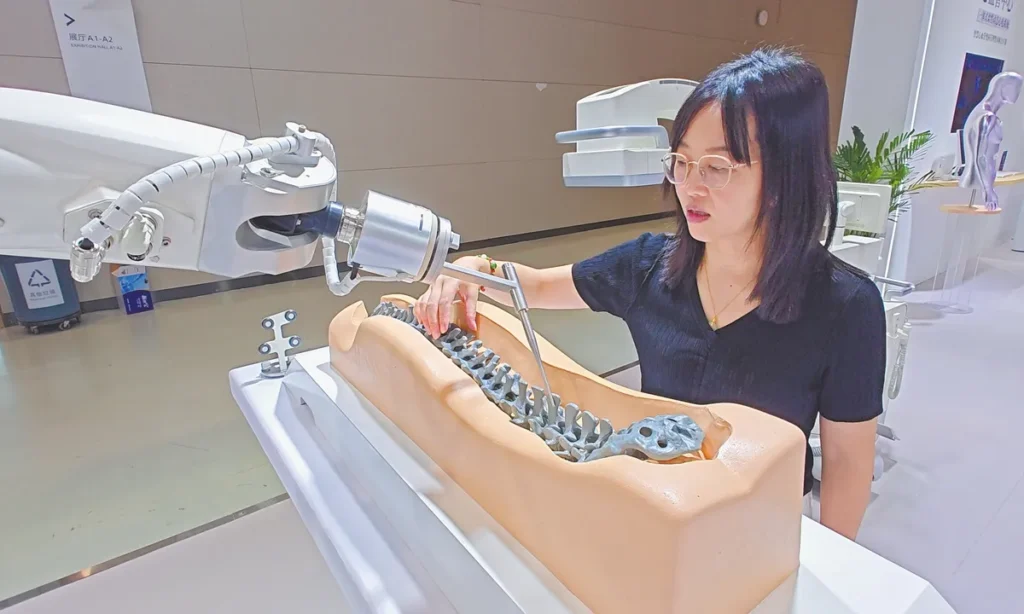
Orthopedic robot-assisted surgery follows a more specialized purchasing process. Hospitals evaluate imaging compatibility, surgical planning, implant workflows, navigation accuracy, and training requirements.
A hospital can purchase both laparoscopic and orthopedic surgical robots because they support different departments and clinical workflows. Success in one category does not automatically provide credibility in another.
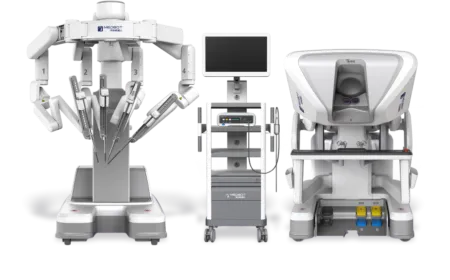
MicroPort MedBot is one of China’s most internationally visible surgical robotics companies. Its flagship Toumai laparoscopic system combines multi-arm surgery with integrated remote-operating capabilities.
On March 12, 2025, MicroPort MedBot announced that the Toumai single-port laparoscopic robot had received NMPA market approval. The Toumai®腔镜 surgical robot has achieved global commercial installation of over 100 units and cumulative orders exceeding 160 units as of December 2025.海外 revenue reached RMB 400 million in 2025, growing 287%, with overseas markets now accounting for 73% of total revenue.
Single-port systems route instruments and imaging through one primary access point. The format can support selected minimally invasive procedures, subject to the robot’s approved scope and the surgical team’s clinical judgment.
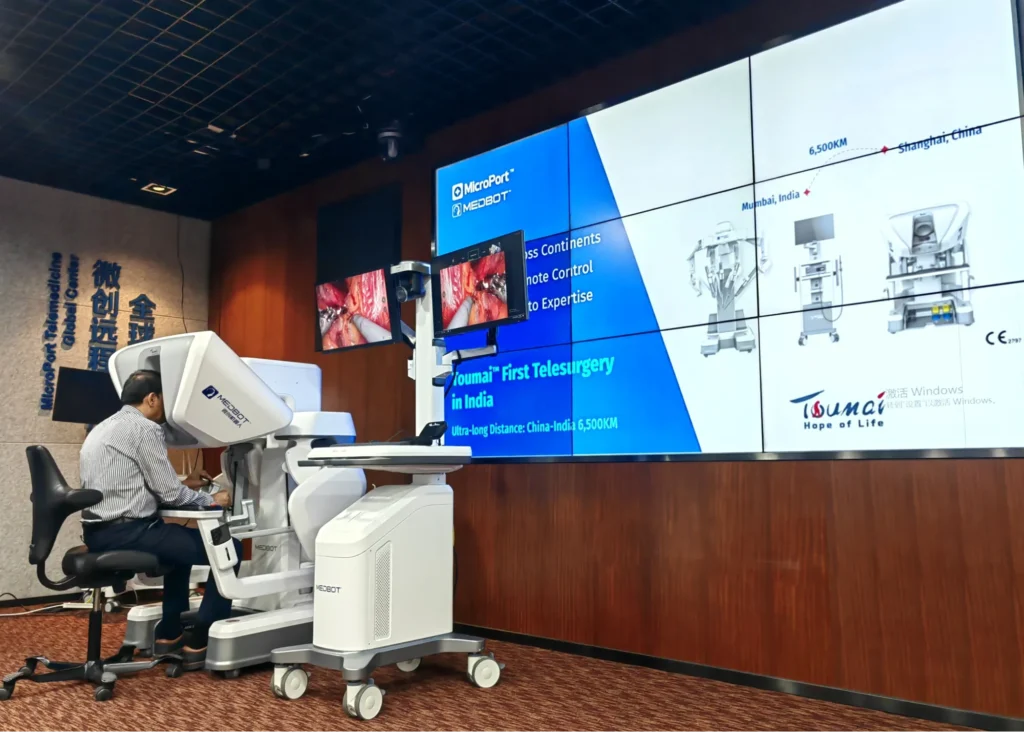
Remote operation is central to Toumai’s market positioning. In June 2025, MicroPort reported completing intra-European telesurgery cases between hospitals in Belgium using a CE-certified system.
Toumai® has surpassed 12,000 global procedures, maintaining the highest volume among domestic腔镜 surgical robots. The Shanghai Pulmonary Hospital alone completed over 1,000 Toumai®-assisted thoracic surgeries.
In July 2025, the company announced a remote procedure conducted via a low-Earth-orbit satellite connection and a mobile platform. This was a company-reported technical milestone rather than independent proof of broad clinical deployment.
These trials demonstrate technical capability under defined conditions. Large-scale adoption still depends on network reliability, emergency protocols, clinical governance, insurance arrangements, and trained teams at both locations.
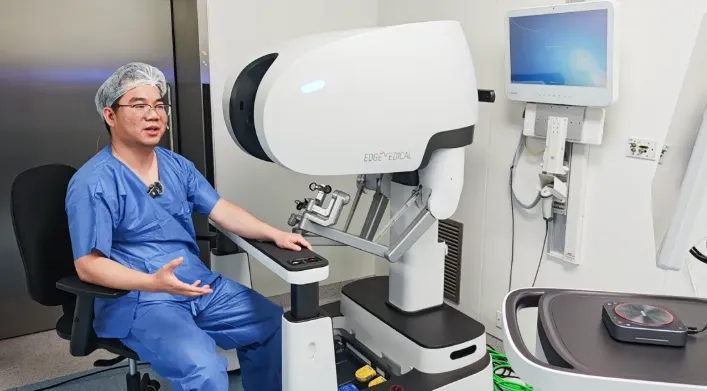
Edge Medical Robotics develops multiport, single-port, and natural-orifice robotic surgery systems for minimally invasive procedures.
According to MedChina’s 2025 tender analysis, Edge Medical secured 16 awarded systems. This accounted for about 34 percent of the domestic awarded volume in the report and placed the company first among Chinese manufacturers by awarded units.
Tender performance gives Edge Medical a visible position in hospital procurement. Long-term market strength will depend on clinical utilization, service quality, procedure expansion, and repeat purchasing.
Edge Medical also promotes cloud-based telesurgery through 5G, dedicated networks, and broadband connections. This supports its broader strategy to extend specialist surgical capabilities beyond leading urban hospitals.
In June 2026, Edge Medical reported the first clinical use of its single-port system in Europe, the completion of North Macedonia’s first robot-assisted surgery, and the initiation of initial endoscopic robotic procedures in Cameroon. These milestones are company-reported and should be assessed alongside independent clinical and procurement evidence.
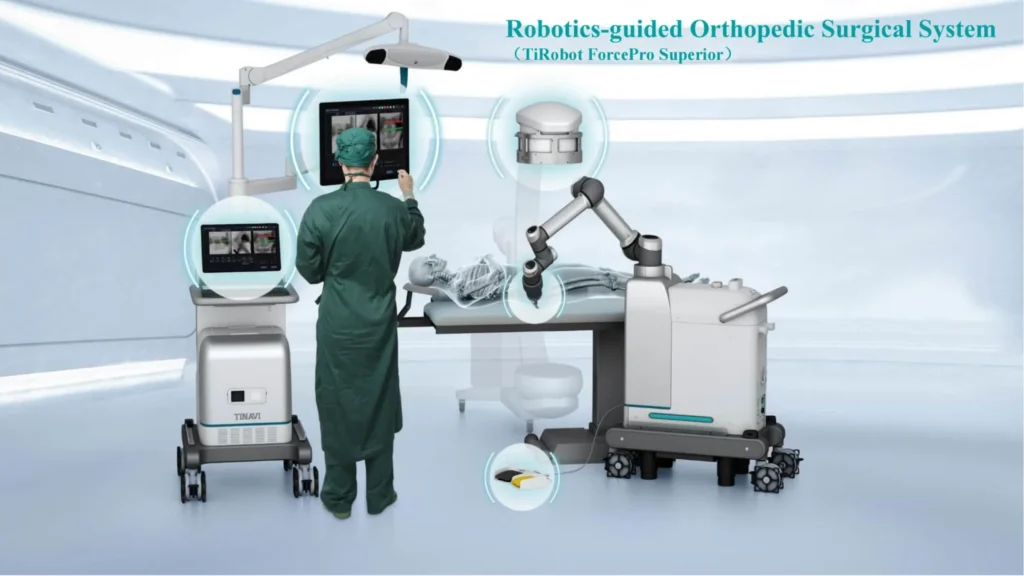
Tinavi competes primarily in orthopedic robot-assisted procedures. Its specialized focus sets it apart from companies focused on robotic-assisted abdominal and pelvic surgery.
Tinavi’s orthopedic robotic systems have received CE Mark certification and are being introduced into hospitals across Europe, Asia, and Latin America as part of its global growth strategy.
Orthopedic adoption depends on how well a system fits the hospital’s imaging equipment, implants, planning process and established operating routines. Strong performance in laparoscopic surgery has limited relevance without these specialist capabilities.
The Tianji骨科 surgical robot performed over 49,000 procedures in 2025. Cumulative clinical applications have exceeded 150,000 cases across more than 200 medical institutions in all 31 provinces. The company holds over 300 patents on its Tianji series 骨科 robots.
Tinavi’s commercial challenge is therefore different from that of MicroPort MedBot or Edge Medical. The company needs to demonstrate value within defined orthopedic workflows and build deep relationships with specialist departments.
Several other players are gaining traction.
Hospital procurement involves much more than the initial equipment price. A robotic surgery program affects operating room schedules, staff training, consumable costs, maintenance, patient communication, and clinical governance.
The hospital needs enough suitable procedures to support regular system use. Low utilization weakens the financial case and slows surgeon skill development. Higher utilization can distribute fixed expenses across more cases and support adoption by several departments.
Three areas carry particular weight:
MedChina’s midyear review of 2025 public hospital procurement recorded 74 surgical robots awarded across laparoscopic, orthopedic, and neurosurgical categories from January through June. The disclosed contracts exceeded RMB 700 million.
This data shows active purchasing across several categories. It does not measure completed installations or procedure volumes.
Tender success opens the hospital door. Sustained adoption depends on post-installation performance. Suppliers with capable local teams and structured clinical education can gain an advantage over companies focused mainly on technical specifications.
An NMPA approval defines the approved commercial use of a medical device in China. It provides legal market access for the registered product and stated indications.
Approval does not prove broad adoption by hospitals. Buyers still examine clinical evidence, workflow impact, training requirements, instrument supply, and long-term service capacity.
The March 2025 approval of the Toumai single-port system illustrates how regulatory scope can shape commercial positioning. Its approved use across urology, general surgery, and gynecology provides the manufacturer with several potential departmental entry points.
Actual hospital conversion depends on local case volumes, surgeon interest, procurement budgets, and confidence in after-sales support.
International manufacturers need to connect registration planning with localization. A product can receive approval and still gain limited adoption when local training, distribution, and hospital relationships remain weak.
China’s market is producing competitors with regulatory experience, access to public hospitals, and expanding product portfolios. Some are also building overseas distribution and clinical relationships.
Five market realities deserve close attention:
| Market reality | Strategic relevance |
| Domestic brands are securing more public tenders | Imported suppliers need clearer clinical and economic differentiation |
| Hospitals examine lifecycle costs | Pricing needs to cover equipment, instruments, service, and training |
| Clinical education influences utilization | Training functions as part of the commercial offering |
| Regulatory scope controls departmental access | Indication planning shapes revenue potential |
| Remote surgery attracts policy and industry interest | Connectivity and governance can become competitive strengths |
The next stage of competition will favor companies that connect engineering with hospital economics. Clinical evidence, workflow integration, service execution, and repeat utilization will carry more weight than demonstration milestones alone.
China’s surgical robotics sector should therefore be viewed as a hospital-transformation market rather than a simple equipment race. Companies that understand procurement logic and departmental adoption will be better placed to interpret where genuine commercial momentum is forming.
China’s surgical robots market is evolving quickly, driven by domestic innovation, hospital procurement, and changing healthcare priorities. Understanding these shifts requires more than market data. It requires local insight and strategic context.
Chozan helps global organizations learn about China and learn from China through China market research, trend watching, digital transformation consulting, tailored strategy projects, and immersive China learning expeditions.
Book a consultation with Chozan to discuss your goals and explore how its research and strategic advisory services can support your China strategy.
Yes. Public procurement and remote clinical programs are expanding access beyond top-tier cities. Local adoption still depends on specialist teams, procedure volumes, technical support, infrastructure and each hospital’s capital budget.
Foreign suppliers need the relevant NMPA approval, compliant commercial arrangements, and dependable local support. Public hospital purchases can involve formal tenders, product evaluations and documentation aligned with Chinese medical device requirements.
Training duration varies by platform, specialty, and prior experience. Programs can combine simulation, classroom learning, supervised procedures, and hospital credentialing. Nurses, anesthesia teams, and technical staff also need platform-specific instruction.
Patient costs differ by hospital, procedure, region, and reimbursement arrangement. Robotic-assisted surgery may involve specialized instruments and equipment charges that differ from those of conventional laparoscopic surgery.
A single-port surgical robot routes imaging and instruments through one primary access point. A multiport platform uses several access points. The suitable format depends on anatomy, procedure type, and clinical judgment.
Most commercial surgical robots are controlled by trained surgeons. The systems translate the surgeon’s movements into instrument actions. Imaging, navigation, and software can provide support, but clinical responsibility remains with the medical team.
Hospitals need redundant communications, local clinical support, and predefined conversion protocols. Safe remote surgery relies on technical resilience, clear responsibilities and emergency preparation alongside the performance of the robotic platform.
Consumables vary by platform and procedure. They can include instruments, sterile covers, access devices, and compatible accessories. Replacement limits and unit prices affect the total cost of a robot surgery program.
Hospitals can assess procedure volume, operating time, complications, conversion rates, length of stay, instrument costs, and surgeon proficiency. They may also monitor departmental growth and patient demand.
Some platforms hold approvals across multiple specialties. Shared use requires coordinated scheduling, compatible instruments, and properly trained teams. Broader approved indications can improve utilization when sufficient procedure demand exists.