CONTENT

Is BeiGene a Chinese company?
The precise answer is: it is China-founded, but today’s corporate structure is global.
BeiGene is no longer just a Chinese biotech story. In May 2025, the company completed a redomiciliation to Switzerland and rebranded as BeOne Medicines Ltd., a global oncology company with $5.3 billion in full-year 2025 revenue, a market-leading BTK inhibitor, and a pipeline of more than 50 investigational assets.
For anyone tracking China’s rise as a technology and life sciences hub, this is the case study that matters. BeOne Medicines shows how a company can leverage Chinese clinical development speed, global regulatory strategy, and commercial execution to compete at the highest level of oncology.

Commercial scale is where the transformation becomes measurable.
BeOne reported approximately $5.3 billion in total global revenue for 2025 and achieved annual GAAP net income for the first time. BRUKINSA, its internally developed zanubrutinib, generated about $3.9 billion in global sales during 2025. U.S. BRUKINSA sales reached approximately $2.8 billion, European sales reached $596.4 million, and China sales reached $344.1 million.
The momentum continued into 2026. Second-quarter revenue reached $1.7 billion, while BRUKINSA generated $1.2 billion. BeOne raised full-year 2026 revenue guidance to $6.6 billion to $6.8 billion, although guidance remains a company forecast rather than a completed result.
BRUKINSA belongs to the class of BTK inhibitors used across several B-cell malignancies. Its importance is larger than one successful drug launch: commercial revenue now gives BeOne greater capacity to fund its own drug development engine.
That engine remains expensive. BeOne reported $2.15 billion in R&D expense during 2025, up 9.9% year over year.

Current BeOne Medicines company information shows a business trying to connect research, clinical execution, production and commercialization internally.
BeOne says its pipeline contained more than 40 clinical and commercial assets as of August 2026, supported by more than 190 clinical trials and over 30,000 enrolled patients, including investigator-initiated trials. Its 2025 SEC filing described an approximately 3,800-person global clinical organization and a research team of more than 1,200 scientists.
That structure matters for international R&D. Large pharmaceutical companies commonly depend heavily on contract research organizations for clinical execution. BeOne says its internal clinical organization allows it to run much of that work directly. The strategic point is control over trial execution, data flow and development timelines, rather than simply headcount.
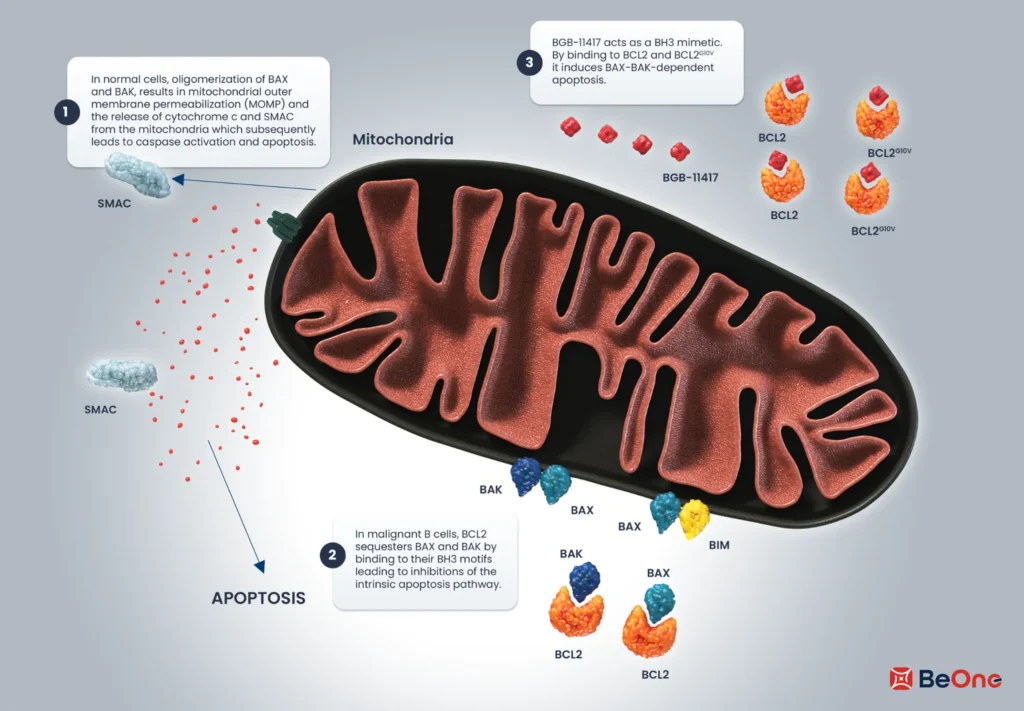
The clinical pipeline also extends beyond zanubrutinib. Sonrotoclax, a BCL2 inhibitor, received its first global approvals in China in late 2025. The NDA is supported by a Phase 1/2 study that enrolled 125 patients who had received prior BTK inhibitor treatment.
Sonrotoclax also received Breakthrough Therapy Designation earlier in 2025, and BeOne Medicines plans to participate in the FDA’s Project Orbis for the asset.
On May 13, 2026, the U.S. FDA granted accelerated approval to sonrotoclax, marketed as Beqalzi, for certain adults with relapsed or refractory mantle cell lymphoma after at least two prior systemic therapies, including a BTK inhibitor.
BGB-16673, a BTK protein degrader developed from the company’s proprietary CDAC platform, is in Phase 1b/2 development as part of the CaDAnCe-104 master protocol study. A BTK degrader offers a different mechanism of action than a BTK inhibitor, which matters for patients who develop resistance to BRUKINSA or other inhibitors in the class.
The strategic relevance is clear. BeOne Medicines is building a hematology franchise with multiple shots on goal. If sonrotoclax wins approval and BGB-16673 succeeds in later-stage trials, the company controls a sequence of treatments that can address patients across lines of therapy.
The move to Switzerland did not remove China from the company.
BeOne’s current China infrastructure includes a Beijing R&D center, a Shanghai R&D center, Suzhou operations and a Guangzhou manufacturing campus. Its Guangzhou site reports 65,000 liters of biologics cell-culture capacity and dedicated antibody-drug conjugate development and production capabilities.
At the same time, BeOne is increasing production capacity outside China. In July 2026, the company announced another $300 million for its Hopewell, New Jersey site, taking its stated U.S. manufacturing investment above $1 billion. The expansion is planned to add small-molecule manufacturing and approximately 120 full-time positions.
That combination is more instructive than a simple China-versus-America framing. BeOne has retained Chinese R&D and manufacturing scale while adding substantial capacity close to other major markets.
BeOne should not be treated as proof that every Chinese biotech model will travel globally. It does, however, sit inside a broader change that became hard to ignore in 2025.
Chinese licensors accounted for 40% of assets in-licensed by big pharma during 2025. The aggregate potential value of therapeutic in-licensing agreements involving Chinese-originated assets, excluding AI-focused agreements, reached $105 billion.
These figures refer to potential deal values, which can include large milestone payments that may never be triggered. They should not be read as $105 billion of cash already invested.
A 2025 Nature review reached a suitably balanced conclusion. It documented major progress in Chinese innovative drug development while stating that the United States continued to lead in first-in-class therapies and breakthrough technologies.
China has also continued regulatory reform. In September 2025, the National Medical Products Administration established a pathway under which qualifying innovative-drug clinical trial applications can be reviewed within 30 working days. Eligible programs include selected globally synchronized development projects.
The strategic lesson is narrower and more useful: China has become an important place to source assets, run development programs, and build scientific companies at speed. Global success still depends on international clinical evidence, regulatory execution, quality manufacturing and commercial access.
BeOne Medicines has used partnerships to fund growth without diluting equity.
The August 2025 Royalty Pharma agreement transferred a significant portion of the company’s rights to royalty payments from Amgen’s IMDELLTRA for up to $950 million, including an $885 million upfront payment. BeOne Medicines retains royalties on sales above $1.5 billion and rights to other Amgen collaboration assets.
In December 2025, BeOne Medicines entered a clinical supply agreement with Senhwa Biosciences. Under the agreement, BeOne Medicines will supply tislelizumab, its PD-1 inhibitor, for a Phase 1b/2a trial.
That trial combines Senhwa’s CX-5461 with tislelizumab in advanced solid tumors, including pancreatic ductal adenocarcinoma and immune checkpoint inhibitor-refractory melanoma.
Companies studying China can learn more from operating systems than from headline rankings.
BeOne’s trajectory highlights four principles: keep critical research capabilities close to the organization, connect clinical development across regions early, build manufacturing before demand becomes a constraint, and treat international regulatory capability as part of product development, not an afterthought.
China contributes research talent, development infrastructure, manufacturing density and a large clinical ecosystem to that equation. The U.S., Europe and other markets contribute their own scientific institutions, capital, regulatory systems, talent and commercial demand.
That is why BeOne is a useful China case. Its story shows that no single market has all the answers. It shows how capabilities developed in China can become part of a genuinely global operating model.
If your interest in BeiGene forms part of a wider effort to understand what global companies can learn from China’s innovation system, ChoZan works at that intersection.
At ChoZan, we currently offer China research, digital transformation consulting, expert dialogues, keynotes and workshops, plus China Learning Expeditions and Innovation Tours that bring teams closer to Chinese companies, technologies and operating models. Our research library also includes the China Mega Report and dedicated technology reports.
The useful question is not simply, “What is China doing?” It is, “Which parts of China’s speed, experimentation and commercialization model can improve our own decisions?”
To discuss how we can help your organization learn from China’s innovation ecosystem, book a consultation with our team.
BeOne Medicines Ltd. is incorporated in Switzerland, and its 2026 SEC filing lists its principal executive office in Basel. Its operational footprint remains international, with substantial teams and facilities in China and the United States.
BeOne Medicines is a global oncology company formerly known as BeiGene. It discovers, develops, and commercializes cancer treatments, with a portfolio spanning hematology and solid tumors. Its lead product is BRUKINSA, a BTK inhibitor.
BeOne Medicines has collaborations with Amgen and Senhwa Biosciences, among others. It also entered a clinical supply agreement in 2025 to test tislelizumab in combination with CX-5461.
BeOne Medicines trades on Nasdaq under ONC. It also has listings in Hong Kong under 06160 and Shanghai under 688235. The Nasdaq identity changed as part of the company’s 2025 corporate transformation.
BRUKINSA is BeOne’s brand name for zanubrutinib, a small-molecule Bruton tyrosine kinase inhibitor used for several B-cell malignancies. It has become BeOne’s largest commercial product and generated $3.9 billion globally during 2025.
TEVIMBRA, or tislelizumab, is BeOne’s PD-1 antibody for cancer treatment. During 2025, BeOne reported additional regulatory approvals and reimbursement progress for the medicine across the United States, Europe, China, Japan and other markets.
Yes. The FDA granted accelerated approval to sonrotoclax, sold as Beqalzi, on May 13, 2026, for certain adults with relapsed or refractory mantle cell lymphoma following at least two systemic therapies, including a BTK inhibitor.
Yes. Current company information lists research facilities in Beijing and Shanghai plus additional Chinese operations. China therefore remains an important component of BeOne’s research, clinical, manufacturing and commercial organization after the company’s Swiss redomiciliation.
BeOne reported more than 40 clinical and commercial assets under exploration as of August 2026. Its work spans hematologic cancers and solid tumors across small molecules, protein degraders, antibodies, ADCs and other treatment modalities.
The practical lesson is organizational. China can provide rapid scientific iteration, manufacturing capacity and clinical-development depth, while international scale still requires multi-country evidence, regulatory credibility, market access and local production strategies tailored to major commercial regions.