CONTENT

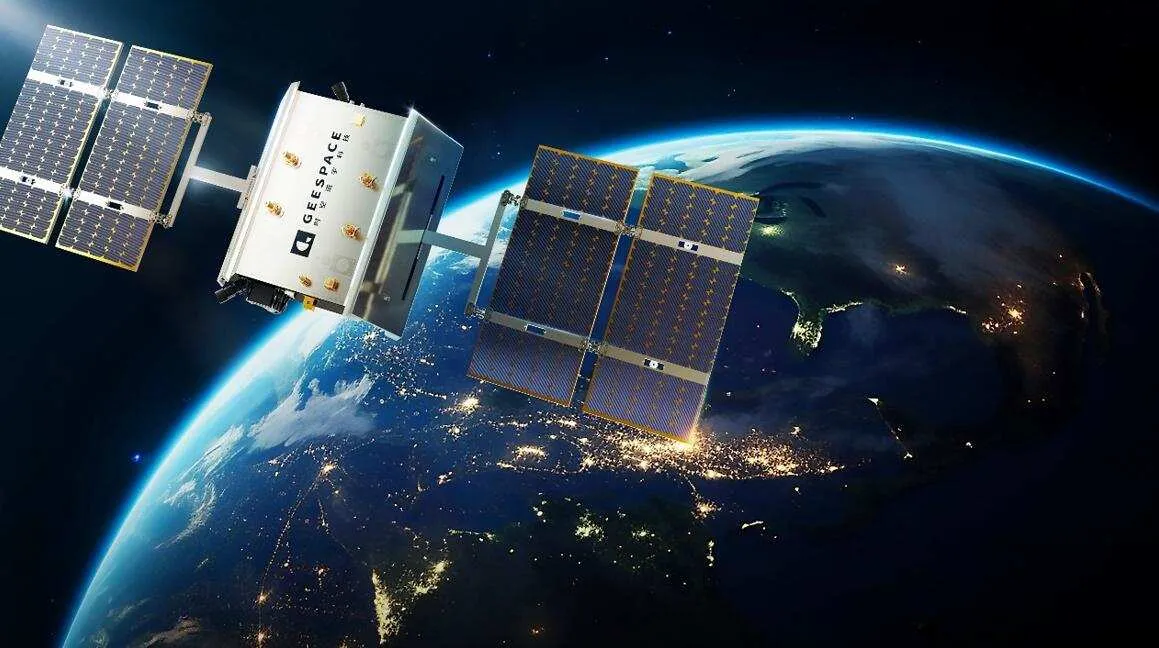
The China Lunar Mission roadmap connects robotic exploration, a planned astronaut landing before 2030, and a basic International Lunar Research Station targeted for 2035. These remain distinct milestones.
Chang’e-7 has missed its planned 2026 launch window, while Chang’e-8 still has a published target around 2029. Official updates separate current progress from future ambitions.
The significance extends beyond reaching the Moon. China’s program offers a case study in coordinating scientific research, autonomous machines, energy systems, and international participation. Its most useful lessons concern how those capabilities fit together and which still require proof.
The Chinese lunar program now spans several development tracks. This distinction matters because a successful component test does not establish readiness for an entire expedition.
| Mission or system | Latest verified position | What it establishes |
| Chang’e-6 research | Peer-reviewed findings published in 2025 | New evidence about the Moon’s interior |
| Chang’e-7 | August 23, 2026 notice ruled out the planned launch window | Schedule revision, with no replacement date in that notice |
| Chang’e-8 | Published launch target around 2029 | Planned resource-use experiments and international payloads |
| Crewed landing | Official target remains before 2030 | A development objective, with major tests still ahead |
| International Lunar Research Station | Basic configuration targeted for 2035 | A planned research facility, not an operating base |
An announcement, a ground test, a flight demonstration, and routine operation represent different levels of evidence. Any assessment of the China moon program should identify which level a claim describes.
The Chang’e program continues to produce knowledge through laboratory analysis. A 2025 Nature study examined Chang’e-6 lunar samples and estimated water concentrations in their mantle source at approximately 1 to 1.5 parts per million.
The researchers concluded that this source region was potentially drier than its near-side counterpart. Their finding adds evidence about uneven water distribution inside the Moon.
That result needs careful interpretation. Water inferred from minerals in volcanic rocks reflects a different phenomenon than accessible ice in polar ground. It cannot establish the volume, location, or extraction cost of a future water supply.
This is where lunar science contributes practical discipline. A resource claim needs a location, measurable concentration, and a workable recovery process. The business lesson is to examine what an experiment actually measured before attaching a commercial forecast.
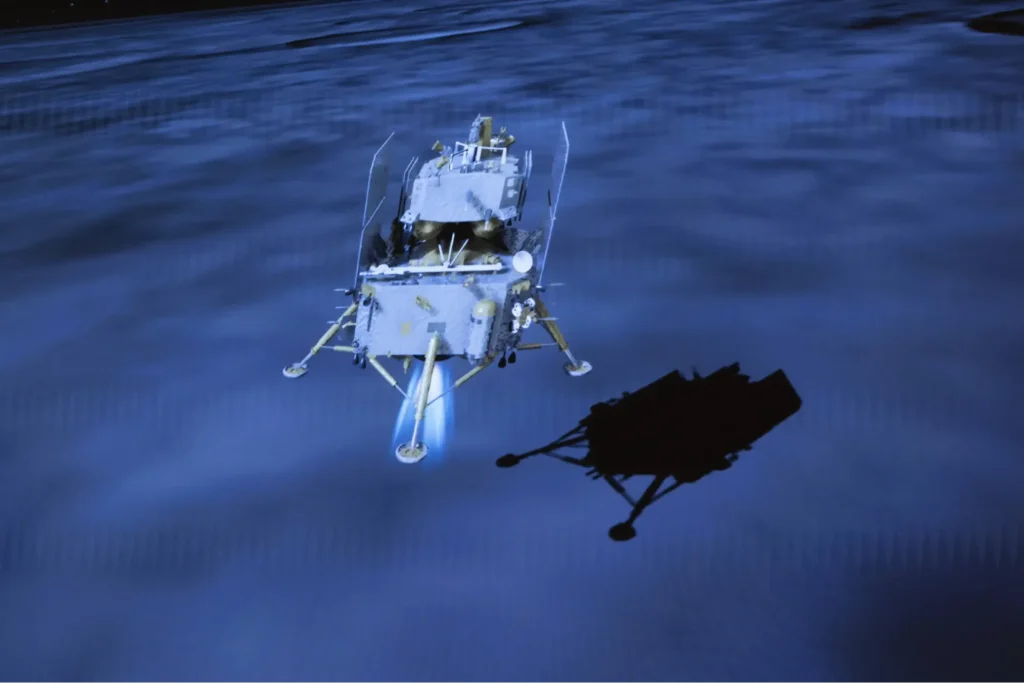
Chang’e-7 aims to investigate the lunar south pole through orbiting, landing, surface travel, and hopping. A July 2026 mission update identifies precision landing, legged movement, and exploration of permanently shadowed craters among its technology objectives.
That combination matters because different instruments must reach different terrain. Orbital observations provide context; surface equipment investigates conditions directly. A hopping vehicle adds access options beyond the routes available to wheeled lunar rovers.
Site selection also depends on local conditions. In research reported in March 2026, Chinese scientists modeled illumination, soil temperatures, and potential ice stability around Shackleton crater.
Such models guide exploration toward promising locations. They do not replace on-the-ground measurements or prove an economically recoverable deposit.
The launch delay adds a separate constraint. The official August notice said launch conditions were unmet after a combined assessment. It supplied neither a detailed technical cause nor a revised date.
Chang’e-8 moves the discussion toward testing how equipment and local resources could serve longer missions. CNSA, the China National Space Administration, announced in April 2025 that it had selected ten international cooperation projects.
Chang’e-8 is planned for launch around 2029, with a targeted landing on the Leibnitz-Beta Plateau near the lunar south pole. Its resource-use experiments are intended to inform the future research station.
One selected project combines a multifunctional surface robot with a mobile charging station. In December 2025, HKUST described its leadership of the Hong Kong Operation Robot project.
Planned tasks include transporting instruments, deploying equipment, and collecting samples with two robotic arms. These remain design objectives.
Its significance lies in its focus on operations after delivery. Once they reach the surface, instruments need placement, power, and coordination. A servicing machine could connect those tasks within emerging lunar infrastructure.
For technology assessment, this suggests specific questions:
Answers to these questions would provide stronger evidence of the robot’s operational capabilities than a promotional demonstration alone.
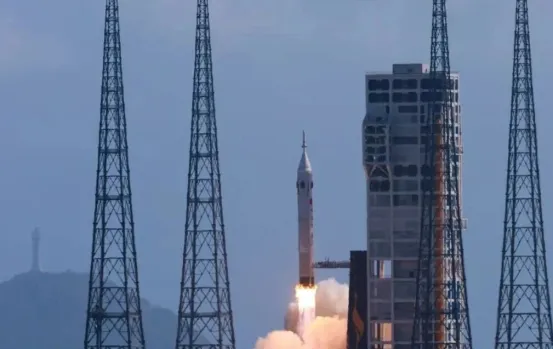
China’s crewed lunar missions require their own transport and safety systems. The main vehicles under development include the Long March 10 rocket, Mengzhou spacecraft, and Lanyue lander.
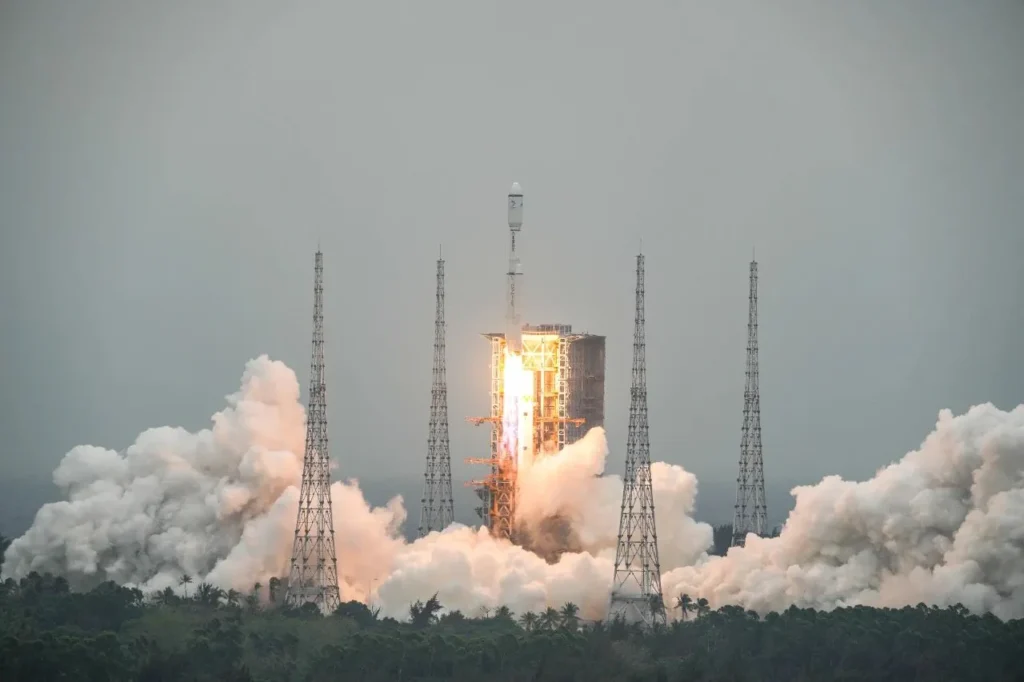
On February 11, 2026, China completed a low-altitude rocket demonstration and Mengzhou abort test. The abort occurred under maximum aerodynamic pressure, a demanding stage of atmospheric flight.
An abort test evaluates emergency escape performance. It does not validate the full journey, lunar descent, surface stay, ascent, and return.
A May 2026 official briefing retained the landing target before 2030 and identified further rocket verification and first flights of Mengzhou and Lanyue among forthcoming tasks.
For anyone tracking a Chinese lunar landing, those completed tests deserve more weight than confident countdowns. Human spaceflight adds safety requirements that robotic missions cannot settle on their own.
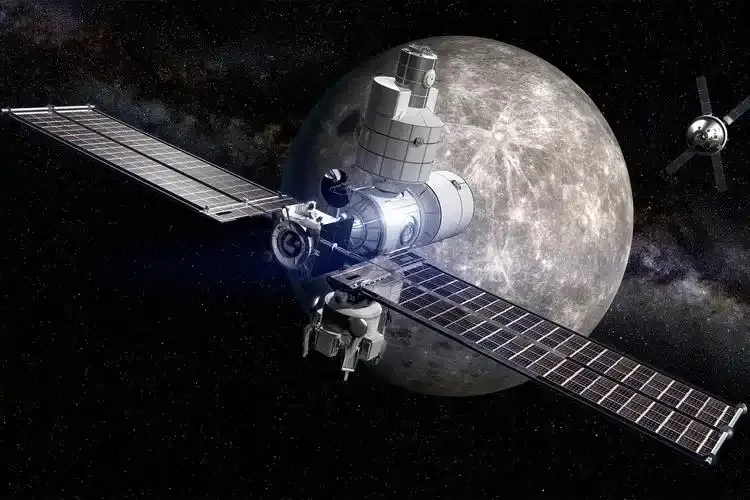
The International Lunar Research Station has a more specific operating concept than the phrase “Moon base” suggests.
In a 2025 interview published by CNSA, chief lunar designer Wu Weiren described long-term autonomous operation with short periods of human participation. He outlined a basic configuration by 2035 and an expanded configuration by 2045.
That description does not establish continuous human occupation from 2035. It places autonomous equipment at the facility’s center.
The planned system includes transport, power, communications, navigation, control, and scientific operations. Its feasibility therefore depends on coordination across these functions. Reliable equipment must also remain maintainable after deployment.
A useful readiness assessment asks how the facility would handle power interruptions, equipment failures, replacement deliveries, and degraded communications. A target date alone answers none of those questions.
A less visible change concerns organization. In May 2026, officials confirmed integration of robotic and crewed efforts across missions, resources, and teams into a unified exploration project.
The strategic implication is closer coordination between scientific objectives and the systems needed to pursue them. That offers a concrete example of China’s capacity to organize complex technology development.
It also suggests a practical way to study the sector: identify the institution, its assigned task, the latest completed test, and the remaining dependency.
International participation deserves the same precision. A selected scientific payload creates a defined research relationship. It does not establish unrestricted commercial access or guaranteed supplier revenue.
The strongest lessons from Chinese moon missions lie in engineering coordination and the evidence produced along the way. Commercial applications on Earth still need their own customers, costs, and performance validation.
The China Lunar Mission offers a starting point for understanding how China connects scientific research with complex engineering. ChoZan’s reports provide broader context on the country’s technology and business developments.
For a closer look at questions relevant to your organization, ChoZan offers tailored research and expert dialogues. Book a consultation to discuss what your team wants to understand and which areas warrant further study.
Start with CNSA and the China Manned Space Agency, then compare their dated announcements. For a China Lunar Mission launch update, prioritize the newest mission-specific notice over undated summaries, launch calendars, or older planning documents.
Yes. CNSA approved a second batch of international sample loans in April 2026, covering three institutions. Access follows an application and expert-review process, so researchers should check current calls, eligibility requirements, and submission deadlines.
The 2025 call directed applicants to the official Lunar Sample Release System and required them to submit application materials. That round closed on November 30, 2025. Researchers should consult newer notices before preparing an application.
The agency’s 2025 announcement reported 41 expressions of interest. Experts assessed scientific objectives, engineering innovation, and partnership diversity. The selection process consolidated fourteen projects into ten final projects for the planned mission.
The 2025 selection includes contributions from Pakistan, Türkiye, South Africa, Peru, Italy, Russia, Thailand, Bahrain, Egypt, and Iran, as well as Hong Kong institutions. Contributions differ by project, and some instruments involve teams from multiple countries.
A May 2026 briefing identifies astronaut experience, technology experiments, and shared spacecraft development as contributions. Station missions provide opportunities to test relevant systems before longer journeys, although each lunar vehicle still requires its own verification.
HKUST identifies radiation, dust, temperature extremes, and limited computing power and energy among the challenges. Its planned robot must coordinate movement and manipulation under those constraints, so autonomy requires careful task prioritization and fault management.
Yes. The published scientific objectives include astronomy from the Moon, observations of the Sun-Earth-Moon environment, and fundamental physics experiments. The planned facility would therefore serve several research fields alongside studies of local materials and resources.
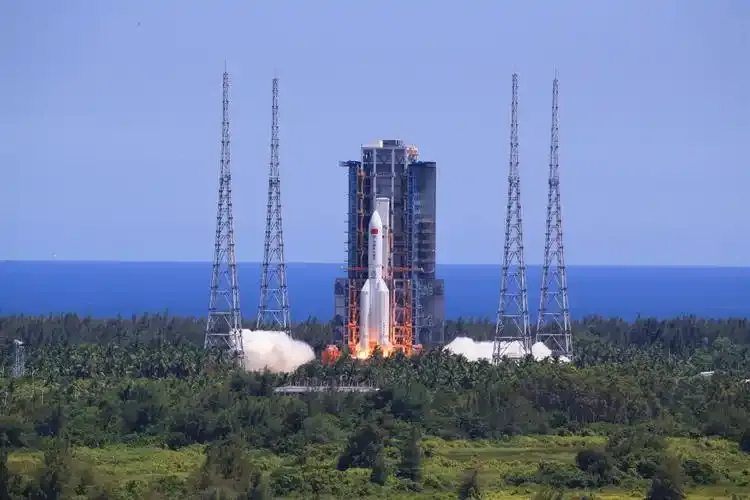
The Long March 5 Y14 rocket is assigned to Chang’e-7. An official July 2026 update documented its arrival at Wenchang. Hardware delivery indicates preparation progress, but does not confirm launch authorization or a departure date.
No. A space experiment establishes performance within its tested conditions. A terrestrial product still needs an identifiable buyer, suitable pricing, repeatable manufacturing, and service arrangements. Assess those factors separately before treating a mission announcement as evidence of market demand.