CONTENT

China’s industrial automation landscape reached a defining inflection point in 2025. The country’s mobile robotics sector recorded sales of 261 billion yuan, with 182,000 units shipped across factory floors and distribution centers.
Within this broader category, the autonomous mobile robot segment delivered the most striking performance. AMR sales alone hit 102,000 units in 2025, a fivefold increase from the 19,900 units recorded in 2021. This trajectory signals more than market growth. It reflects a fundamental restructuring of how goods move through China’s logistics ecosystem and, increasingly, the world’s.
The shift from guided vehicles to truly autonomous mobile robots marks a decisive break from past automation paradigms. Traditional automated guided vehicles depend on magnetic tape, reflectors, or QR codes fixed to the floor.
AMR robots operate differently. They perceive their environment in real time, build maps on the fly, and choose their own paths. This capability transforms warehouse operations from rigid metal conveyor belts into adaptive, intelligent systems that respond to change without downtime for reconfiguration.
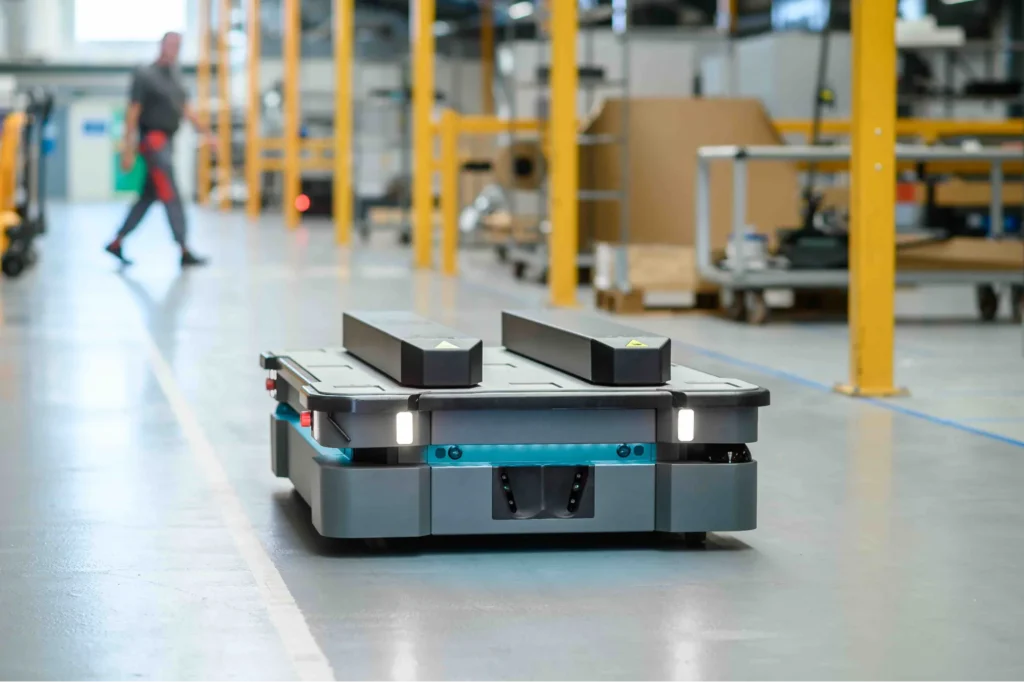
China’s demand for flexible logistics automation stems from high transaction volumes, shorter fulfillment windows, and factories requiring more precise internal flows. The State Council’s 2025 AI Plus policy called for wider use of intelligent manufacturing equipment and stronger coordination of the industrial supply chain.
Shanghai’s 2025 embodied intelligence plan also names parcel sorting, warehouse handling, last-mile delivery, and industrial material handling as priority scenarios.
These policies support commercial deployment at scale. China’s logistics platforms, manufacturers, and robotics suppliers can test systems in dense environments and turn successful workflows into repeatable products.
For operators, AMR automation sits between manual movement and highly fixed infrastructure. Fleets can expand in stages, routes can change with the layout, and several robot types can operate under a single control layer.
An autonomous mobile robot combines perception, localization, route planning, and task execution. Hardware carries the load. Software determines the robot’s position, destination, and response to activity around it.
Many current mobile robots use LiDAR, cameras, inertial sensors, or a combination of these technologies. SLAM navigation lets a robot build or update a map while estimating its position.
Current Geek+ systems combine LiDAR, visual SLAM, and inertial navigation. Some ForwardX models support laser SLAM and visual semantic positioning.
The sensor layer supports dynamic routing and obstacle avoidance. A robot can slow down, stop, or select another path when people, pallets, forklifts, or temporary obstructions affect its route. Site design still matters because narrow intersections, poor floors, and congested work zones can reduce performance.
A single AMR robot can automate one transport task. A fleet needs orchestration. Fleet software allocates missions, manages traffic, balances charging, prevents deadlocks, and connects robot activity with warehouse or production priorities.
This is where AMR robotics becomes commercially important. The control layer may connect with a WMS, WES, MES, ERP, or logistics execution system. Orders, replenishment requests, and production calls can then trigger robot missions.
Quicktron’s 2025 QuickMix model coordinates bin, shelf, pallet, dense storage, and material-handling workflows through a single scheduling layer.
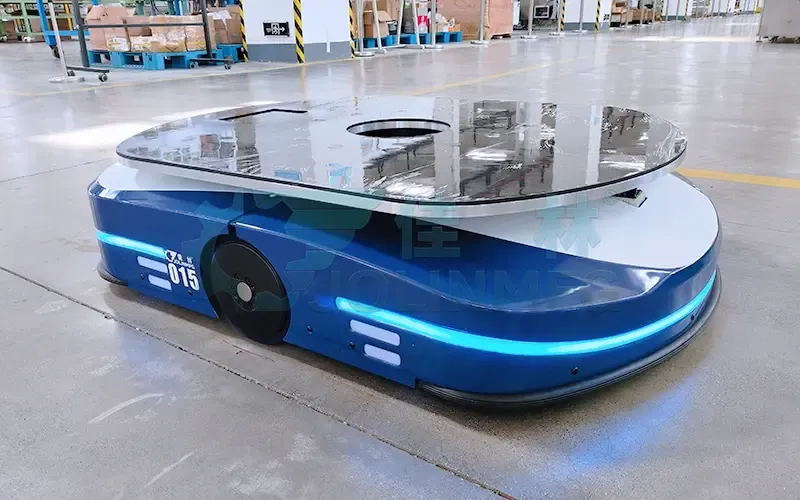
In goods-to-person workflows, AMR robots bring shelves, racks, totes, or inventory units to a workstation. Workers spend less time walking and can focus on picking, checking, packing, or exception handling.
This form of fulfillment automation depends on the full process. Workstation design, inventory slotting, order batching, and robot traffic all shape throughput.
A fast fleet cannot fix poor inventory accuracy or an overloaded packing area. Strong projects treat warehouse AMR deployment as a flow redesign.
Factories use AMR for material handling, including parts delivery, work-in-progress movement, rack transport, line-side replenishment, empty container returns, and pallet transfer. Timing matters because a late delivery can interrupt production.
It was reported that a 2025 deployment of 435 AMRs at Chery’s Dalian factory had covered welding and assembly operations. The project used different robot families for smaller deliveries, heavy loads, and towing tasks. Its scale shows how Chinese manufacturers are moving toward coordinated intralogistics networks.
One facility may use shelf carrying units for picking, autonomous forklifts for pallets, tote robots for dense storage, and transport units for dock or production movement. Each robot should match the load, route, and service level of its task.
A unified fleet layer can reduce the fragmentation that appears when separate automation islands use different rules and interfaces. This mixed fleet approach has become a defining direction in Chinese mobile robotics.
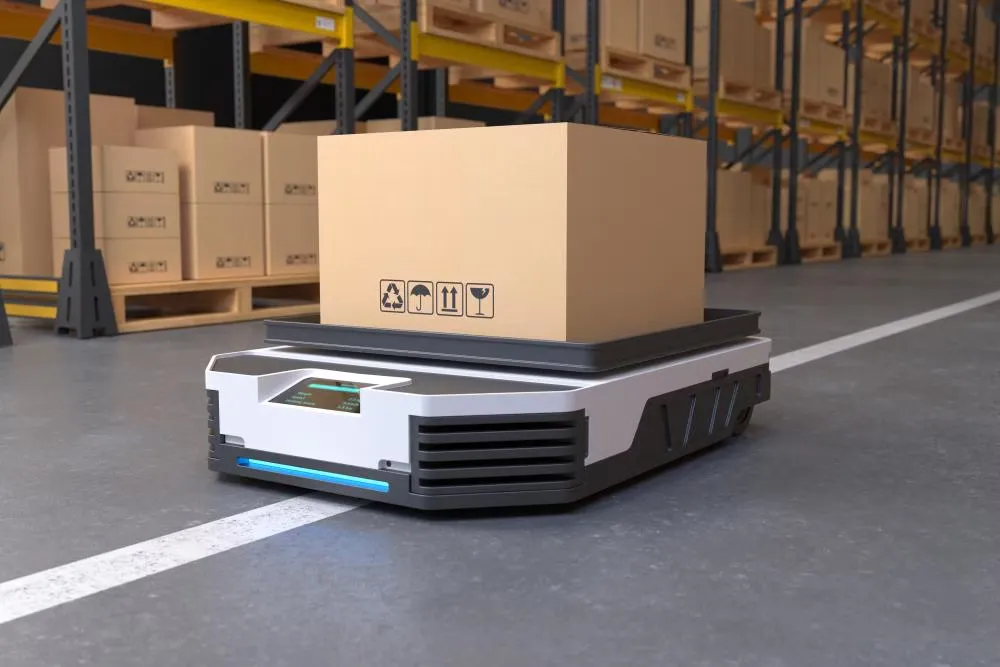
Start with the operating problem. Measure travel, queue time, labor allocation, missed moves, replenishment delays, and congestion. Then identify tasks that can become standardized robot missions.
Review five areas before procurement:
The strongest business case links robot missions to site-level outcomes. Throughput per hour, order cycle time, labor hours per unit, intervention rate, uptime, and cost per movement provide a clearer view than robot speed alone.
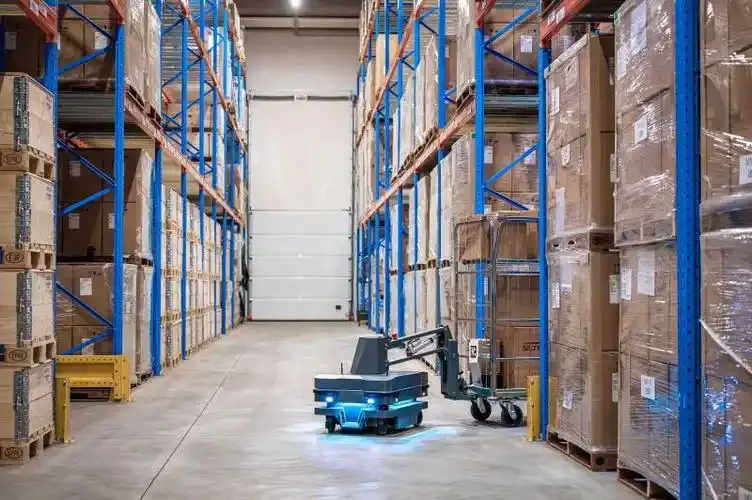
Chinese AMR robot companies have translated domestic scale into global competitive positioning. Geek+, which was listed on the Hong Kong Stock Exchange in July 2025, raised 2.71 billion Hong Kong dollars in the largest robotics IPO in the exchange’s history. The company has held the position of the largest global仓储履约 AMR provider by revenue for six consecutive years.
Its international revenue share exceeded 70 percent in 2024, with operations across more than 40 countries. The company has deployed over 30,000 AMR units globally and serves approximately 806 end customers, including 63 Fortune Global 500 enterprises.
The export trend extends beyond individual companies. Chinese mobile robotics export order share climbed from 25.87 percent in 2022 to over 40 percent in 2025. Aggregate overseas sales for Chinese AGV and AMR companies reached 8.5 billion yuan in 2025, a 25 percent year-over-year increase. This export share now represents approximately one-third of total industry sales.
The international expansion reflects a shift in competitive positioning. Chinese manufacturers are no longer competing primarily on cost. They are exporting integrated solutions that combine hardware, software, and deployment expertise.
The domestic market’s demanding logistics environment served as an effective proving ground. Companies that solved China’s complex warehousing challenges found themselves well-equipped for global markets.
Chozan helps global companies understand how autonomous mobile robots, warehouse automation, AI, and smart logistics are developing across China. Our research connects policy, technology, company activity, and operating models to practical market decisions. Explore China market intelligence, competitor analysis, and strategic advisory for a sharper view of logistics automation.
Book a consultation with Chozan.
Autonomous mobile robots use onboard perception and software to map environments, select routes, and react to obstacles. Traditional AGVs usually follow predefined paths or guidance infrastructure, so they are better suited to more stable and predictable transport flows.
Most AMR fleets need reliable wireless connectivity for task dispatch, traffic coordination, monitoring, and system integration. 5G is not always required. Some current platforms use Wi-Fi as standard and offer cellular connectivity as an option.
Yes. AMRs can exchange tasks and handoffs with conveyors, storage systems, lifts, workstations, and robotic arms through warehouse software and equipment interfaces. The integration design should define ownership of each task and exception.
No. A WMS manages inventory, orders, and warehouse rules, while fleet software manages robot missions and traffic. The two systems exchange instructions and status data so physical movement follows business priorities.
There is no standard fleet size. The right number depends on travel distance, mission volume, payload, charging strategy, congestion, peak demand, and target cycle time. Simulation and a measured pilot provide a stronger estimate.
Most mobile robots perform best on flat, clean, stable floors with controlled gaps, slopes, and thresholds. Site surveys should also check aisle width, turning space, drainage, debris, lighting, and wheel traction.
AMRs commonly return to charging stations automatically when battery levels or fleet demand reach configured thresholds. Fleet software can schedule opportunity charging during quieter periods so that enough robots remain available for active missions.
Buyers can overlook software integration, mapping, safety equipment, chargers, wireless upgrades, floor repairs, workstation changes, training, spare parts, and ongoing support. A credible model should include ramp-up time and expected maintenance.
Yes. Robotics as a Service can shift some upfront spending into recurring fees that may include hardware, software, support, and maintenance. Contract review should cover usage limits, service levels, upgrades, data access, and exit terms.
Yes. AMR automation can route returned goods to inspection, sorting, restocking, or resale workflows. The main design challenge is exception handling because the return condition, packaging, and disposition can vary more than standard outbound orders.