CONTENT

China’s manufacturing base has become the gravitational center of global automation. In 2025, Chinese companies shipped roughly 80 % of the world’s humanoid robots and accounted for over 70 % of industrial robot installations. That momentum continued into 2026 as national policy and market forces converged.
The robotic welding sector stands at the heart of this trend because welding is both labor-intensive and safety-critical. This article explores the latest technologies, market dynamics, and supplier strategies in robotic welding and guides manufacturers seeking to adopt or expand welding automation in China.
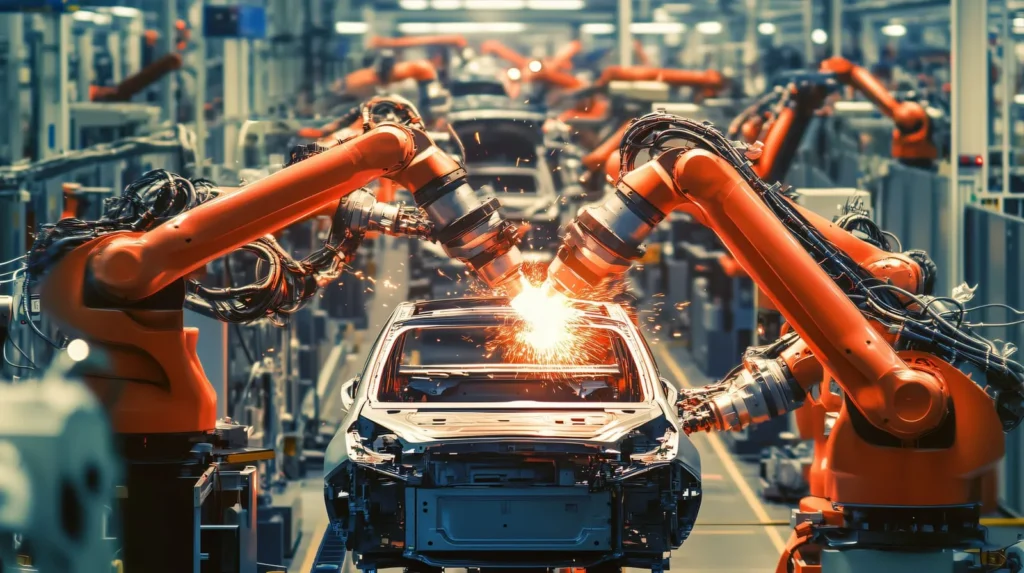
The Silicon Valley Robotics Center (SVRC) report on China’s robotics market notes that the domestic robotics market reached $14.2 billion in 2026 after growing 47% in a single year.
This surge correlates with a 2025 installation of approximately 276 000 industrial robots, representing more than 70 % of global installations.
Chinese manufacturers are not only leading the adoption of automation but are also competing effectively against international suppliers. They supply over 92 % of the domestic cobot market and offer competitive costs—typically 20–40 % lower than comparable Japanese or European brands.
Beijing’s 2025 Humanoid Robot Action Plan aims to deploy 1,00,000 humanoids by 2027, and the Robot+ and AI+ Manufacturing initiatives set ambitious targets to double robot density and expand embodied AI applications.
The Mercator Institute for China Studies notes that China’s robot expansion is driven by a manufacturing chain dominated by the automotive and electronics sectors, as well as by economic and social pressures stemming from a growing labor shortage and rising labor costs.
Chinese policymakers view embodied AI as a solution to these challenges and have invested CNY 1 trillion in venture capital to support domestic robotics firms.
China’s robotics ecosystem benefits from an integrated supply chain concentrated in the Yangtze River Delta. Component manufacturers such as DJI and DeepSeek are located within a two‑hour radius of robot assemblers, enabling rapid prototyping and cost‑effective production.
This integration shortens development cycles—prototypes of robotic arms can be built in 10–14 days in Shenzhen, as opposed to 12 weeks in the US or Germany. Such speed advantages, combined with state‑backed demand from EV giants BYD, CATL, and Foxconn, make China a strategic hub for robotic welding systems.
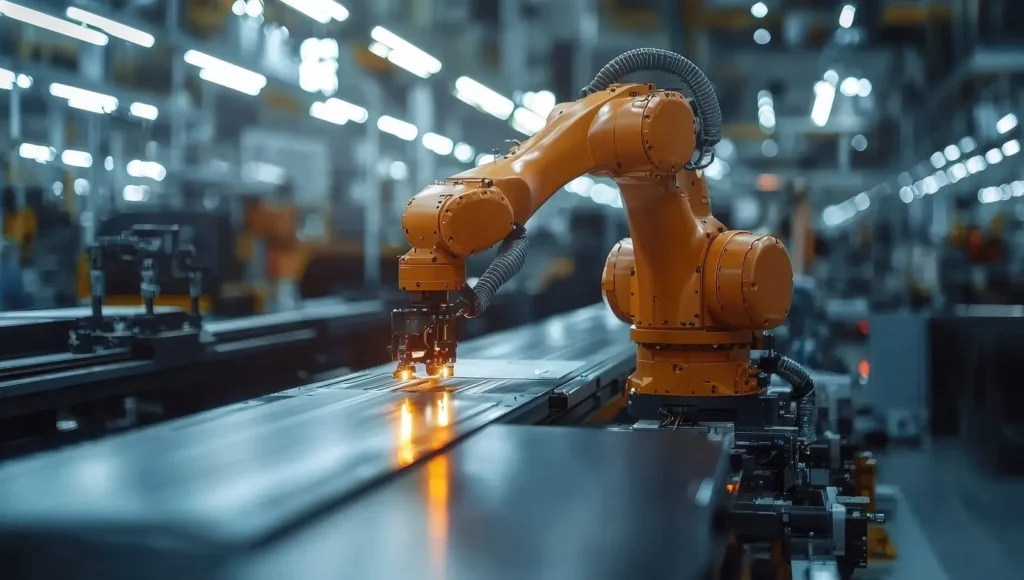
Robotic welding refers to programmable systems that execute welds with minimal human intervention. Modern installations rely on integrated production cells with robotic arms, power sources, positioners, fixtures, and safety enclosures. Multiple welding processes are available; choosing the right one depends on material, thickness, production volume, and quality requirements.
MIG (Metal Inert Gas) or MAG (Metal Active Gas) welding dominates robot welding installations worldwide, accounting for roughly 70 % of all applications. Robots feed a continuous wire electrode while shielding gas protects the arc, allowing travel speeds of 800–1 500 mm/min on structural steel.
This process offers high deposition rates and a balance of speed and penetration, making it ideal for automotive welding, agricultural machinery, and general metal fabrication. The main trade‑off is surface finish—post‑weld grinding is often needed for aesthetic applications.
TIG (Tungsten Inert Gas) welding uses a non‑consumable tungsten electrode with separate filler wire to produce superior aesthetic quality and penetration control. Robotic TIG welding is essential for aerospace components, pharmaceutical equipment, and food‑grade stainless steel applications where weld integrity is paramount.
However, travel speeds of 200–500 mm/min indicate that TIG is slower than MIG and requires precise joint preparation. It is justified when high-value or inspection‑grade welds are required.
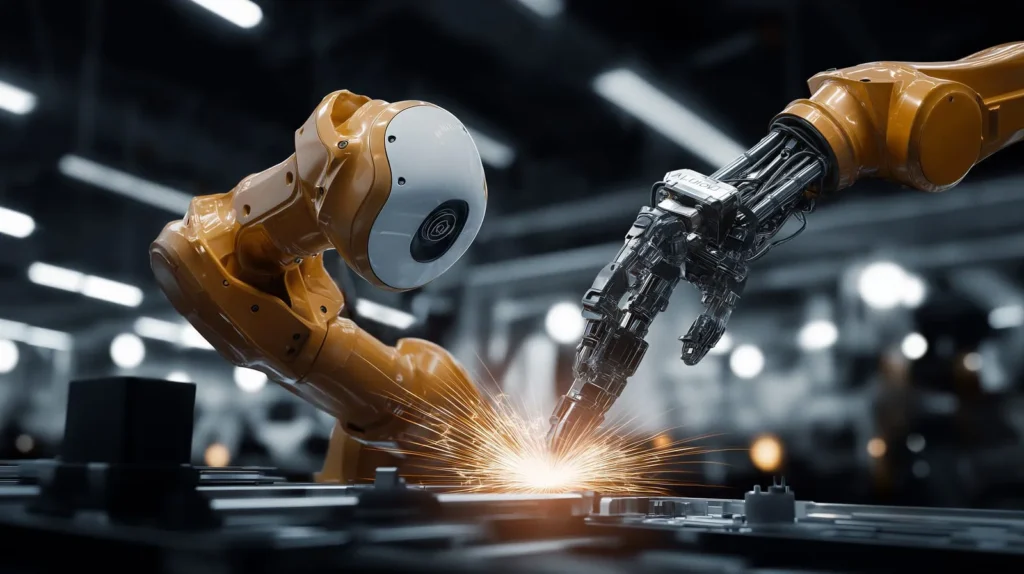
Laser welding offers the highest speeds (3 000–8 000 mm/min) and minimal heat input, producing narrow, deep welds suitable for thin‑sheet automotive panels, battery enclosures, and precision assemblies. Equipment costs are higher—laser cells may cost two to four times as much as MIG cells—but the speed advantage yields a strong ROI in high‑volume production.
Laser‑hybrid welding combines a laser beam with an MIG arc in the same weld pool. This hybrid process delivers laser‑like penetration while bridging gaps with filler metal. It is increasingly used for thick‑section steel in shipbuilding and heavy structural projects.
Resistance spot welding remains the primary method for body‑in‑white assembly. Automotive vehicles typically require 3 000–5 000 spot welds, each applied by welding robots at cycle times of 1–3 seconds. Spot welding robots are mature technologies with established quality monitoring and electrode management systems. They excel at joining overlapping sheet metal but are limited to lap joints and conductive materials.
In addition to the main processes above, some niche applications employ plasma welding, friction stir welding, and submerged arc welding. The process selection matrix summarises typical speeds and material ranges:
| Process | Speed (mm/min) | Material Thickness (mm) | Best For |
| MIG/MAG | 800–1 500 | 1–30 | General fabrication, automotive frames |
| TIG | 200–500 | 0.5–8 | Aerospace, food‑grade, thin materials |
| Laser | 3 000–8 000 | 0.3–12 | Automotive body panels, battery enclosures |
| Laser‑Hybrid | 1 500–4 000 | 3–20 | Shipbuilding, thick plates |
| Spot | 1–3 sec/spot | 0.5–4 (per sheet) | Body‑in‑white assembly |
This table emphasizes that each process has a distinct niche. For many Chinese manufacturers, arc welding using MIG/MAG remains the workhorse for welding automation, yet laser and hybrid solutions are gaining traction in high‑value applications.
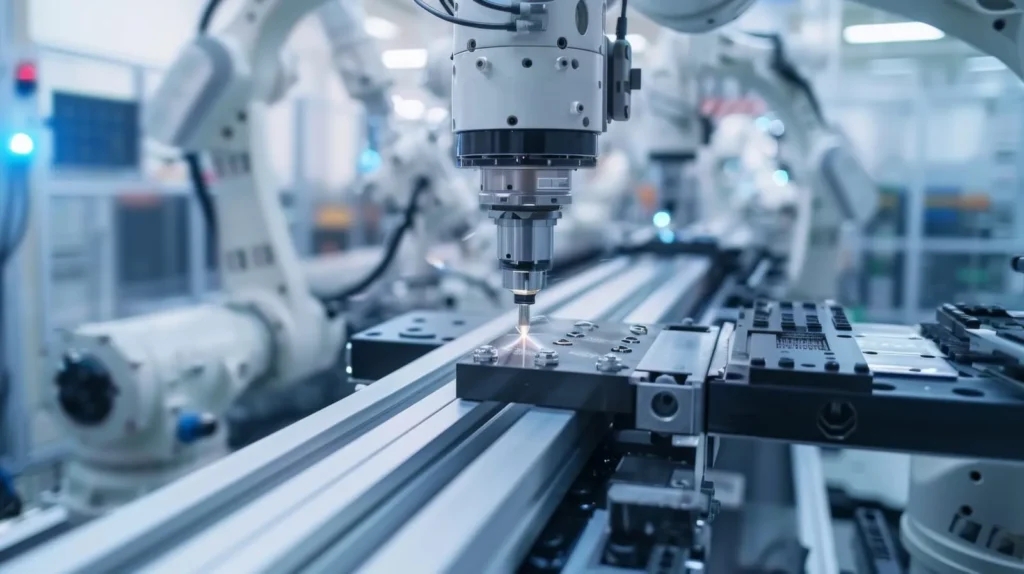
A robotic welding machine is more than a robot arm. Complete systems include power sources with pulsed capability, synergic programs for different wire–gas combinations, and real‑time arc monitoring.
Positioners rotate the workpiece to maintain optimal joint orientation, reducing defects. Well‑designed fixtures hold parts precisely and help deliver consistent paths. Safety systems use fencing, interlocks, light curtains, and fume extraction to protect operators. Automated torch cleaning stations maintain gas flow and wire feeding for continuous production.
Quality assurance has evolved rapidly. Closed‑loop control systems now monitor arc characteristics and adjust trajectories in real time to correct deviations. Visual and laser seam tracking solutions resist spatter and arc light, enabling precise joint following.
AI‑driven inspection analyses large volumes of sensor data to detect defects early, shortening the detection-to-correction cycle. Digital traceability is shifting from paper protocols to machine‑readable records, with platforms like Fronius WeldCube providing structured weld data for audits.
Safety standards have also advanced. Updated ISO 10218‑1:2025 and ISO 10218‑2:2025 frameworks emphasize risk assessment, protective features, and documentation for new installations. In collaborative environments, compliance with ISO/TS 15066 is essential. These standards help manufacturers manage hazards while adopting flexible automation.
The welding monitoring market is booming. Industry forecasts cited by Xiris project that global real‑time welding monitoring revenue will grow from $1.76 billion in 2025 to over $4.14 billion by 2035, at an 8.6 % CAGR.
Real‑time data has become essential in automotive, aerospace, and oil & gas sectors. Asia‑Pacific adoption is accelerating due to manufacturing expansion.
Machine vision systems integrated with AI can identify weld status, monitor morphology, and adjust parameters, leading to more consistent bead profiles and fewer defects. The combination of robotics and vision technology creates smarter robotic welding systems that can adapt instantly to process variations.
China’s automotive sector remains the largest adopter of welding robots. Body‑in‑white assembly uses spot welding for sheet metal, while MIG and laser processes join chassis components, battery enclosures, and exhaust systems.
Strict quality regimes, such as IATF 16949 and statistical process control, govern these cells. As electric vehicles proliferate, laser and hybrid welding are being adopted to handle new battery architectures and lightweight materials.
Robotic MIG welding excels in structural fabrication, including steel beams, agricultural equipment, and heavy machinery. Travel speeds of 800–1 500 mm/min and high deposition rates improve throughput. Laser‑hybrid cells are gaining adoption in shipbuilding and pipeline construction, enabling single‑pass welding of thick plates. The ability to maintain consistent penetration reduces rework and speeds project delivery.
Robotic TIG welding is essential where weld aesthetics and metallurgical integrity matter. Aerospace assemblies, defense hardware, and medical equipment rely on TIG processes to achieve defect‑free joints. Laser welding also plays a role in thin‑sheet components and battery cases, delivering minimal distortion.
Trends in 2026 highlight flexible automation for high‑mix, low‑volume production. Suppliers now offer intuitive programming tools and easier changeovers to support project‑based fabrication. Collaborative robots integrated with vision systems allow small job shops to adopt robotic welding without high capital outlay.
The shortage of skilled welders—projected by the American Welding Society to exceed 400 000 in the US by 2026—makes automation attractive even for smaller producers.
Robotic systems maintain 70–90 % arc‑on time compared with 20–30 % for manual welders. This translates into higher throughput and faster cycle times. Continuous operation enables overnight production and reduces bottlenecks on assembly lines. For heavy fabrication, the ability to run multiple shifts without fatigue can double output.
Robots deliver repeatable welds, reducing variability caused by human fatigue or skill differences. Closed‑loop control and AI monitoring further enhance quality by detecting deviations in real time.
Manufacturers using vision‑guided systems report more consistent bead profiles and reduced spatter. Documented quality data also helps meet regulatory requirements in the automotive and aerospace sectors.
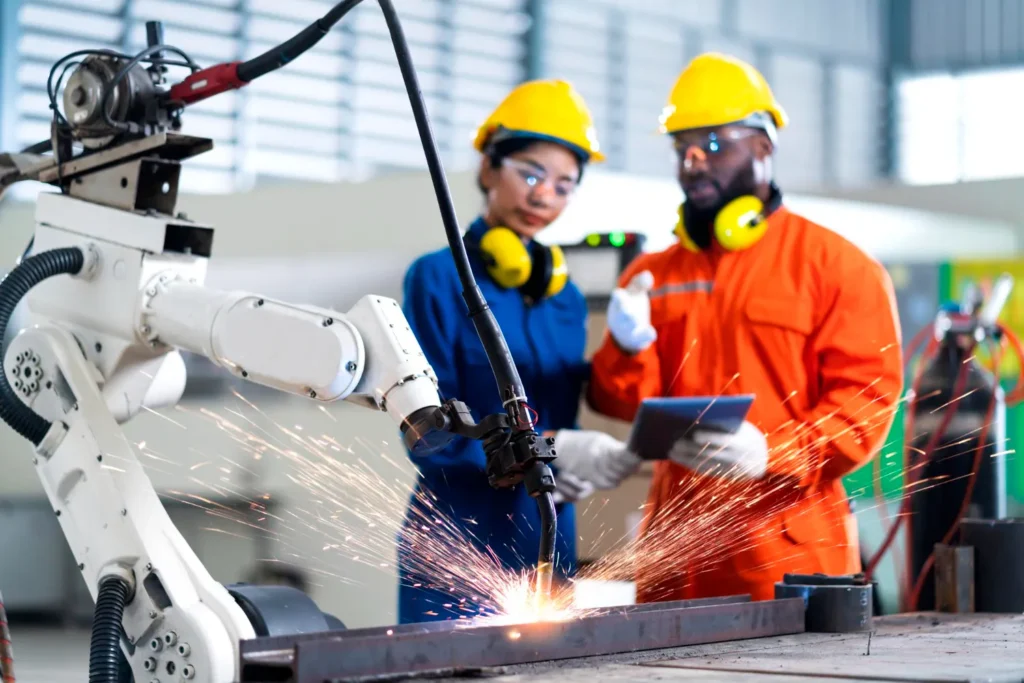
Welding involves ultraviolet radiation, fumes, and intense heat. Robotic welding machines move human operators away from these hazards, improving workplace safety. Collaborative robots equipped with force sensors and vision systems can work alongside people while still reducing exposure to dangerous environments. The decline in physical strain may also improve workforce retention.
Manufacturers worldwide struggle to recruit skilled welders. Deloitte and The Manufacturing Institute project a 2.1 million-worker shortfall in the US by 2030, including in welding roles. The American Welding Society expects a shortage of over 400 000 welders by 2026.
In China, demographic shifts and rising wages contribute to a similar gap. Robotic welding allows manufacturers to scale production while deploying existing welders in higher‑value tasks such as fixturing, inspection, and process optimization.
The global “Big Four”—FANUC, ABB, KUKA, and Yaskawa—continue to lead in precision and software ecosystems. They remain the default choice for safety‑critical, high‑precision applications requiring global support networks. However, Chinese manufacturers offer compelling alternatives.
They compete on cost‑effectiveness—often 20–40 % cheaper for comparable payload and reach—and provide rapid customization.
For welding, palletizing, and general assembly applications, the performance gap has narrowed significantly; selection often depends on project requirements and total cost of ownership.
Top Chinese suppliers have improved reliability. Buyers should look for certifications such as CE, IATF 16949 (automotive quality), ISO 9001, and ISO/TS 15066 for collaborative robots.
Evaluating case studies and third‑party testing results helps validate performance. International support through regional service partners is also critical.
The EVS guide recommends Chinese manufacturers that provide dedicated robotic welding workstations rather than just robot arms. ESTUN (with Cloos technology), EFORT, and EVST offer integrated systems with AI‑powered welding libraries and 3D vision.
Their products cover a range of processes (MIG/MAG, TIG, laser) and are exported globally. Matching the supplier’s strengths to your specific process, production volume, and support needs is vital.
Industrial robotics will become more adaptive, connected, and data-driven. AI will help robots learn from production data, adjust parameters in real time, and handle changing factory conditions with less manual programming. This supports more flexible welding, inspection, machine tending, and quality control.
Digital twins will also become more important. By using sensor data, edge computing, and cloud analytics, manufacturers can simulate processes before production and identify quality issues earlier.
Policy and market momentum will continue to support adoption. IFR’s 2026 robotics trends highlight AI, autonomy, and IT/OT convergence as key forces shaping the sector. As Chinese manufacturers gain share, improve components, and expand internationally, China’s robotics ecosystem will move further from cost competition toward higher-value industrial innovation.
Robotic welding in China is no longer only about lower labor costs. It reflects a broader shift in industrial automation, in which AI, machine vision, welding cells, supplier networks, and smart manufacturing systems are reshaping factory productivity.
ChoZan helps global executives, innovation teams, and strategy leaders understand how China’s automation ecosystem is developing in real business settings. Through China learning expeditions, innovation tours, executive briefings, workshops, expert calls, and custom research, ChoZan connects market signals with practical business insight.
For teams exploring robotic welding, smart manufacturing, or supplier strategy, ChoZan can help clarify which technologies matter, which companies are scaling, and how China’s industrial innovation model differs from other markets.
If your organization wants to understand China’s next wave of factory automation, ChoZan can help turn complex robotics trends into a clear strategic direction.
Book a consultation to understand China’s robotic welding and automation ecosystem with ChoZan and explore how it can inform your next growth, innovation, or transformation agenda.
A part is ready for robotic welding when its joints, gaps, tolerances, and repeatability are stable. Consistent fit-up matters because robots follow programmed paths and cannot correct poor preparation without sensing support.
Fixture accuracy should match the weld tolerance and part design. Strong fixtures hold components in repeatable positions, reduce gap variation, support consistent torch access, and prevent distortion during high-volume robotic welding production.
Offline programming helps manufacturers create and test robot paths before production starts. This reduces machine downtime, supports faster changeovers, and helps teams validate torch angles, reach, collision risks, and cycle timing.
Touch sensing helps a welding robot locate the real part position before welding. The robot briefly touches reference points with the wire or torch, then adjusts the programmed path to match actual placement.
Robotic MIG welding commonly uses argon-based gas blends, often mixed with carbon dioxide or oxygen. The best choice depends on the base metal, wire type, penetration needs, bead appearance, and spatter control.
A robotic welding cell should follow a preventive maintenance schedule based on shift count, duty cycle, dust, spatter, and wire usage. Common checks include torch cleaning, cable inspection, nozzle condition, liners, and calibration.
Operators need training in robot safety, basic programming, fixture loading, weld inspection, consumable replacement, alarm response, and daily maintenance. Skilled welders often adapt well because they already understand weld behavior and defects.
Poor robotic weld quality usually results from inconsistent fit-up, worn consumables, incorrect parameters, poor grounding, wire-feeding problems, contaminated material, or weak fixtures. Reliable automation depends on stable upstream preparation.
Floor space depends on robot reach, part size, fixtures, positioners, safety guarding, fume extraction, and operator access. Compact cobot welding setups need less space, while multi-axis cells require larger planned layouts.
Yes, robotic welding can work for aluminum parts, but it needs careful process control. Aluminum requires clean material, proper wire feeding, the correct shielding gas, effective heat management, and stable fixtures to reduce porosity.