CONTENT

Sungrow has evolved from an inverter specialist into a broad clean energy platform built around power conversion, storage, software, and grid control. In 2025, energy storage generated more revenue than its inverter business, confirming that the shift is commercial rather than cosmetic.
Yet the inverter remains the strategic core. The same power electronics expertise now connects solar generation, batteries, EV charging, hydrogen production, and digital operations.
This matters because energy procurement is moving from separate equipment purchases toward integrated systems. Buyers now assess how generation, storage, control software, service, and grid compliance work together across the asset lifecycle.
Yes. Sungrow Power Supply is a Chinese clean energy technology company headquartered in Hefei, Anhui, and listed on the Shenzhen Stock Exchange under code 300274. Its current business covers PV inverters, energy storage, wind power conversion, EV control and charging equipment, floating solar, hydrogen equipment, renewable project development, and power solutions for AI data centers.
The 2025 numbers show the scale behind this expansion. Revenue reached approximately $13.18 billion, up 14.55 percent, while net profit attributable to shareholders rose 21.97 percent to approximately $1.99 billion. Research and development spending increased 31.97 percent to approximately $618 million. Sungrow’s official 2025 annual report summary provides these figures.
The important China insight is the company’s focus on power conversion as a reusable capability. Rather than leaving the inverter category, it has extended that engineering base into adjacent energy flows and operating scenarios.
A PV inverter converts the direct current produced by solar modules into alternating current used by a building or grid. Modern equipment also manages voltage, detects faults, communicates with plant software, and supports grid stability.
The 2025 portfolio spans outputs from 0.45 kW to 9.6 MW. It includes microinverters, residential units, string inverters, central inverters, and modular systems. This coverage gives the company entry points into homes, commercial sites, and utility plants. Sungrow inverters reached 143 GW of shipments during 2025, according to the annual report.
Recent releases show how the hardware is changing. The 1+X 2.0 modular Sungrow solar inverter scales from 800 kW to 9.6 MW. Its split design supports field replacement of key modules, while grid-forming controls provide rapid inertia support during disturbances. The system also works with AC-coupled and DC-coupled solar plus storage configurations.
This modular approach combines the scale economics associated with central equipment and the service flexibility associated with smaller units. That matters when downtime, spare parts, and technician access affect project returns for decades.
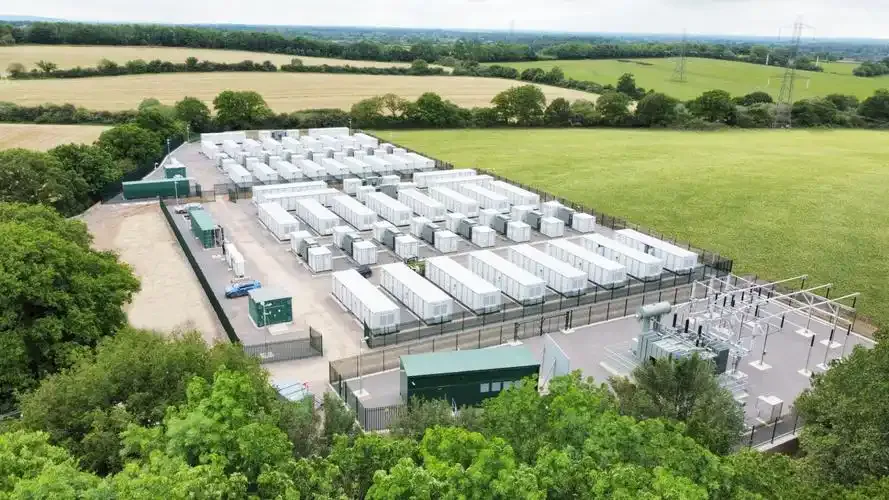
Energy storage became the clearest proof of the Sungrow power platform’s expansion in 2025. The company shipped 43 GWh of storage systems, up 54 percent. Storage revenue reached approximately $5.49 billion, rising 49 percent, while inverter revenue reached approximately $3.93 billion, up 4 percent. These official figures show that storage has become the larger business line.
The portfolio now serves three distinct layers. Utility projects use PowerTitan. Commercial and industrial sites use PowerStack. Homes combine hybrid inverters with a modular Sungrow battery, including the SBR battery system where local compatibility applies.
Sungrow launched PowerTitan 3.0 in August 2025 at the MEA PV & ESS Summit in Dubai. The system integrates a 1.72 MW silicon carbide PCS with 6.9 MWh batteries in a 20-foot configuration, delivering 99.3% PCS efficiency and full-power output at 55°C without derating. The stacked 684Ah battery cells reduce internal resistance and thermal runaway risk. Overall system conversion efficiency reaches 92%
PowerTitan 3.0 packages batteries, power conversion, thermal management, diagnostics, and grid-forming controls into an AC storage platform. Its configurations support durations from two to twelve hours. The design also adds PowerBidder for electricity market decisions and PowerDoctor for plant maintenance.
Sungrow is also deploying PowerTitan 2.0 at scale. The company is the technology provider for the Thorpe Marsh project in the UK—the country’s largest battery storage project at 1.6 GW / 3.3 GWh, enough to power over 785,000 homes annually. The project secured approximately £750 million in financing from EIG, the UK National Wealth Fund, and a syndicate of international lenders.
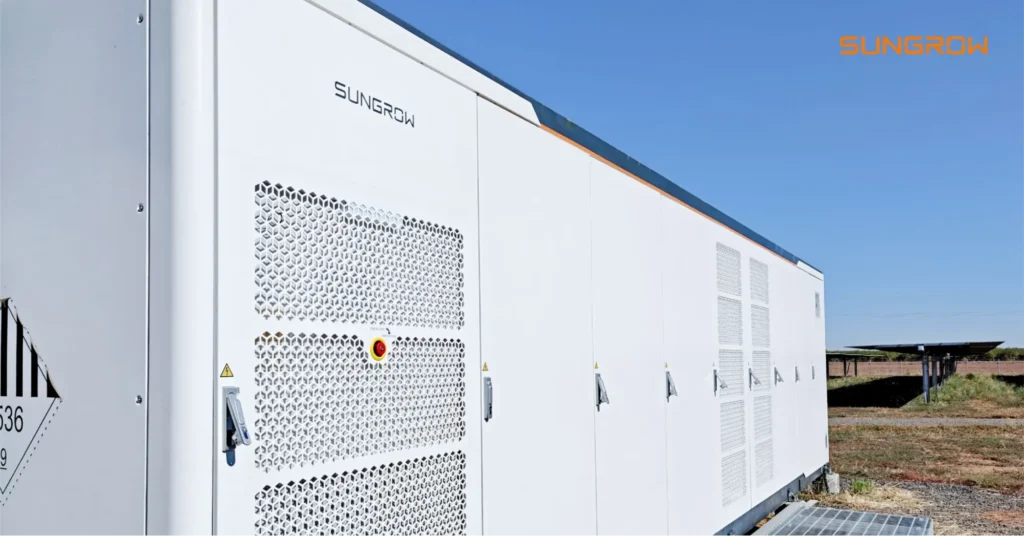
The 2025 PowerStack 255CS combines the battery, power conversion system, battery management system, and energy management system in one liquid-cooled cabinet. A unit provides 257 kWh for a two-hour configuration or 514 kWh for four hours. Up to 25 units can support projects reaching 6.4 MWh.
This design addresses a practical commercial problem. Factories, warehouses, charging hubs, and campuses need storage that can manage peak demand, solar self-consumption, backup power, and changing site loads without a custom engineering stack for every deployment.
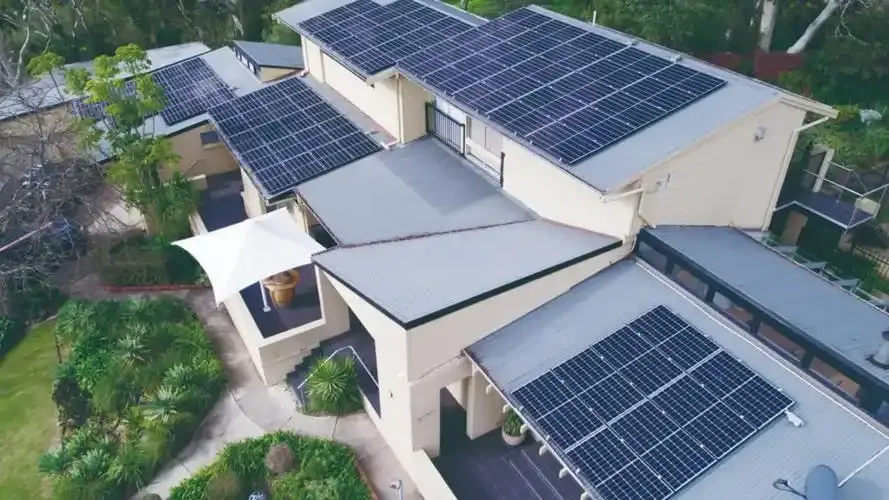
At Intersolar Europe 2026, Sungrow launched PowerHarbor, an all-in-one residential ESS offering 10–30 kW inverter power with 6–10 kWh modular LFP battery blocks expandable to 120 kWh. The system features the industry’s first real 10 kWh stackable battery module and an AI-powered energy management solution called iHomeManager Mini.
In Southeast Asia, Sungrow unveiled low-voltage residential solutions featuring the MG8/10RL hybrid inverters and stackable MBL battery modules at Solar & Storage Live Vietnam 2026. The system includes AFCI protection, IP65 rating, and C5 anti-corrosion technology for tropical climates.
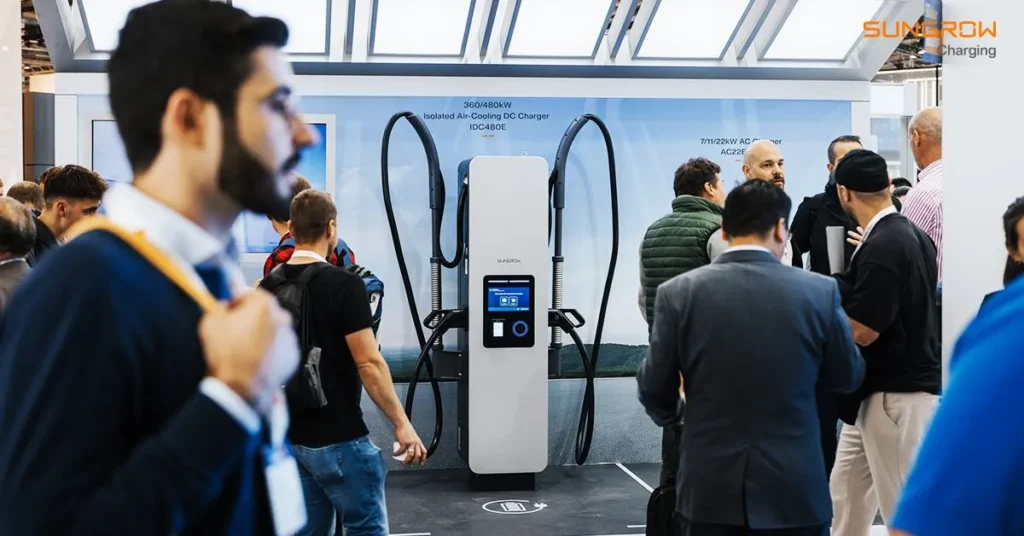
In October 2025, Sungrow held its Charging Summit in Amsterdam and debuted the 1+X Megawatt Charging System CDC1000E, with parallel expansion up to 3.5 MW. The system uses silicon carbide power modules, supports reactive power regulation, and has a lifespan exceeding 10 years. In May 2025, Sungrow introduced the ultra-fast compact charger IDC480E-C at Power2Drive in Munich.
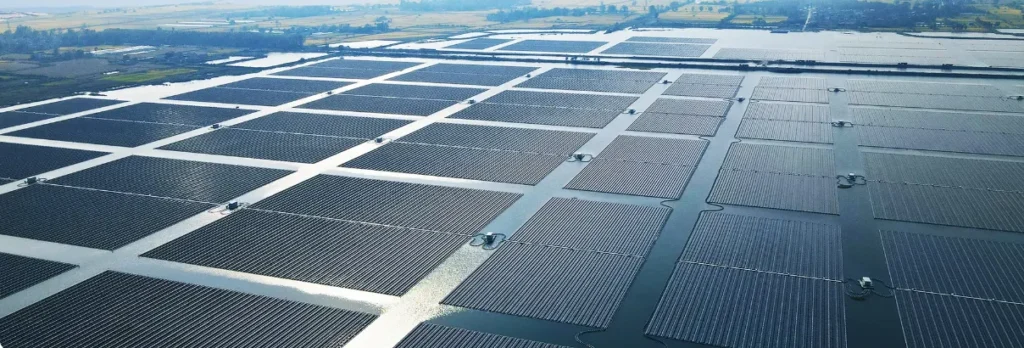
Sungrow FPV deployed the Philippines’ first megawatt-scale floating solar plant at the Malubog Reservoir in Cebu City in 2025. The 4.99 MW project, equipped with Sungrow floating solar solutions, supplies power to the Carmen Copper mining site.
The system features an anti-wind design based on a 75 m/s ultimate wind speed, passed fatigue tests exceeding one million cycles, and uses an elastic mooring system. Sungrow FPV also displayed the SGF-TS30M floating solar system at Intersolar Europe 2025, with modular design reducing installation time by 30%.
Sungrow Hydrogen participated in World Hydrogen Week 2025 in Copenhagen, showcasing multi-to-one and modular flexible hydrogen production solutions. In June 2025, Sungrow Hydrogen partnered with Wison Engineering to launch MegaFlex “Plant-as-a-Product,” a turnkey green hydrogen production solution.
In August 2025, Sungrow established a European Hydrogen Technology Laboratory in Munich, joining its 30 MW water electrolysis empirical platform to form a complete innovation chain.
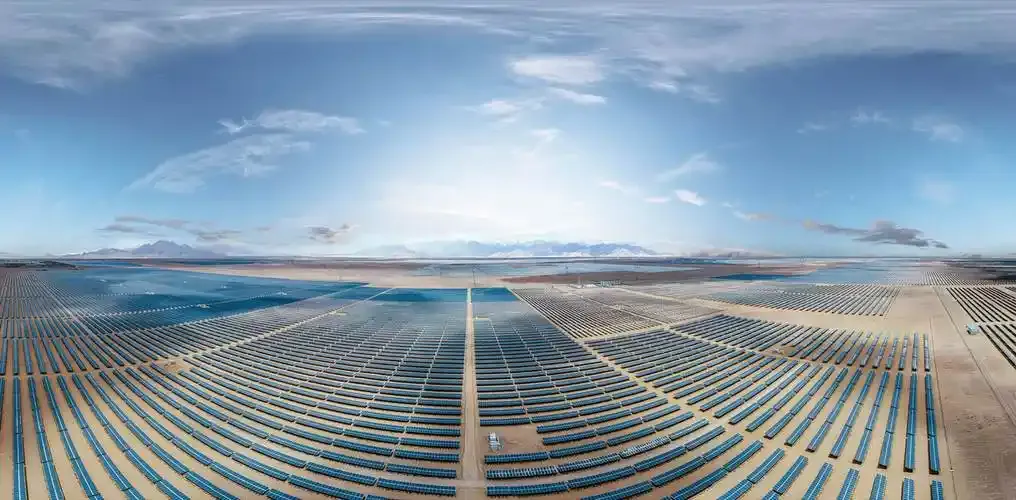
Hardware breadth alone does not create a platform. Shared control and asset data connect the portfolio. iSolarCloud monitors and manages PV and energy storage systems, while iHomeManager links inverters, batteries, EV chargers, and heat pumps within home energy systems.
For asset owners, this shifts the purchase decision. Software availability, permissions, data access, interfaces, update policies, and cybersecurity now carry commercial weight beside conversion efficiency. A unified platform can simplify operations, but it can also increase dependence on one vendor’s cloud, service network, and product roadmap.
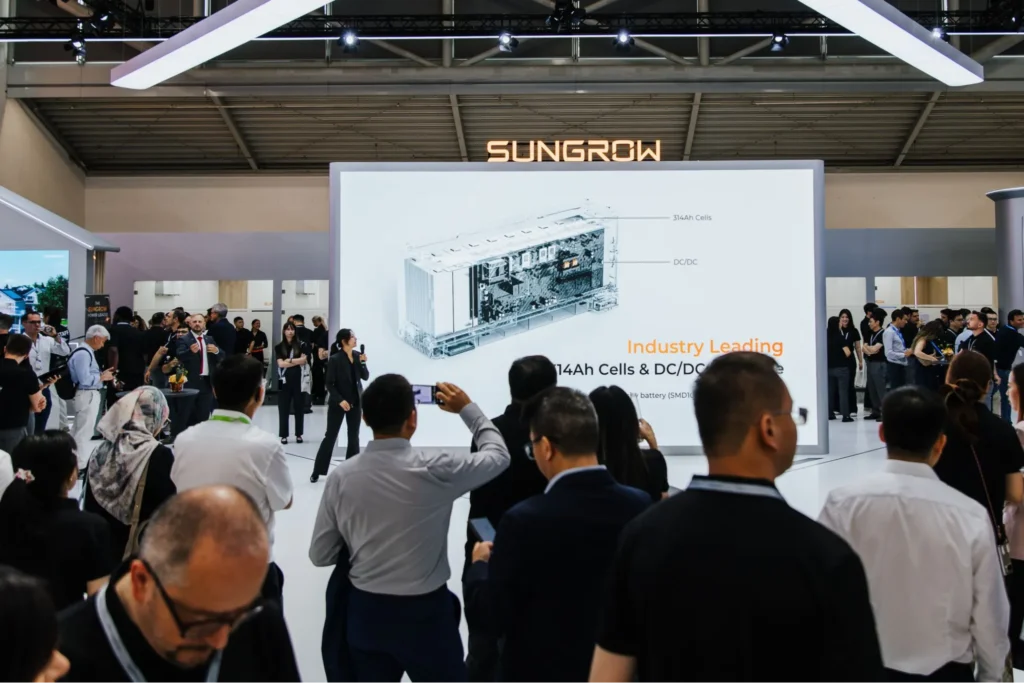
The main advantage is coordinated system design. One supplier can connect solar production, battery energy storage, charging loads, monitoring, and grid services. This reduces integration work and clarifies responsibility when components share a control architecture.
Manufacturing scale and modular design create a further cost advantage. Sungrow extends expandable architectures across residential, commercial, and utility systems. Standardized modules let buyers size projects more closely to current demand, add capacity later, repeat designs across markets, and simplify spare-parts management.
These features can lower CAPEX through reduced cabling, land use, installation work, and unnecessary initial capacity. Faster component replacement, lower auxiliary power consumption, and automated diagnostics can reduce OPEX.
The savings vary by product and project. Sungrow’s 2025 releases report approximately $7.41 million in combined CAPEX and OPEX savings for a 1 GW plant using its 1+X 2.0 modular inverter. PowerTitan 3.0 can reduce land use by 45 percent and cabling by 10 percent in a 1 GWh project.
PowerStack supports scalable commercial installations from 257 kWh to 6.4 MWh, with preinstalled components that reduce installation complexity. Official 1+X 2.0 specifications, PowerTitan 3.0 platform details, and 2025 commercial system information document these benefits.
Selected Sungrow products work with equipment outside its own hardware portfolio. The MG5/6RL residential inverters support more than 50 third-party storage batteries. Logger1000 can connect with third-party devices and operation platforms through several communication protocols. The 2025 MG Series announcement and Logger1000 product information confirm this product-level flexibility.
Compatibility is not universal across every model or market. Buyers should request current battery lists, API documentation, supported protocols, firmware requirements, and regional certifications before assuming that third-party equipment will work.
Embedded software can increase project income. PowerBidder supports electricity-market trading decisions and aims to improve trading profits while controlling risk. PowerDoctor predicts more than 30 fault types with over 99 percent diagnostic accuracy, helping operators reduce downtime and protect revenue.
PowerTitan’s grid-forming functions can also support ancillary services, creating income beyond basic energy arbitrage. Sungrow’s PowerTitan 3.0 release explains these capabilities.
The remaining tradeoff is concentration risk. Buyers should assess local service coverage, replacement timelines, battery sourcing, software access, API rights, warranty boundaries, cybersecurity controls, and offline operating capability. Project teams should also test performance under the site’s grid code, climate, duty cycle, and revenue model.
Regulatory exposure requires market-specific review. In 2026, the European Commission proposed a framework that could restrict inverters from high-risk suppliers when necessary.
The US Federal Communications Commission added foreign-produced power inverters to its Covered List and established a conditional-approval process for certain equipment. These actions can affect procurement, financing, approvals, and product availability.
Sungrow’s expansion shows how Chinese companies connect power electronics, storage, software, and grid control within one commercial platform. Global energy teams must now determine how this model could affect supplier selection, partnerships, technology roadmaps, investment priorities, and operational risk.
ChoZan supports these decisions through China technology trend watching, custom China research, and expert calls. Each engagement can combine competitor monitoring, real-time data tracking, policy impact assessments, expert interviews, competitive benchmarking, and tailored executive briefings. Teams receive findings through strategic reports, presentation decks, working sessions, and follow-up consultations.
For firsthand market exposure, ChoZan also creates customized China Learning Expeditions featuring company visits, innovation hubs, expert discussions, and guided strategic reflection.
Book a consultation with ChoZan to build a focused program around clean energy strategy, sourcing, partnerships, investment, or technology planning.
Its 2025 shipment scale, broad product range, and continuing R&D investment show substantial operating capacity. Product quality still depends on the chosen model, installer, grid requirements, warranty terms, and strength of local after-sales support.
Sungrow operates a global production and service network, but manufacturing origin can vary by model and destination. Buyers should verify the factory, certification, country of origin, and authorized sales channel on project-specific documentation before purchase.
The right comparison depends on system size, grid code, storage compatibility, software access, service coverage, cybersecurity requirements, and lifecycle cost. Compare current regional models and contracts rather than relying on broad brand-level rankings or old reviews.
Warranty length and coverage vary across products, countries, and sales programs. Confirm the current regional certificate, start date, labor coverage, replacement process, shipping responsibility, and installer obligations before signing a supply or installation contract.
Compatibility depends on approved hardware, firmware, communication protocols, and local certification. Do not assume that matching voltage is sufficient. Check Sungrow’s current compatibility list and obtain written confirmation from both manufacturers before combining equipment.
Standard grid-connected units shut down when the grid fails. Backup operation requires a compatible hybrid model, battery, protection equipment, and correct system design. Available loads, transfer time, and three-phase behavior vary across regional configurations.
Both are modular residential battery families, but capacity ranges, module counts, current limits, and compatible hybrid models differ. Use the latest regional data sheets and compatibility tables because available configurations and certifications can change between markets.
Remote monitoring, cloud data, notifications, and software services generally require connectivity. Core energy conversion can follow the installed system design without continuous app use, but owners should confirm offline controls, data retention, and reconnection behavior.
Technical capability alone does not guarantee participation. Market access depends on local rules, metering, dispatch systems, aggregator arrangements, response requirements, and software integration. Review the complete revenue stack before choosing storage size or operating strategy.
Use Sungrow’s official distributor finder or a locally authorized installer. Confirm model numbers, serial numbers, certification, warranty registration, and support responsibility. Gray-market equipment may create problems with firmware, grid approval, replacement parts, and warranty claims.