CONTENT
China’s auto industry was reshaped by a decade of NEV incentives covering battery electric, plug-in hybrid, and fuel cell models. In 2025, China produced more than 70 percent of the world’s EVs and exported about 40 percent of them.
That scale now brings a harder challenge. China’s domestic EV market is saturated, dozens of brands compete for similar buyers, and price cuts have weakened margins. Meanwhile, Beijing has removed NEVs from the strategic emerging industries list for the 2026 to 2030 Five-Year Plan, signaling a shift from expansion to discipline.
This article examines how Chinese EV manufacturers are responding by pursuing battery innovation, software-defined vehicles, export strategies, and localized production amid growing geopolitical pressure.
By 2026, China’s EV market had moved from rapid expansion to maturity. Domestic sales slowed, while exports continued to rise. Reuters reported that car sales fell 18 percent in 2025, even as overseas shipments increased.
Pressure intensified in March 2026, when BYD posted its seventh straight monthly sales decline. Sales fell 20.5 percent year on year to 300,222 vehicles, while first-quarter sales dropped 30 percent.
Automakers responded with aggressive discounts. BYD’s discounts averaged about 10 percent in March 2026, while Geely and Chery followed with similar moves. Regulators warned against loss-making sales, but the price war had already erased an estimated US$69 billion in revenue between 2023 and 2025.
Chinese factories can produce roughly 55.5 million vehicles annually, while domestic sales sit near 23 million. This leaves capacity utilization below 50 percent and forces automakers to compete harder for volume.
Beijing’s latest Five-Year Plan now prioritizes quantum technology and hydrogen energy over EVs. It also urges provinces to stop duplicative investment. Xi Jinping warned against identical “new productive forces” and supported easing local purchase restrictions to lift demand.
Removing NEVs from the strategic priority list reflects sector maturity, not policy hostility. Beijing now wants less speculative investment, fewer redundant projects, and more disciplined competition.
Chinese automakers are using exports to offset weaker domestic margins and absorb excess capacity. China exported 5.8 million vehicles in 2025, up 20 percent year-on-year, with exports forecast to reach 7.4 million in 2026.
BYD’s overseas sales reached 320,673 vehicles in Q1 2026, or 45.8 percent of total sales. The company expects 1.5 million overseas sales in 2026.
Other brands are building similar global targets. Huawei-backed Aito aims for one million vehicle sales by 2030, with overseas markets contributing 20 percent within three years. XPeng expects more than half of its revenue to come from outside China within five to ten years.
Chinese EV exporters face rising protectionism as their global share grows. Europe has imposed duties on China-made EVs, while the United States remains largely closed through tariffs and national-security restrictions. Canada has also tightened access through tariff measures and import limits.
These barriers are pushing Chinese automakers toward local production. BYD’s Hungary plant, Leapmotor’s partnership with Stellantis in Spain, and Chery’s European production plans show how companies are adapting. Local assembly helps reduce tariff exposure, improve political acceptance, and build regional supply chains.
For Chinese brands, the next stage of globalization will depend less on exporting finished cars and more on building local manufacturing, service networks, and trust.
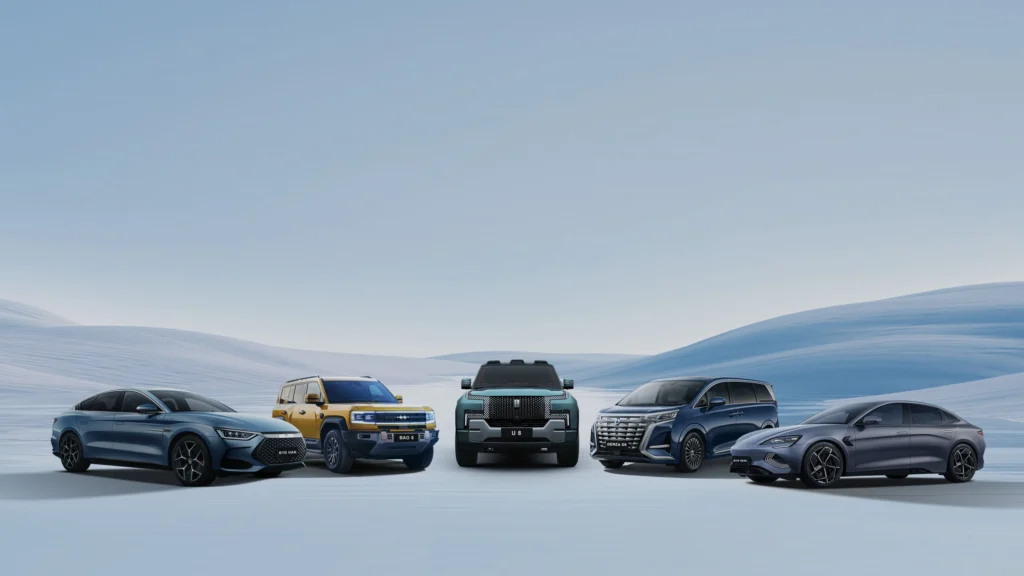
BYD leads global EV volume through deep vertical integration across batteries, semiconductors, and vehicles. This structure gives it supply-chain control and cost advantages as China’s EV price war intensifies.
To defend its edge, BYD launched its first major battery upgrade in six years and pushed models above 150,000 yuan. Its long investment in LFP technology supports lower costs and safer battery performance, without repeating the broader market data covered later.
BYD is also expanding overseas through plants in Thailand, Brazil, and Hungary, with further moves explored in Mexico and Southeast Asia. Its Denza N9 flash-charging edition claims a nine-minute charge time without degrading the battery. Meanwhile, tariffs are pushing BYD to localize production rather than rely only on exports.
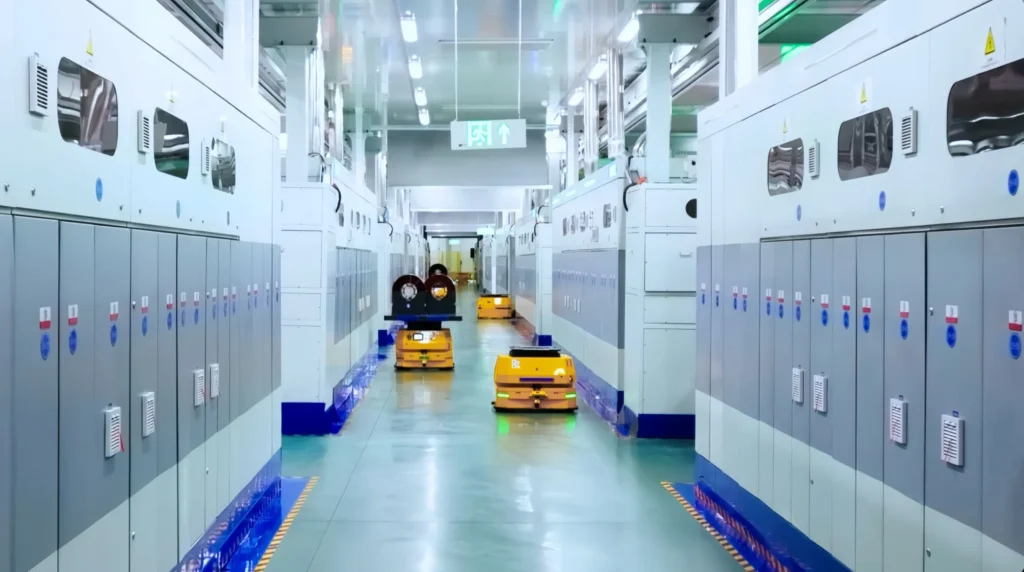
CATL is the world’s largest battery maker, supplying Tesla, BMW, Ford, and most major Chinese EV brands. Its scale, cost control, and chemistry portfolio make it central to affordable EV production.
CATL’s strength comes from LFP, ternary, and emerging sodium-ion batteries. The company is scaling sodium-ion batteries for budget EVs and stationary storage. These packs offer lower energy density than lithium-ion cells, but they use abundant sodium, reduce cost pressure, and perform better in cold conditions.
Its roadmap also includes semi-solid and solid-state batteries for premium EVs. That makes CATL less a component supplier and more a battery infrastructure platform for global electrification.
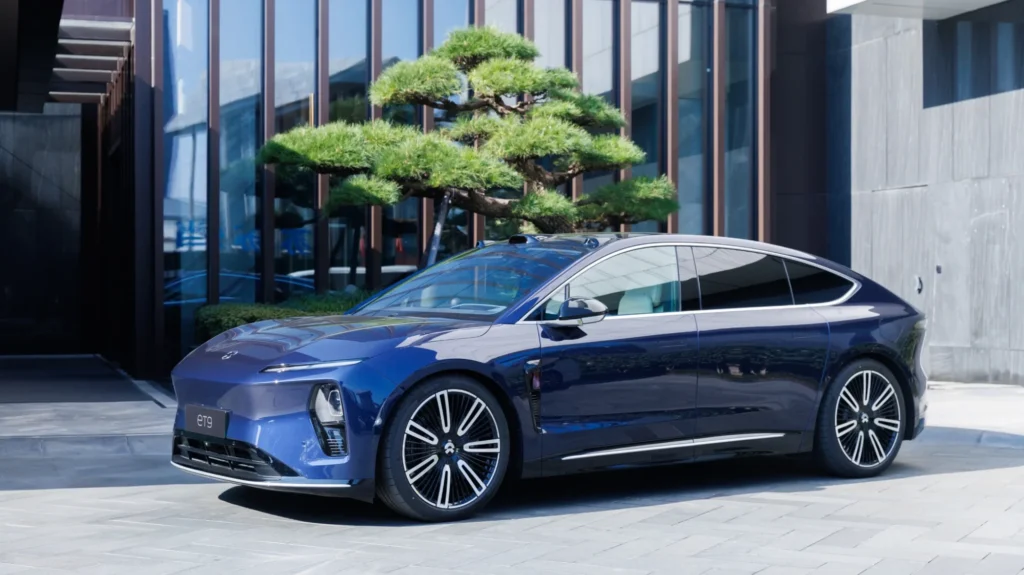
NIO differentiates itself through battery swapping, assisted driving, and premium services. In February 2026, it completed its 100 millionth battery swap, proving the model has moved beyond pilot-stage infrastructure.
Its Power Swap stations replace a depleted battery in about three minutes and have delivered 5.28 billion kWh of energy. NIO says swapping has saved users 83.41 million hours and RMB 26.3 billion in energy costs.
NIO’s 2,100-plus patents strengthen its battery-swapping moat. The model also separates battery ownership from the vehicle, helping address degradation concerns and supporting subscription-based ownership.
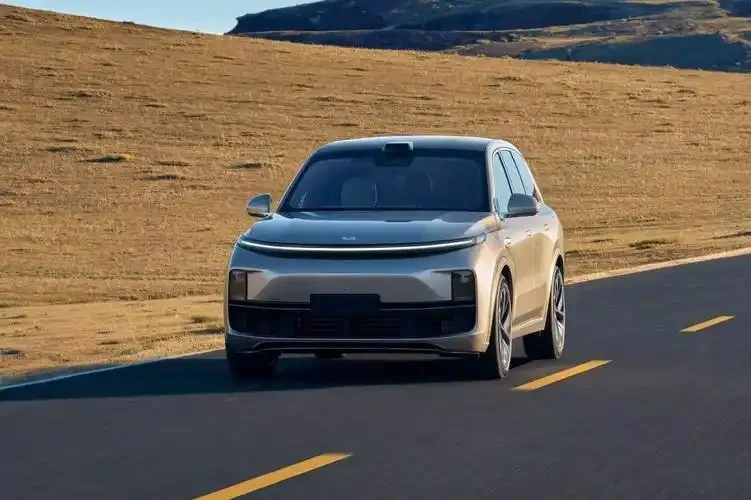
Li Auto built its niche around extended-range electric vehicles that pair a battery with a small combustion-engine generator. This setup reduces range anxiety in regions with limited charging infrastructure.
In March 2026, Li Auto delivered 41,053 vehicles, raising cumulative deliveries to 1.63 million. After resolving production bottlenecks, the Li i6 delivered more than 24,000 units in one month, while the Li L9 was planned for launch in Q2 2026.
Li Auto is also expanding into autonomous driving and infrastructure. At NVIDIA GTC 2026, it unveiled MindVLA and a 3D Vision Transformer encoder. Its China network includes 517 retail stores, 552 service centers, and 4,057 super-charging stations with 22,439 stalls.
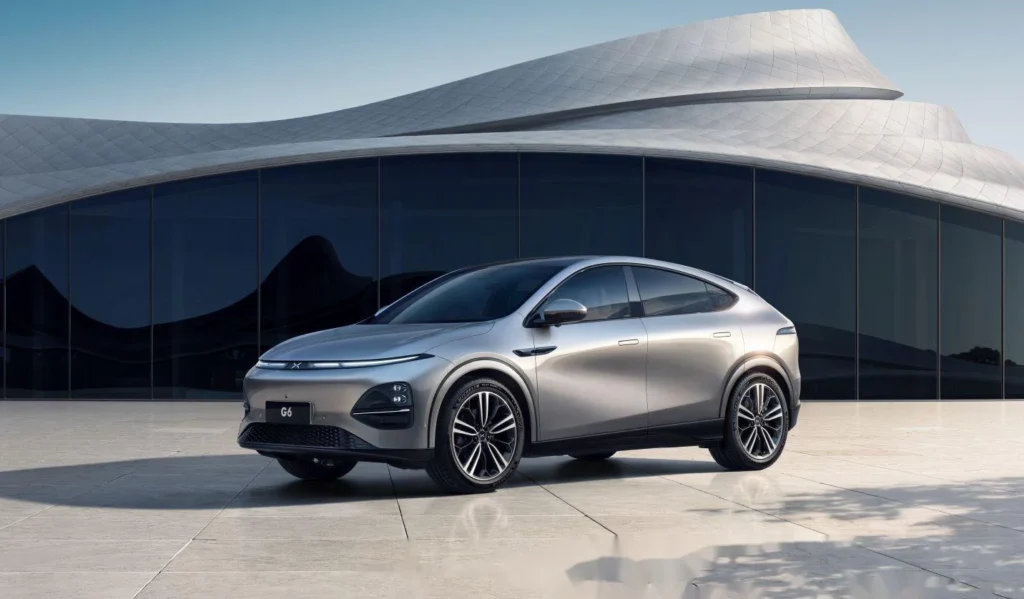
XPeng combines high-tech ambitions with mass-market pricing. In May 2026, it began mass production of its first in-house robotaxi, built on the GX platform and pre-assembled for driverless deployment.
Pilot operations will begin in the second half of 2026, with hundreds or thousands of robotaxis planned over 12 to 18 months. XPeng aims for fully driverless operations by early 2027.
The company also expects overseas markets to generate more than 50 percent of revenue within five to ten years. Its expansion in Norway, Sweden, and the Netherlands shows how Chinese brands use software, pricing, flying cars, and robotaxi services to attract early adopters.
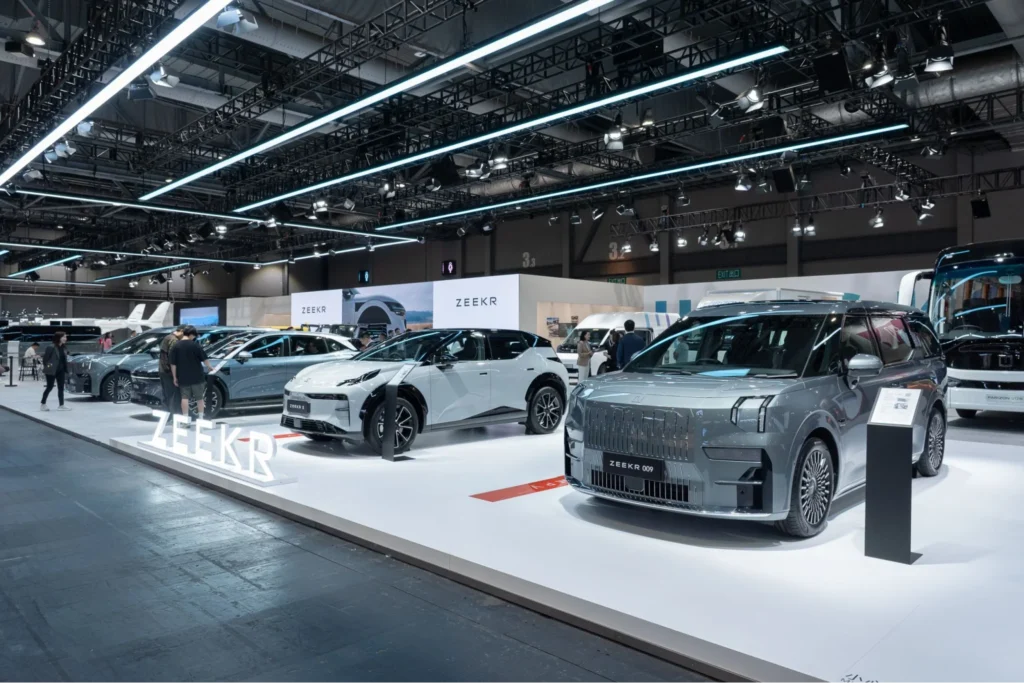
Geely, owner of Volvo and Polestar, uses a multi-brand strategy to cover different EV segments. Its premium subsidiary Zeekr focuses on performance EVs, faster charging, and European expansion. The Zeekr 009 MPV uses a 900-volt architecture, while Geely’s work with Renault’s Ampere and Volvo shows how Chinese automakers combine domestic scale with global partnerships.
Other Chinese automakers are building distinct routes to growth.
China’s battery industry has shifted decisively toward lithium iron phosphate chemistry. In April 2026, LFP made up 81.5 percent of monthly power battery installations and 80 percent of the year-to-date total. Ternary batteries held just 18.5 percent of the market.
LFP’s popularity reflects demand for lower prices and improved safety. LFP cells are less prone to thermal runaway and cost less because they avoid expensive cobalt and nickel. BYD and CATL together held 63.4 percent of China’s battery market, reinforcing the scale advantage of China’s leading battery players.
More than 90 percent of global battery energy storage relies on LFP chemistry, almost exclusively supplied from China. Over 80 percent of the world’s lithium‑ion batteries are manufactured in China, and battery factories in Europe and the US depend heavily on Chinese materials and components.
Domestic production in Western countries can be up to 50 percent more expensive. This dominance raises geopolitical risks: any disruption in Chinese supply chains—whether due to trade disputes, epidemics, or resource shortages—could delay global electrification.
Chinese firms are therefore investing overseas; CATL is building plants in Germany, Hungary, and Indonesia, while Gotion and EVE Energy plan factories in the US.
Battery makers are exploring alternatives to LFP and ternary chemistries. Sodium‑ion batteries promise lower cost and improved safety, though energy density remains modest. Nearly all sodium‑ion manufacturing capacity is being developed in China.
Solid‑state batteries, which replace liquid electrolytes with solid materials, could dramatically increase energy density and reduce fire risk. Chinese companies such as NIO, BYD, and CATL are investing heavily in solid‑state research, often through partnerships with Japanese and European firms.
NIO’s battery-swapping network offers an alternative to conventional charging. By 2026, NIO operated 3,790 stations worldwide, including 1,020 along highways, with another 1,000 planned. The company aims to reach 5,000 stations globally by the end of 2026.
China’s charging infrastructure continues to expand alongside the growth of swapping. Li Auto operates 4,057 super-charging stations and 22,439 charging stalls. State-owned grid operators and private companies such as Star Charge, Teld, and Xiaoju are also accelerating deployment.
Together, swapping and fast charging reduce range anxiety and support mass adoption of EVs.
As hardware becomes easier to compare, Chinese carmakers increasingly compete through software, connectivity, and smart cockpits. Many brands now offer ADAS and Level 2 autonomy as standard.
XPeng’s robotaxi uses its GX platform with proprietary sensors and perception algorithms. Li Auto’s MindVLA uses 3D Vision Transformers to enable human-like spatial cognition. Huawei’s HarmonyOS powers infotainment in Aito and Chery models, connecting smartphone and vehicle ecosystems.
Smart cockpits now include voice control, augmented-reality head-up displays, integrated entertainment, and over-the-air updates. This software-led strategy helps Chinese brands improve vehicles after purchase and generate recurring revenue through digital services.
Europe remains a major opportunity and battleground for Chinese EVs. Chinese brands can price vehicles 20 to 30 percent below European competitors, even with tariffs, because their manufacturing costs are lower.
BYD sells the Dolphin and Atto 3 across the UK and continental Europe, while SAIC-owned MG has become a top-selling EV brand in several countries. However, EU subsidy investigations may raise tariff pressure. As a result, Chinese automakers are pursuing local assembly. Leapmotor’s Stellantis partnership in Spain, Chery’s European production plans, and BYD’s Hungary plant all reflect this shift.
Developing markets now drive a growing share of Chinese EV exports. According to the IEA, Chinese imports represented 85 percent of EV sales in Brazil and Thailand, and 75 percent of EV sales growth across emerging economies in 2024.
These markets often lack large domestic EV industries, which creates demand for affordable models such as the Wuling Mini EV. Chinese automakers also localize products through right-hand-drive variants for Thailand, stronger suspension for Brazilian roads, and battery-swap options for some Middle Eastern fleets. Tax incentives and zero-tariff policies further support adoption.
North America remains difficult for Chinese EV brands. The United States imposes steep tariffs and national security restrictions, effectively keeping Chinese vehicles out.
Some Chinese automakers are exploring assembly in Mexico to benefit from free-trade agreements. However, Washington is tightening rules to close loopholes. Canada now allows up to 49,000 China-made vehicles per year under a tariff quota. Chinese brands are unlikely to gain significant share in North America soon, but their global success may still influence US policy and industry lobbying.
China has more than 70 EV manufacturers, so consolidation looks inevitable. Many startups lack the capital, software capabilities, battery technology, and scale needed to survive prolonged price pressure.
At the same time, Huawei, Xiaomi, and Baidu are entering mobility with strong software expertise and deep funding. Their rise blurs the line between consumer electronics and automotive competition.
Overcapacity also puts pressure on the battery supply chain. CATL and BYD dominate, while smaller players such as Gotion, CALB, and Geely’s ENERGEE must differentiate through new chemistries or partnerships. Policymakers are encouraging mergers and collaboration to reduce redundancy and improve competitiveness.
China’s EV industry is now reshaping batteries, software-defined vehicles, manufacturing costs, charging infrastructure, and global mobility competition. For executives, the important question is not only which Chinese brands are growing, but what their strategies reveal about the future of industrial innovation.
ChoZan helps global leadership teams understand these shifts through China innovation research, executive briefings, workshops, and curated learning expeditions. Its work turns complex market developments into practical insight for strategy, transformation, and future growth.
Book a consultation with ChoZan to explore what China’s EV transformation means for your business.
Yes, several Chinese EV brands are improving long-term reliability through better battery warranties, software support, and overseas service networks. However, ownership experience still depends heavily on local dealer coverage, replacement-part availability, and regional after-sales infrastructure.
European automakers are partnering with Chinese EV companies to access lower-cost battery technology, faster software development, and affordable EV platforms. These partnerships also help legacy manufacturers accelerate electrification while reducing pressure from rising Chinese competition.
Zeekr, NIO, and some Huawei-backed models are increasingly viewed as premium Chinese EV brands for their emphasis on advanced interiors, digital experiences, performance, and fast charging. These companies are targeting buyers who traditionally preferred German luxury automotive brands.
Chinese EV companies reduce prices through battery scale, localized supply chains, vertical integration, and faster product cycles. Many manufacturers also reuse shared vehicle platforms across multiple brands, significantly lowering engineering and manufacturing costs.
Yes, Chinese electric vehicles are becoming attractive to fleets because they combine lower acquisition costs with advanced technology and improved charging infrastructure. Leasing companies in Europe are increasingly partnering with Chinese brands to expand affordable EV offerings.
Chinese EV brands focus on smartphone integration because younger buyers increasingly expect cars to function like connected digital devices. Features such as app ecosystems, voice assistants, and synchronized mobile services help manufacturers strengthen customer retention and software engagement.
Yes, affordable Chinese EVs could reshape Europe’s entry-level market because many European automakers have moved away from low-margin compact vehicles. Chinese manufacturers now compete aggressively on pricing, technology, and charging performance in smaller vehicle categories.
Chinese EV software systems usually prioritize rapid updates, ecosystem connectivity, and entertainment-focused user experiences. Traditional automakers often move more slowly because their vehicle-development cycles, supplier structures, and software integration processes remain less centralized.
BYD, Chery, MG, XPeng, and Zeekr are rapidly expanding their dealership and retail networks across Europe. Their strategy focuses on combining competitive pricing with stronger local sales support, financing partnerships, and service accessibility for mainstream consumers.
Tariffs, political restrictions, consumer trust concerns, and inconsistent service infrastructure could slow global expansion for Chinese electric car brands. Competition from Tesla, European automakers, and lower-cost hybrid vehicles will also remain a major long-term challenge.