CONTENT
EVE Energy has become more important in 2026 because the battery market is no longer shaped solely by EV growth. Grid storage, commercial vehicles, European localization, battery passports, and large-cell formats are now reshaping how global companies evaluate Chinese suppliers.
In 2025, EVE Energy reported revenue of RMB 61.47 billion, with power battery shipments of 50.15 GWh and energy storage battery shipments of 71.05 GWh.
Its storage battery revenue reached RMB 24.44 billion, close to the RMB 25.86 billion generated by power batteries. That mix explains why EVE Energy now matters as both an EV supplier and a grid storage player.
EVE Energy sits in a different position from China’s two headline battery giants. CATL dominates at scale. BYD integrates batteries tightly with its own vehicles.
EVE Energy is better understood as a multi-segment supplier with exposure to consumer, power, and energy storage batteries. Reuters describes the company as active in consumer, power, and energy storage batteries in both domestic and international markets.
That makes the company strategically relevant for brands that need a China supplier view beyond the most visible names. In 2025, SNE Research data placed Eve Energy eighth globally for EV battery installations, with 31.3 GWh and a 2.6 percent market share. It is not the largest EV battery company, yet it is significant enough to remain in global procurement discussions.
The clearest signal is the near-balance between power and storage batteries. EVE Energy reported 42.07 percent of 2025 revenue from power batteries and 39.76 percent from energy storage batteries.
Consumer batteries still contributed 18.02 percent. This is not a one-product story. It is a portfolio story with commercial and passenger vehicles, grid and industrial storage, and specialist applications all driving the company’s growth.
This matters because supplier risk looks different when a company serves multiple demand pools. EV cycles can soften. Storage can accelerate. Industrial and consumer battery demand can bring resilience. The most commercially intelligent view of EVE Energy is to study how those segments interact.
The company’s power battery business performed strongly in 2025. Its annual report said power battery shipments reached 50.15 GWh, up 65.56 percent year-on-year. The report also highlighted commercial vehicle batteries and large cylindrical cells as core areas of progress.
China’s electric truck and commercial vehicle market is becoming a practical testing ground for battery suppliers. The IEA said electric trucks accounted for about 8 percent of global EV battery deployment in 2025, with growth largely driven by China.
That context helps explain why EVE Energy is focusing on commercial use cases. Fleet operators care about lifecycle costs, downtime, charging speed, cold-weather performance, and predictable supply. These needs differ from those in passenger car marketing. Battery suppliers that win commercial vehicle projects must prove operational value over time.
Europe is also relevant. EVE Energy said in September 2025 that its Hungarian factory had been approved for construction and was expected to enter operation in 2026. The company also said its European service network included six delivery VMI hubs and more than 500 customers across Europe.
The commercial meaning is clear. Global OEMs want Chinese battery technology, but they also want closer regional supply, traceability, technical service, and regulatory alignment.
The strongest current momentum is in storage. EVE Energy reported 71.05 GWh of energy storage battery shipments in 2025, up 40.84 percent. Its annual report cited EVTank data placing its battery storage shipments among the top two globally. CATL, Hithium, EVE Energy, BYD, CALB, and REPT BATTERO among the top six global energy storage cell suppliers in 2025.
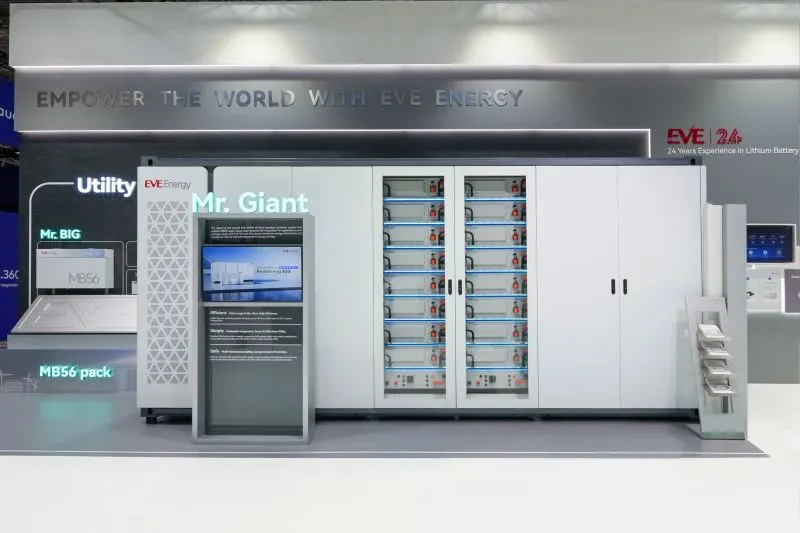
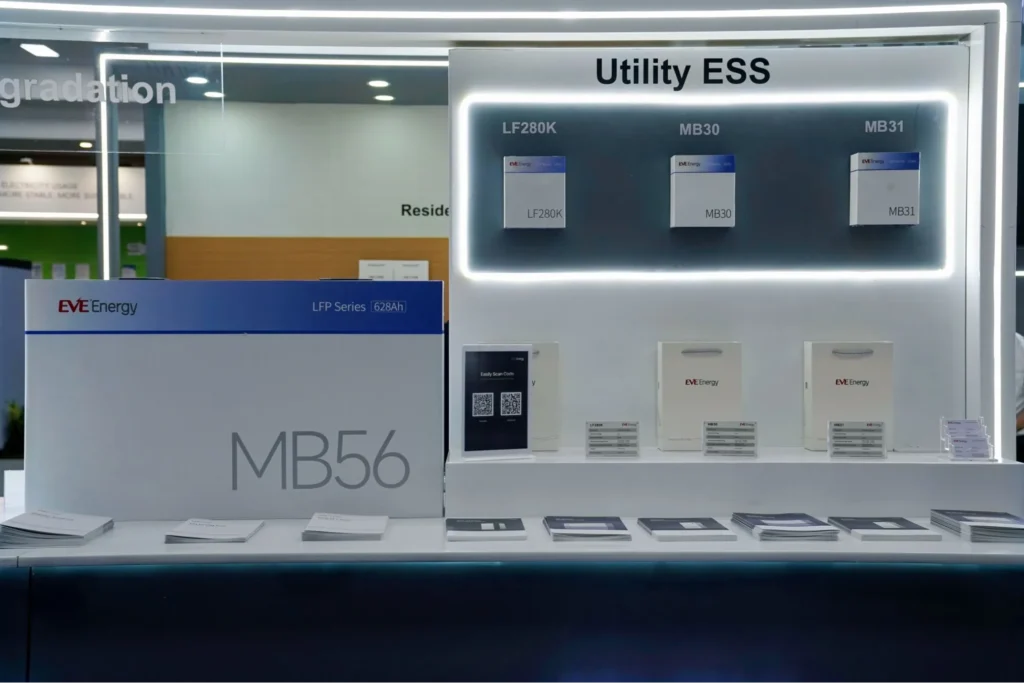
The company’s storage story is tied to large format LFP cells. In 2025, EVE Energy promoted its 628 Ah Mr. Big cell and 5 MWh Mr. Giant system as tools to simplify power station management.
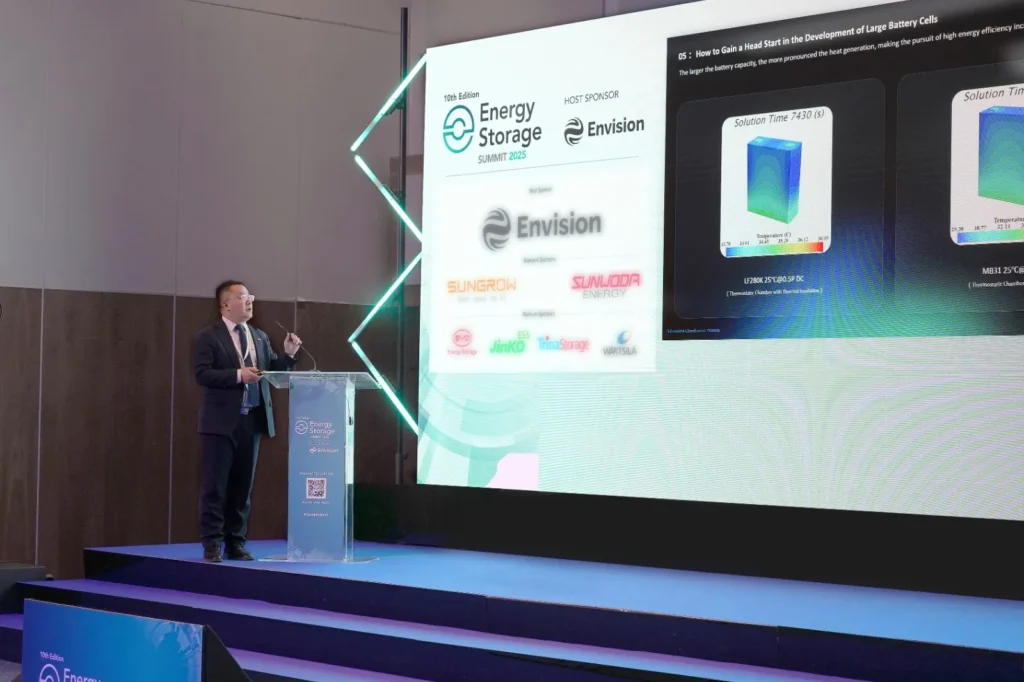
At the London Energy Storage Summit 2025, the company said the 628Ah cell could halve the number of data collection points at power stations of the same scale and reduce lifecycle operating costs by 30 percent.
A BESS buyer is not only buying cell chemistry. It is buying integration architecture, thermal design, monitoring simplicity, safety logic, delivery reliability, and service response.
China’s policy environment strengthens the case for storage. In September 2025, China announced a plan to reach more than 180 million kilowatts of installed new-type energy storage capacity by 2027. The plan is expected to drive about RMB 250 billion, or about $35.2 billion, in direct project investment.
For EVE Energy, this matters because domestic scale gives suppliers a deep proving ground before global expansion. For global buyers, China’s storage market is a living laboratory for cost compression, system integration, and large-project delivery.
In February 2026, EVE Energy said a 200MW, 400 MWh independent energy storage station using 628 Ah cells had been connected to the grid. The station used 80 sets of 5MWh Mr.Giant DC energy storage systems. The company also said it signed a future 10GWh large battery systems cooperation agreement with Beijing Guowang Technology.
The strategic value is not the headline alone. It is the shift from product launch to grid-scale validation. Battery buyers have learned to be cautious with laboratory claims. What matters is deployment data, manufacturability, and service performance under real operating conditions.
The 2025 annual report also highlighted developments in sodium-ion and solid-state technologies. It said EVE Energy had planned a 100MWh solid-state battery production base and that sodium-ion battery energy storage systems had entered operation. It also said the EVE sodium energy headquarters project had begun construction, with a planned annual capacity of 2 GWh.
Lithium iron phosphate remains central in grid storage today. Sodium ions and solid-state are strategic options, not proof that the market has already moved. For investors and technology leaders, the important point is that Chinese suppliers are preparing for chemistry diversification while still scaling LFP.
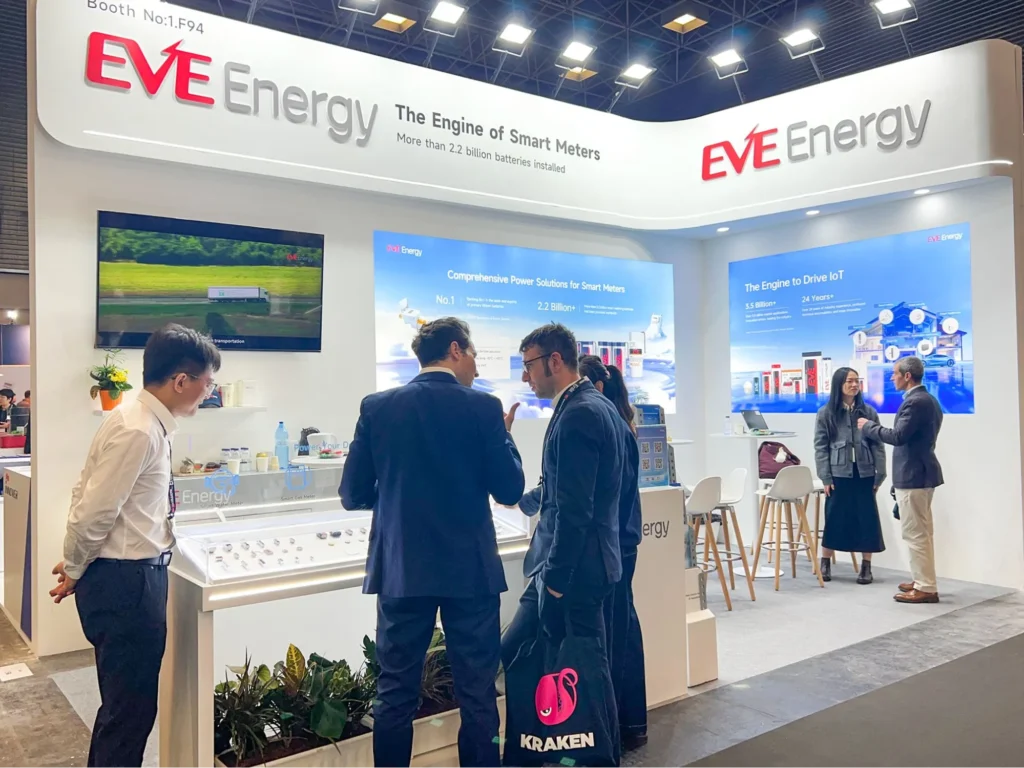
The 2025 picture is broader. EVE Energy said its global model focuses on manufacturing, cooperation, and services. Its annual report described 11 production bases worldwide, with a Malaysian base already built and the Hungarian project progressing.
This matters because global battery procurement is being redesigned around regional compliance. The EU Battery Regulation, carbon footprint disclosure, battery passports, and supply chain traceability are becoming commercial requirements. EVE Energy said in 2025 that it had launched a battery passport system to support lifecycle traceability.
For executives, the question is not simply capacity. It is how capacity is governed. Buyers should examine product certification, warranty structure, after-sales coverage, cell traceability, project references, and exposure to policy risk in target markets.
For investors, the key question is margin quality. Storage shipments can grow quickly, but price pressure can compress profitability. In 2025, EVE Energy reported a 12.28 percent gross margin for storage batteries, lower than that of consumer batteries and power batteries. That mix deserves attention as EVE Energy scales further into BESS.
EVE Energy is best understood as a supplier that reflects China’s battery sector entering a more complex phase. The market is no longer only about who has the biggest EV battery share. It is about multi-segment resilience, large-scale storage products, regional manufacturing, and compliance systems that support international buyers.
For automotive companies, EVE Energy is relevant in commercial vehicles, large cylindrical cells, and localized European supply. For energy developers, it is relevant in grid-scale storage, 5MWh systems, large LFP cells, and full-scenario storage solutions. For investors, it offers a view into how a Chinese battery manufacturer balances EV demand with the faster-moving storage cycle.
The biggest lesson is that China’s battery supplier base is widening. CATL and BYD still set the benchmark, but companies like EVE Energy show how second-tier global champions can compete through specialization, speed, and application depth. In 2026, that makes EVE Energy one of the Chinese battery names global strategy teams should track closely.
Need sharper insight into EVE Energy, China’s battery supply chain, or the companies shaping EVs and storage? Chozan helps global leaders decode China through executive briefings, learning expeditions, custom research, expert calls, and digital transformation consulting.
Book a consultation to turn China market intelligence into a practical strategy.
EVE Energy makes consumer, power, and energy storage batteries. Its product scope includes lithium primary batteries, cylindrical cells, passenger-vehicle batteries, commercial-vehicle batteries, and storage batteries for grid, industrial, and commercial applications.
EVE battery usually refers to battery products made by EVE Energy or sold through related channels. Buyers should verify product datasheets, distributor authorization, warranty terms, and certification documents before purchasing cells or storage systems.
Yes, EVE Energy is a meaningful global EV battery supplier. SNE Research data reported by CnEVPost ranked Eve Energy eighth globally in 2025 EV battery installations, with 31.3 GWh and a 2.6 percent share.
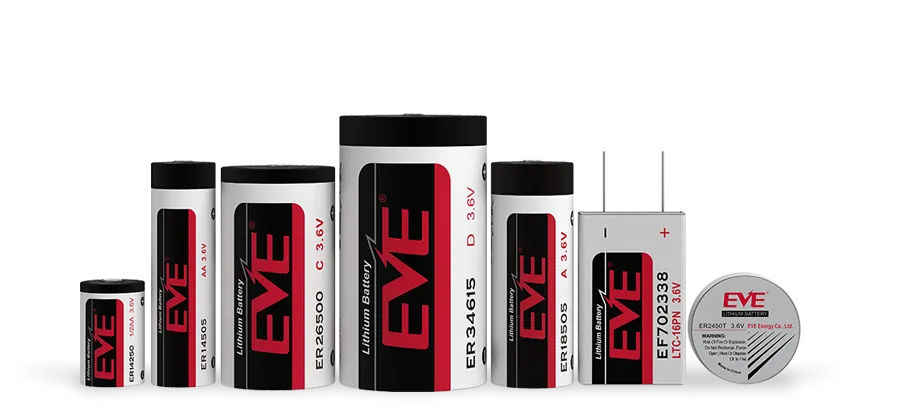
Eve lithium battery products are used across consumer electronics, smart meters, power tools, electric vehicles, commercial mobility, marine power, and energy storage. The company’s current portfolio spans consumer batteries, power batteries, modules, BMS, and battery systems.
Buyers are searching for Eve Energy Storage because the company has become active in large-format LFP cells and BESS systems. Its 2025 storage battery shipments reached 71.05 GWh, according to its annual report.
EVE Energy BESS usually refers to EVE battery energy storage system products or cells used in BESS projects. Developers should compare cell format, system integration, liquid cooling, safety design, LCOS assumptions, and long-term service terms.
Eve Energy Storage Co Ltd is commonly used in searches for EVE’s storage business and related subsidiaries. The 2025 annual report lists EVE storage-related entities, including Wuhan EVE Energy Storage and EVE Energy Storage Malaysia.
EVE Energy is smaller than CATL, but it is a serious competitor in storage. InfoLink listed CATL, Hithium, EVE Energy, BYD, CALB, and REPT BATTERO among the top six global storage cell suppliers in 2025.
Yes, EVE Energy sells outside China and is expanding overseas capacity and service. Its 2025 report said overseas revenue reached RMB 14.48 billion, equal to 23.56 percent of total revenue.
EVE Energy is important because it shows China’s battery sector moving beyond EV scale alone. Its growth combines commercial vehicles, grid storage, overseas localization, digital traceability, and new chemistry options.