CONTENT

GoodWe connects solar inverters with energy storage through three coordinated layers: a hybrid or AC-coupled power converter, an approved battery with battery management communication, and software that directs energy between solar panels, loads, storage, and the grid. This matters because the value of storage depends on system coordination, not battery capacity alone.
The Suzhou company now sells that coordination across homes, businesses, and larger projects. Its current portfolio spans grid-connected products, battery-ready systems, hybrid inverters, batteries, backup equipment, smart meters, and energy management software. The result is a platform strategy built around controlling energy flow across the full installation.
The financial mix shows how central storage has become to GoodWe Technologies. Its 2025 annual report recorded RMB 8.89 billion ($1.31 billion) in revenue. Grid-connected PV inverters generated RMB 2.56 billion. Storage inverters generated RMB 956 million, while storage batteries produced RMB 1.55 billion ($378 million).
Storage inverter and battery revenue therefore represented about 28% of total company revenue, based on the reported categories. Overseas revenue reached RMB 3.64 billion ($538 million), or about 41% of the total. These figures show a Chinese inverter producer building a larger business around paired hardware, software, and services rather than relying on one conversion device.
The product direction reinforces that reading. New storage systems arrived in May 2025, followed by the global SEMS+ software launch in January 2026.
A GoodWe solar inverter converts PV direct current into alternating current for on-site use or grid export. Storage adds bidirectional conversion and control.
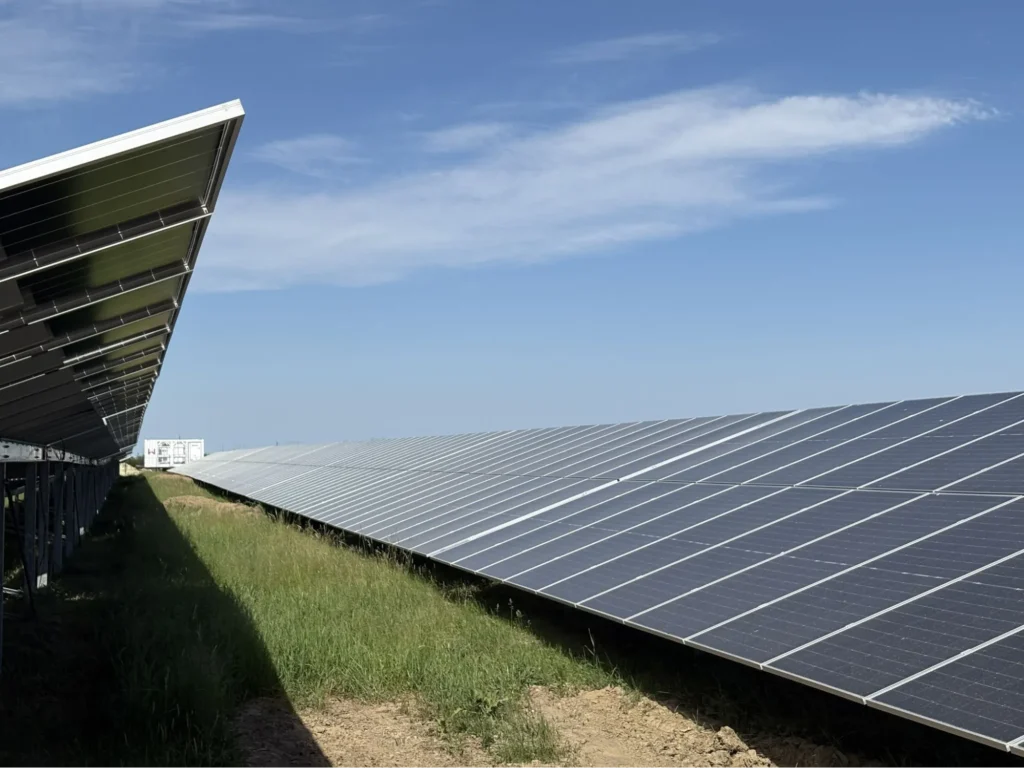
In a DC-coupled system, PV power reaches the inverter through maximum power point trackers. The inverter can serve loads, charge the battery, export surplus power, or discharge stored energy after solar production falls. A smart meter measures electricity at the grid connection point. The control layer applies rules for self-consumption, timed charging, export limits, and backup reserve.
The battery management system shares state of charge and operating limits with the inverter. Voltage alignment alone is insufficient because communications and firmware must also match. GoodWe maintains a current battery compatibility document for low voltage, high voltage, commercial, and US-specific configurations.
Standard grid-tied inverters lack a direct battery interface. The DNS Series, including DNS G3, converts solar for onsite use and grid export, but a battery cannot connect directly to its DC input.
An existing GoodWe solar installation can add storage through an AC-coupled battery inverter such as SBP G2, subject to compatibility and local rules. Another option is a hybrid replacement. The presence of monitoring does not prove battery compatibility.
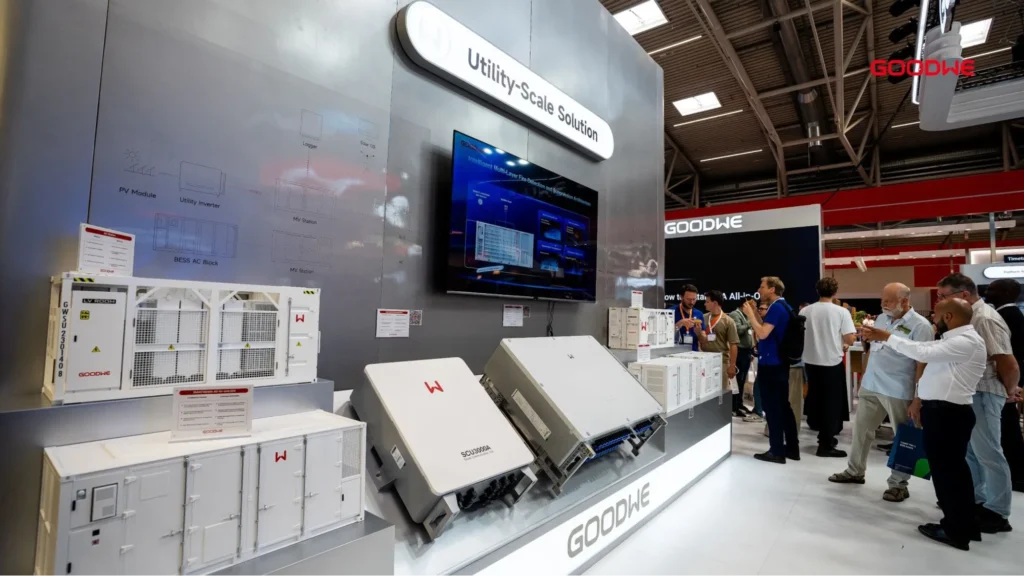
The right product depends on phase configuration, battery voltage, backup loads, retrofit status, and power. The current global product portfolio supports this practical map.
| Product family | Architecture | Best fit | Key decision |
| DNS Series G3, 3 to 6 kW | Single phase, grid connected | Residential solar without direct storage | Later storage needs an AC-coupled route or new inverter hardware |
| EH Series Plus+, 3.6 to 6 kW | Single phase, battery ready, high voltage | Solar first, storage later | An activation code enables storage; the battery must be approved |
| ES Series G2, 3 to 6 kW | Single phase hybrid, low voltage | Home storage and backup | Check battery, firmware, generator needs, and backup limits |
| ET Series G2, 6 to 15 kW | Three-phase hybrid, high voltage | Larger three-phase homes | Offers up to three MPPTs, a built-in meter, and scalable storage |
| ET Series, 15 to 30 kW and higher | Three-phase hybrid, high voltage | Large homes and commercial and industrial solar | Match peak demand, phase balance, storage power, and expansion plans |
The 2025 ET G2 launch added 6, 8, 10, 12, and 15 kW models. It supports up to 160% PV oversizing, as many as three MPPTs, and paired high-voltage batteries. Project-specific design still determines system fit.
GoodWe inverters work with Lynx batteries and approved third-party products. The documented list provides choice while requiring precise model and firmware checks.
The company’s GoodWe solar battery range covers low-voltage and high-voltage home systems plus commercial cabinets. The 2025 Lynx Home F G2 manual lists 6.4 to 28.8 kWh for one cluster.
SolarGo supports local commissioning, settings, battery selection, firmware work, and troubleshooting. Inverter monitoring and portfolio control sit in SEMS+.
The SEMS+ launch announcement says the platform connects more than 13 device categories, including compatible third-party equipment. It adds station controls, energy flow views, battery analysis, and scheduling based on usage, weather, and tariffs. This is the center of smart energy management across the system.
Hardware creates the installed base. Software extends the relationship through diagnostics, operating modes, EV chargers, and heat pumps.
Commercial storage requires more than a larger home battery. Power conversion, thermal management, fire protection, site controls, peak demand logic, and expansion planning become central.
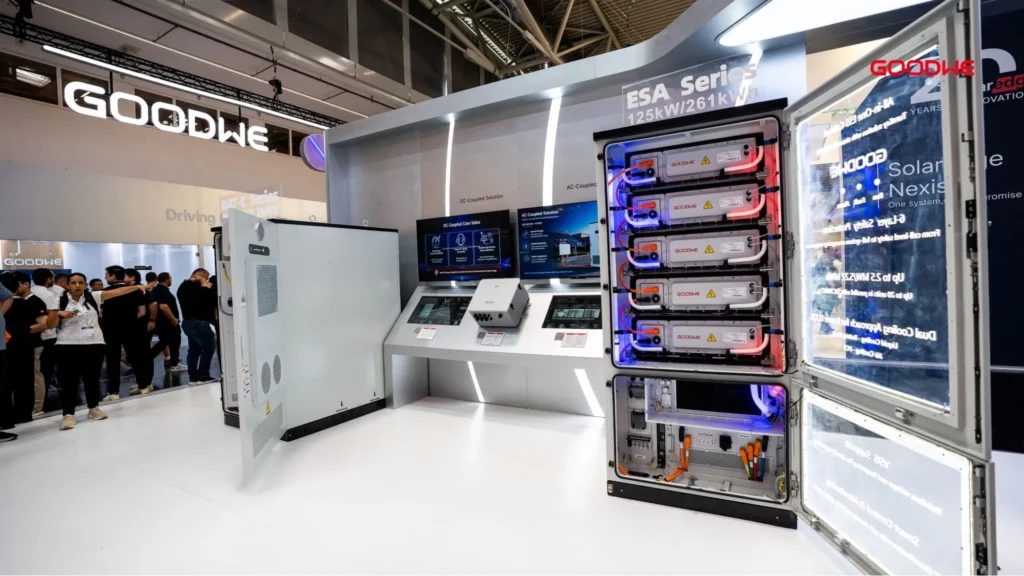
GoodWe launched a 125 kW and 261 kWh ESA all-in-one commercial system in August 2025. It integrates the power conversion system, battery, energy management system, and battery management system in one cabinet. The company’s launch information says up to 20 units can operate in parallel, reaching 5.22 MWh in grid-connected configurations.
The integrated design simplifies interfaces but increases supplier concentration. Buyers should examine service, spare parts, software access, warranties, cybersecurity, and third-party controls.
Product selection should start with the operating goal, then move to the equipment.
GoodWe shows how Chinese solar companies are moving up the value chain. The inverter remains essential, but value is shifting toward integrated storage, controls, software, and service. The company’s 2025 revenue mix gives that strategy commercial weight, while its 2026 SEMS+ launch adds a stronger digital layer.
System fit remains the central buyer question. A matched GoodWe inverter, battery, meter, backup design, and platform can operate as one system. Poor matching can restrict functions, delay commissioning, and weaken project economics.
ChoZan helps global teams understand what GoodWe reveals about China’s move toward integrated smart energy. Our research and advisory, strategy workshops, China learning expeditions, innovation tours, expert calls, and strategy dialogues connect product releases with competitive positioning, supply chain shifts, and market entry decisions. Book now to turn current China intelligence into a practical strategy.
Yes, selected GoodWe inverters support approved third-party batteries. Compatibility depends on the exact inverter, battery model, communications protocol, firmware, and region. Installers should check the latest official compatibility list before ordering or commissioning equipment.
Battery ready means the inverter contains storage capability that requires later activation. A fully enabled GoodWe hybrid inverter can manage a compatible battery once commissioning is complete. Backup still requires the correct wiring, protection, and supported operating mode.
Some storage configurations support scheduled grid charging through an economic or time-based mode. Availability depends on the inverter, firmware, tariff, and local regulation. The installer should confirm that grid charging is permitted before enabling the setting.
It can support whole home or selected load backup only when inverter power, battery output, phase arrangement, surge demand, and transfer equipment are sized correctly. Large motors, heating equipment, and air conditioners require careful starting current calculations.
A standard grid-connected unit shuts down for anti-islanding safety. A compatible storage system can continue serving approved backup circuits after grid isolation, provided the battery has sufficient charge and the required backup or transfer equipment is installed.
Kilowatts measure how much power the battery and inverter can deliver at one moment. Kilowatt hours measure stored energy and approximate runtime. Strong backup needs adequate values for both, based on simultaneous loads and desired duration.
No. SolarGo focuses on local device commissioning, settings, firmware, and service work. SEMS+ provides remote plant visibility, cross-device coordination, alerts, analysis, and higher-level energy control for owners, installers, and operating teams.
Compatible systems can limit export when paired with the correct smart meter, communications equipment, and configuration. Local grid rules still govern permission and settings. The commissioning process should include meter direction checks and a witnessed export control test.
Compare phase type, nominal power, MPPT count, battery voltage, charging power, backup output, switching equipment, communications, approved batteries, and regional certification. Warranty coverage and local service capacity deserve equal weight alongside headline electrical specifications.
Some commercial configurations support third-party energy management protocols, but access varies by controller, firmware, and project design. Confirm available interfaces, write permissions, data frequency, cybersecurity controls, and responsibility for future software updates before procurement.