CONTENT
China’s lithium-ion battery industry is entering a mature phase. Consolidation is accelerating, technology cycles are shortening, and global customers now want more than low cost per kilowatt-hour. They need resilient supply chains, bankable technology roadmaps, and suppliers that can scale across EVs and energy storage. Sunwoda fits that role with growing clarity.
The company is best known for consumer electronics batteries, ranking first globally in mobile phone battery shipments and second in laptop and tablet battery shipments. Today, its business spans six segments: 3C batteries, power batteries, energy storage batteries, energy services, smart hardware, and industrial ecological innovation.
This expansion matters because battery demand is shifting fast. In 2025, global EV battery deployment reached 1.2 TWh, up almost 30 percent from 2024. China accounted for 60 percent of global EV battery deployment, over 80 percent of battery cell production, and about 85 percent of EV battery cathode active material output. Within that ecosystem, Sunwoda is no longer just a 3C battery player.
China’s battery advantage is built on proximity. Materials, components, cell manufacturing, pack design, vehicle production, and storage deployment are closely linked. This allows Chinese suppliers to move faster across cost reduction, product iteration, and customer engineering.
That market pressure became clearer in 2025, when average battery prices fell 8 percent. Battery energy storage systems saw some of the sharpest price declines among major applications. For global buyers, this creates an important sourcing question. The strongest Chinese suppliers are not only competing on price. They are competing through speed, engineering support, application knowledge, and the ability to serve multiple demand cycles.
Sunwoda fits into this system as a diversified battery manufacturer with exposure to consumer electronics, electric vehicles, and energy storage. That breadth gives the company more than one growth path, which makes it a supplier worth tracking even though it is smaller than China’s largest battery champions.
The commercial base behind Sunwoda battery still comes from consumer electronics. Sunwoda has long been associated with 3C batteries, where scale, compact design, process control, and high-volume quality management matter.
In 2025, Sunwoda reported total operating revenue of RMB 63.246 billion, up 12.90 percent year-on-year. Industry reports said consumer batteries generated RMB 31.41 billion, electric vehicle batteries RMB 18.91 billion, and energy storage RMB 2.31 billion.
This mix shows the company’s current position. Consumer batteries remain the main revenue base. EV batteries and storage are the strategic growth areas. For teams comparing battery manufacturer Sunwoda with CATL, BYD, EVE Energy, or CALB, the key question is how well its electronics manufacturing discipline transfers into automotive safety, grid reliability, and overseas project delivery.
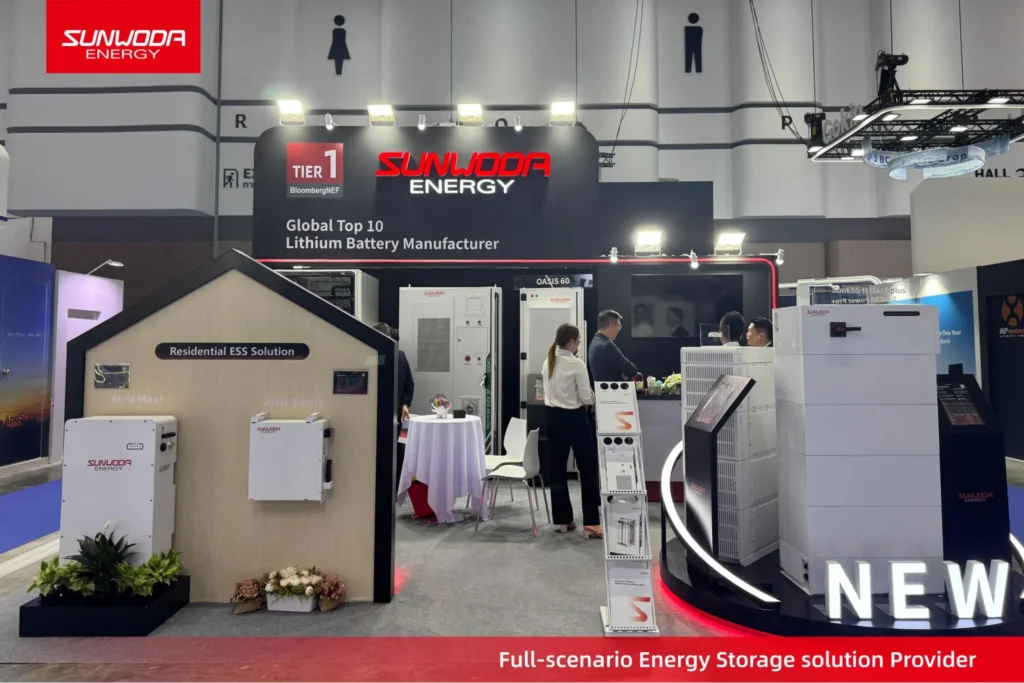
The Sunwoda EV battery business is moving closer to automaker programs. In November 2025, Sunwoda said it had entered Volkswagen AG’s high-voltage battery supplier system for HEV battery pack supply. That signals stronger access to global OEM procurement standards.
The company also expanded its role with Chinese automakers. In October 2025, Li Auto and Sunwoda Power Technology formed Shandong Li Auto Battery Co., Ltd. Each side holds 50 percent, with registered capital of RMB 300 million. The joint venture focuses on lithium-ion power batteries for electric vehicles, with mass production targeted for 2026.
Capacity planning supports this push. In June 2026, reports said Sunwoda secured environmental approval for a RMB 5.367 billion new-energy battery project in Beijing’s Shunyi district. The plan includes four lithium-ion cell production lines and four pack assembly lines, with an annual capacity of 41.32 GWh after completion.
These moves show how Sunwoda EVB is trying to compete through customer proximity, pack capability, and program integration.
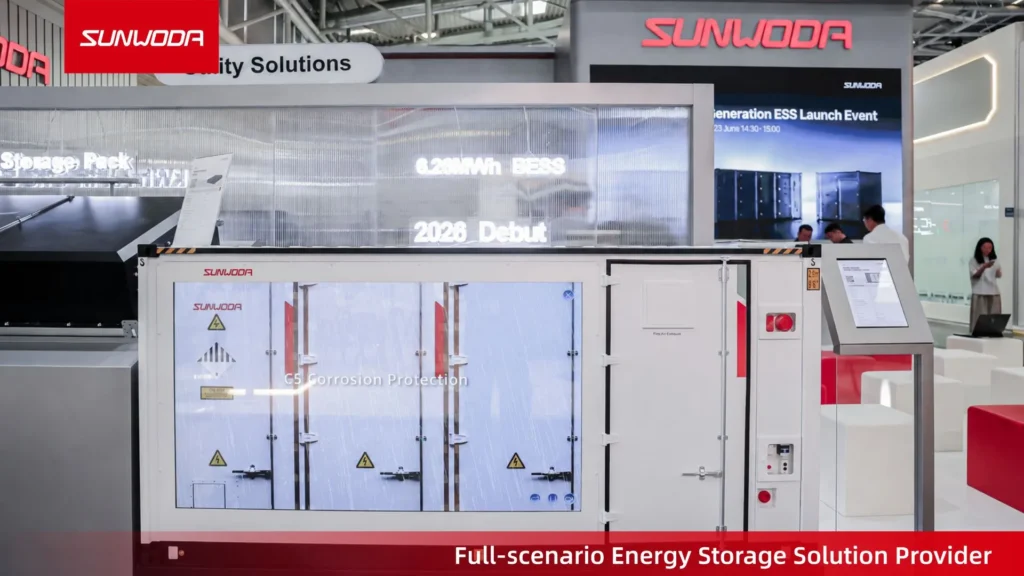
Storage gives Sunwoda a second growth lane as buyers assess residential storage, commercial and industrial systems, telecom backup, data center power, and utility-scale projects.
Sunwoda Energy lists products across energy storage cells, residential ESS, network energy, commercial and industrial ESS, and utility-scale containerized liquid-cooling BESS. The company states that Sunwoda Energy has 22.33 GWh of accumulated ESS installed capacity, projects in more than 100 countries, and BNEF Tier 1 Energy Storage Manufacturer status.
China’s policy direction supports this opportunity. In 2025, the NDRC cited a roadmap expecting China’s new energy storage capacity to exceed 180 million kilowatts by 2027, 240 million kilowatts by 2030, and 300 million kilowatts by 2035.
At the World Future Energy Summit 2026, Sunwoda showcased storage solutions for the Middle East, including a 5.015 MWh ESS and a 261 kWh all-in-one liquid-cooling ESS.
For global strategy teams, the key point is simple. Storage is a system business. Product selection depends on cooling, safety, grid connection, lifecycle economics, installation partners, and service coverage.
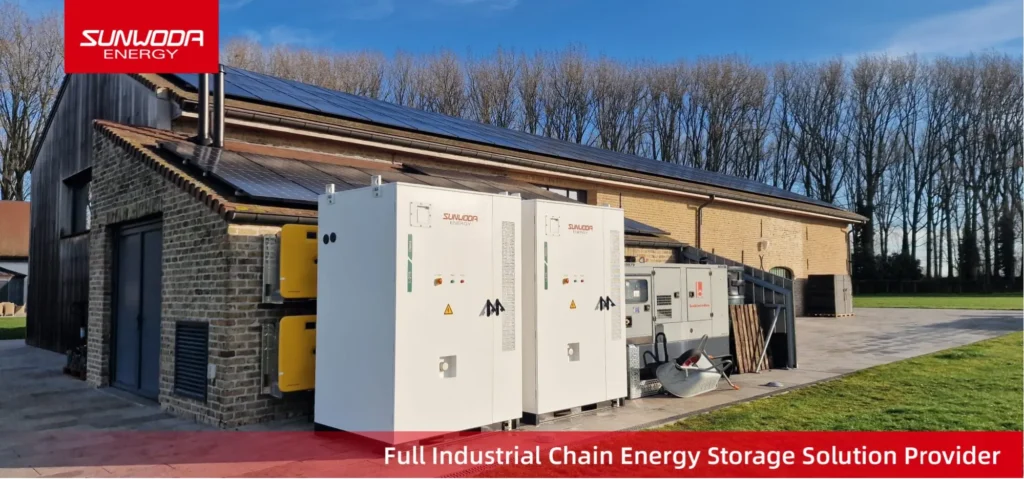
The strongest way to read about Sunwoda lithium battery innovation is through use cases. Sunwoda is developing products for different operating conditions rather than relying on one broad battery message.
At CIBF 2026, Sunwoda presented a motorcycle ultra-fast-charging battery that pairs with 6 kW chargers to reach an 80 percent state of charge in 20 minutes. The company also claimed more than 2,000 cycles, a five-year service life, IPX7 waterproofing, and compatibility with over 90 percent of battery swap stations.
Marine batteries show another path. In May 2026, Sunwoda unveiled a marine battery portfolio and said two 3,000-ton methanol hybrid container ships under construction would use its marine battery systems based on 268 Ah cells.
These examples show where battery competition is heading. Light mobility, marine electrification, commercial storage, residential storage, and data center backup each require different assumptions around charging speed, safety, packaging, cycle life, and service.
A serious view of Sunwoda needs a risk lens. In February 2026, Reuters reported that a Sunwoda subsidiary settled a lawsuit with Vremt, Geely’s battery unit, related to earlier alleged defective cell supplies.
Reuters said the settlement was expected to affect Sunwoda’s 2025 net profit by RMB 500 million to RMB 800 million, equivalent to about $72.06 million to $115.3 million at the exchange rate used in the report.
For buyers, this makes due diligence essential. Battery sourcing should cover warranty exposure, traceability, certification records, safety testing, field performance, recall response, service coverage, spare parts access, and project references.
For investors, the issue highlights the cost of moving from consumer electronics into automotive and storage markets. Scale brings opportunity, but failures are more costly when batteries operate in vehicles, homes, data centers, and grid assets.
Sunwoda reflects a broader pattern in Chinese batteries. Chinese suppliers are shifting from product sales to ecosystem positions that integrate cells, packs, energy storage systems, OEM relationships, and international project delivery. Sunwoda is still smaller than the dominant battery champions, but its 2025 revenue mix, EV partnerships, storage portfolio, and 2026 product activity make it commercially relevant.
For global leaders, the sharper question is where Sunwoda’s capabilities match market gaps. In EVs, that may mean hybrid, pack, and localized production programs. In storage, it may mean commercial and industrial systems, data center backup, or utility-scale projects where China’s cost curve remains powerful.
For leadership teams assessing Sunwoda, Chinese battery suppliers, EV supply chains, or energy storage opportunities, Chozan provides China-focused research, executive briefings, learning expeditions, workshops, expert calls, and market strategy support. Book a consultation to turn supplier intelligence into clearer decisions.
Yes, Sunwoda is publicly listed. Its official investor materials show stock name Sunwoda and stock code 300207, which matters for buyers checking disclosures, financial reports, governance, and supplier transparency before approval.
Sunwoda EVB is the electric-vehicle battery business affiliated with Sunwoda. Its official power technology page describes solutions across battery cells, modules, BMS, and PACK systems for power-battery and energy-storage applications.
Sunwoda battery includes more than packs. Sunwoda’s power technology business covers research, development, production, and sales of battery cells, modules, BMS, and PACK systems for new energy vehicle and storage customers.
Sunwoda Energy is the energy storage arm of the wider Sunwoda Group. Searchers use Sunwoda energy technology to find ESS products, distributor information, technical support, and energy storage solutions.
Buyers can find official Sunwoda financial reports on the company’s investor page. It lists recent files, including the 2025 annual report and the 2026 first-quarter report, which are useful for supplier reviews.
Yes, Sunwoda Energy provides distributor-related information through its ESS site. The page includes product categories, support services, download resources, partner options, and a distributor list for market access checks.
Buyers should check Sunwoda’s certifications, warranty terms, grid code fit, thermal design, installation support, monitoring software, and local service partners. These details matter because BESS performance depends on system integration, not cells alone.
Yes, Sunwoda lithium battery research is linked to solid-state development. In 2025, industry coverage reported Sunwoda’s 400 Wh/kg polymer solid-state cell and related pilot-line activity.
Buyers can verify battery manufacturer Sunwoda through official financial reports, product documentation, certifications, customer references, site audits, and warranty terms. For regulated projects, legal entity matching and after-sales responsibility should be checked early.
欣旺达 is the Chinese name of Sunwoda, so it is useful for finding local filings, Chinese media coverage, supplier documents, and product announcements. Global teams should search both names when building a fuller supplier picture.