CONTENT

China’s factory floors have quietly become the proving ground for one of the most consequential shifts in industrial logistics. The automated guided vehicle is no longer a novelty reserved for flagship smart factories. It has become standard infrastructure across electronics assembly, automotive parts supply, e-commerce fulfillment, and heavy manufacturing.
China’s manufacturing labor pool has tightened, and wages have climbed steadily across the coastal industrial belt. At the same time, order volumes from e-commerce and export manufacturing have grown more volatile and less predictable.
Factories that once absorbed demand swings with temporary labor now need material handling systems that scale without a hiring cycle. That combination has pushed automated guided vehicles from pilot projects into core operational infrastructure.
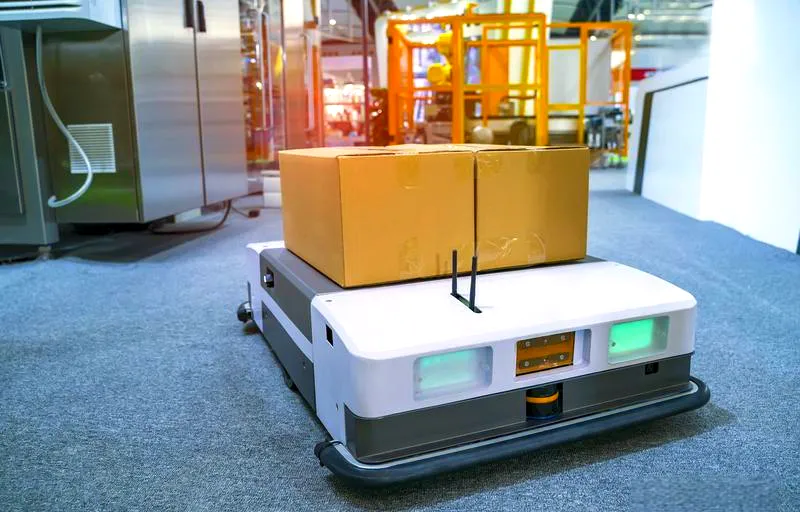
Chinese manufacturing has spent years automating individual production steps. The next operational challenge lies between them, as components and finished goods still need reliable movement across the site.
This is where automated guided vehicles fit. They standardize repetitive movement and reduce manual dispatch on predictable routes. In high-volume plants, transport consistency can protect line rhythm.
In 2025, the Chinese mobile robot market, which includes both AGVs and autonomous mobile robots (AMRs), reached 261 billion yuan in sales, with 182,000 units sold. This represents 18.1 percent year-on-year growth in value and nearly 31 percent growth in volume.
More importantly, the automated guided vehicle market in China is now valued at 180 billion yuan, with a compound annual growth rate exceeding 30 percent. Projections put the Chinese market at over 450 billion yuan by 2030.
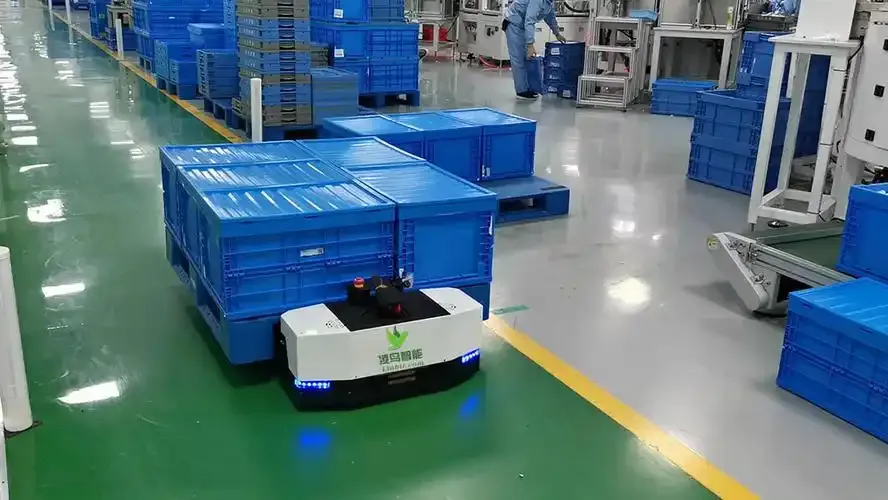
An AGV robot moves materials through a facility according to defined routes, digital maps, or controlled traffic rules. Traditional models rely on fixed-path navigation such as magnetic tape guidance or physical markers. Newer vehicles use laser navigation, natural feature positioning, cameras, and LiDAR.
Some modern AGV robots can detect obstacles, select alternate paths, and adapt to changing conditions. KION noted in 2025 that guided vehicles increasingly use sensors, cameras, and machine learning in existing warehouses.
Magnetic tape guidance remains useful in stable production environments. The route is visible, the operating logic is easy to understand, and the vehicle follows a controlled path. This can suit repetitive line feeding where processes change slowly.
A layout change may require new tape, markers, traffic rules, or validation. The tradeoff can still suit sites that value predictable movement and simple maintenance.
The most consequential technical shift in the automated guided vehicle space is the migration from fixed path to autonomous navigation. In 2021, laser reflector navigation and magnetic tape guidance together accounted for nearly a quarter of the market. In 2025, laser reflector navigation had collapsed to 2.64 percent, and magnetic guidance to 6.59 percent.
The reason is straightforward. Fixed-path systems require physical infrastructure that cannot adapt to changing production lines or warehouse layouts. They are brittle in an era of flexible manufacturing.
SEER Robotics introduced its SPT 1000 intelligent forklift in 2025 with laser SLAM, natural feature localization, QR codes, and reflective plates. The product also uses AI-based pallet recognition for difficult load conditions.
Multi-sensor fusion systems achieve positioning accuracy of ±2 millimeters in complex environments. The新一代视觉 SLAM systems recorded fault rates of just 0.3 incidents per thousand operating hours in dynamic obstacle avoidance scenarios in 2025
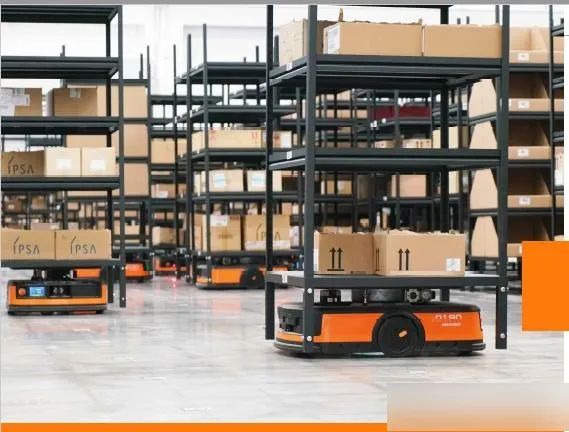
Factories use AGVs to move components, work in progress, tools, packaging, and finished assemblies. Tugger AGVs pull carts on scheduled milk runs, while low-profile and heavy platforms serve specialized loads.
At the Lynk & Co automobile plant in Zhangjiakou, Hebei Province, 31 5G-enabled intelligent navigation AGVs now handle 21 material-handling scenarios. The AGVs operate without magnetic tape or QR code guidance, using 5G专网 connectivity and laser SLAM navigation to navigate the complex assembly environment.
The results are concrete. The system reduced total assembly logistics personnel by 14 workers per two-shift operation, eliminated seven traditional tow vehicles, and cut annual costs by 1.5 million yuan. More importantly, the system can adapt to production line changes without re laying floor infrastructure, supporting the factory’s flexible production needs.
The heavy equipment sector shows similar momentum. In July 2025, the Shanqi Automobile Equipment Manufacturing Plant deployed its first self-developed underride lifting AGV, marking a transition from traditional manufacturing to intelligent logistics.
In the aerospace sector, the 航天科技集团’s 803 Institute implemented an intelligent 仓储物流 system in which AGVs transport materials between floors via vertical lift systems. The system integrates with WMS and MES platforms, enabling automatic material requisition, delivery, and inventory updates.
Food and beverage manufacturers are also scaling AGV deployments. In September 2025, JingSong Intelligence was selected as the lead bidder for COFCO Coca-Cola’s black warehouse AGV project in Shaanxi Province.
The project, part of a 1 billion yuan investment in a digital intelligent factory, deploys 大批量 dual-fork counterweight FMR robots capable of simultaneous dual-pallet handling at speeds up to 3.2 meters per second. The system manages raw material replenishment and finished goods turnover across the entire plant.
Warehouse automation represents the second major frontier for automated guided vehicle technology in China. The shift from “people hunting for goods” to “goods coming to people” is accelerating across ecommerce, retail, and third-party logistics.
The numbers reflect this transformation. By 2025, the global 仓储自动化 solutions market is expected to exceed 500 billion yuan, with the Asia-Pacific region showing the highest growth rate.
China’s intelligent logistics market alone reached approximately 120 billion yuan, with mobile automation equipment emerging as the fastest-growing segment. The AGV warehouse is becoming standard infrastructure, not experimental technology.
A case in point is the partnership between Shandong China Post and China National Heavy Duty Truck Group. The project introduced intelligent仓储 systems and automated equipment that颠覆ed the traditional “people find goods” warehouse model. The results were dramatic.
This is not an incremental improvement. This is a structural transformation.
The dairy industry provides another example.
Beizhi Technology helped a dairy manufacturer build what it describes as the world’s first liquid milk “lighthouse factory”. The system uses AGVs for automatic material unloading, palletizing, and transport to dense storage areas, followed by fully automated material feeding. The entire process runs without manual intervention from supplier delivery to production line feeding.
What makes these warehouse deployments commercially compelling is the integration layer. The AGV system does not operate in isolation. It connects to warehouse, order, and transportation management systems. This integration enables real-time inventory visibility, dynamic task allocation, and data-driven performance optimization. The value proposition extends beyond labor savings to inventory accuracy, space utilization, and order accuracy.
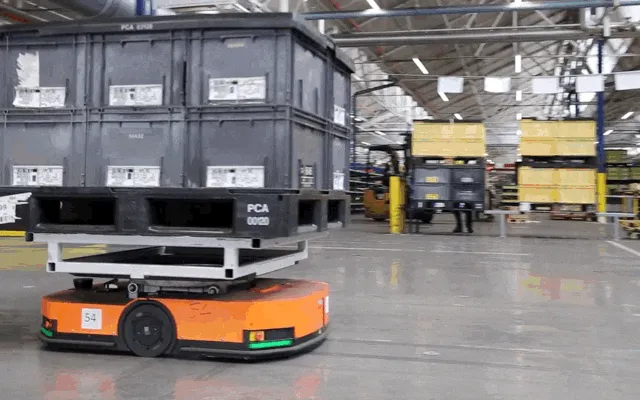
Hardware remains important, but fleet intelligence is becoming the main source of operational value. The larger system decides which vehicle receives a task, which route it takes, how traffic conflicts are handled, and when to charge.
HIKROBOT’s current software architecture illustrates this direction. Its warehouse management and robot control platforms connect with enterprise systems, dispatch multiple robot types, plan routes, manage traffic, and balance tasks across fleets.
Quicktron has taken a similar path through unified scheduling for different robot formats. Its 2025 portfolio linked autonomous forklifts with storage, picking, conveyors, elevators, robotic arms, and line-side delivery.
The shift changes supplier evaluation. Buyers need to assess integration tools, simulation, cybersecurity, maintenance, and local service alongside payload and speed. A low vehicle price can lose its appeal if commissioning is slow.
Overseas projects also require compliance with standards, documentation, spare parts, and responsive service. Leading vendors are investing in certification, partner networks, and localized support.
Start with the movement problem rather than the vehicle catalog. Map each origin, destination, load type, pickup method, delivery window, and exception. Strong targets have stable demand, repeated travel, clear handoff points, and measurable cost.
Match navigation to operating reality. Fixed path guidance can work well for stable loops. Laser navigation suits more complex routes. A hybrid approach can combine flexible travel with precise docking.
Then test the full automated guided vehicle system against real site conditions:
A pilot should measure completed missions, wait times, interventions, charging, congestion, pickup accuracy, and uptime over a full shift.
Safety also needs process design. Speed zones, pedestrian crossings, load stability, emergency procedures, traffic priority, and staff training must be tailored to the actual facility.
Automated guided vehicles are one part of China’s broader transformation in manufacturing, logistics, AI, and industrial automation. At ChoZan, we help business leaders, investors, and innovation teams understand the technologies, companies, and business models shaping China’s industrial future through custom research, strategic consulting, executive workshops, and immersive China Learning Expeditions.
Book a consultation to discuss your business objectives, commission tailored China research, or explore how China’s automation ecosystem can inform your growth, innovation, and digital transformation strategy.
Pricing varies by payload, navigation, lift height, safety hardware, software, integration, and service scope. Chinese suppliers usually quote after reviewing the site and workflow because the vehicle price alone does not reflect the total deployment cost.
A focused pilot may take several weeks, while a larger fleet can require months of mapping, integration, testing, and staff training. Timelines depend heavily on site readiness, software interfaces, and process complexity.
AGVs can use onboard sensors for movement and safety, but fleet deployments usually need reliable wireless communication for task dispatch, traffic control, status updates, and system integration. Coverage should be tested across the full operating area.
AGVs can operate in cold environments when batteries, sensors, seals, lubricants, and charging systems are specified for the target temperature. Condensation, floor grip, and transitions between temperature zones also need careful review.
Common options include scheduled charging, opportunity charging during idle periods, and automatic battery exchange. The right model depends on shift length, fleet workload, battery chemistry, available charging space, and required uptime.
AGVs perform best on level, clean, predictable surfaces with controlled gaps and slopes. Uneven joints, damaged concrete, reflective areas, dust, water, and steep transitions can affect traction, sensing, docking accuracy, and vehicle life.
Yes. Fleet software can exchange signals with elevators, doors, conveyors, fire controls, and other equipment. Reliable integration requires clear interface ownership, safe handshakes, fallback logic, and testing under normal and fault conditions.
They can share a facility when traffic rules, route priorities, safety zones, and fleet coordination are designed together. A unified control layer can simplify mixed fleet management, but interoperability should be validated before rollout.
Routine work may include sensor cleaning, wheel inspection, battery checks, brake testing, software updates, calibration, and review of error logs. Maintenance intervals should reflect operating hours, floor conditions, payload, and environmental exposure.
Some models can work outdoors when their positioning, weather protection, tires, braking, sensing, and route design suit the environment. Outdoor projects must account for rain, glare, slopes, traffic, surface changes, and seasonal conditions.