CONTENT

China’s restaurant industry is no longer experimenting with automation. The question has shifted from “if” to “how fast” and “how much.”
In 2025, the country’s service robot market was projected to reach $40 billion, with growth at a compound annual rate of 17.1 percent to $195 billion by 2035. For restaurant operators facing relentless labor pressure and thinning margins, robot waiters have become a commercial necessity rather than a novelty.
China’s catering income reached approximately $680 billion in the first 10 months of 2025, up 3.3 percent year-on-year. The sector accounted for 11.2 percent of total retail sales in October.
For executives, the real question is no longer novelty. It is operational leverage. A restaurant robot must reduce pressure during peak-hour service, support human staff, and fit into a broader digital stack that may include POS integration, table service automation, fleet management, and RaaS models.
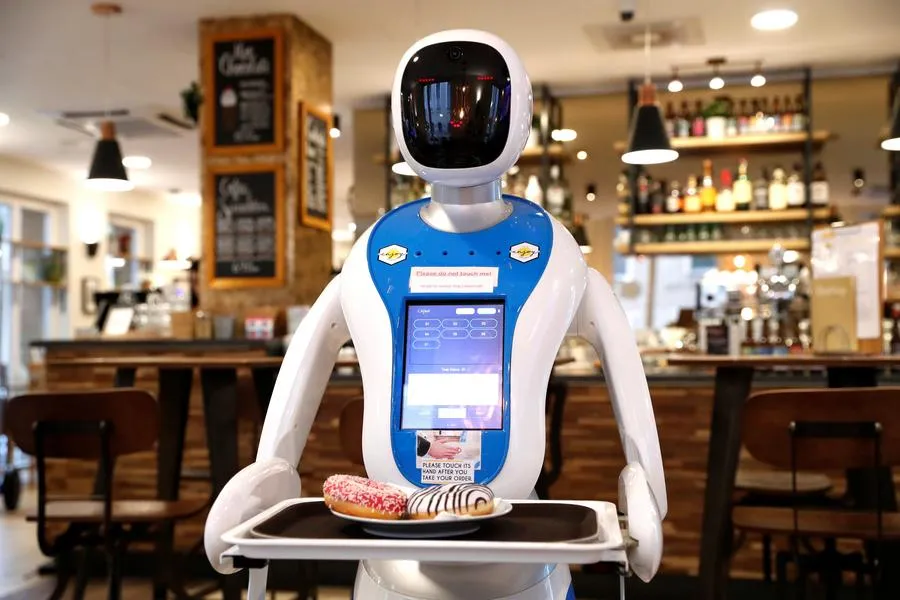
China’s restaurants face a rare mix of volume, margin pressure, and customer expectations. In September 2025, China’s catering income reached approximately $66.4 billion for the month and $603.4 billion from January to September.
This scale creates fertile ground for robots in restaurants. Dining brands do not adopt automation because it looks futuristic. They adopt it because labor allocation, tray delivery, kitchen-to-table speed, and floor efficiency affect revenue per square meter.
For China market strategists, robot waiters sit at the intersection of three forces:
| Business pressure | Automation relevance |
| Peak-hour congestion | Robots handle repeat tray delivery |
| Labor pressure | Staff focus on hospitality and selling |
| Digital operations | Fleet dashboards support better deployment |
| Customer experience | Visible tech reinforces modern brand positioning |
The best use case is not replacing staff. It is redesigning the service journey so human teams spend less time walking and more time engaging guests.
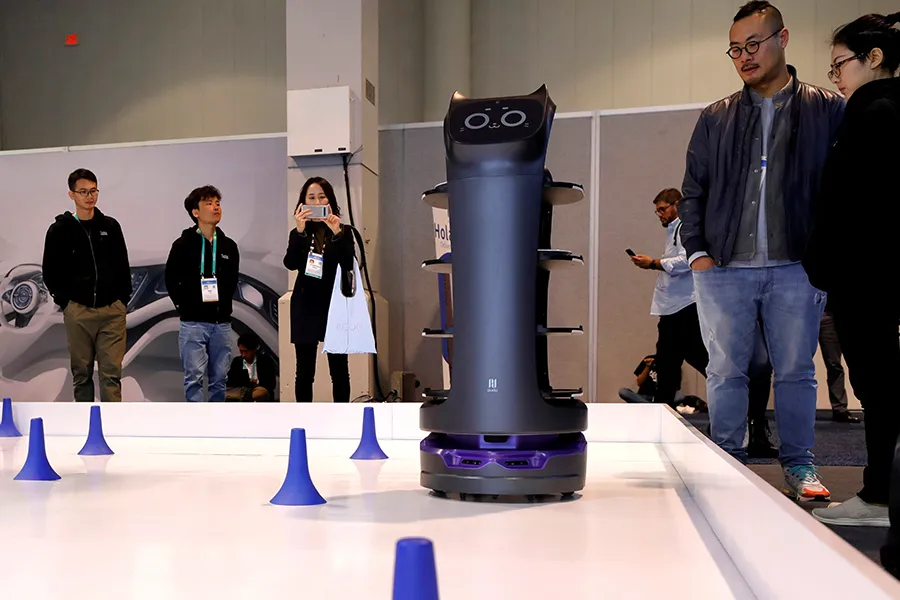
Pudu Robotics’ BellaBot Pro shows how China’s automation companies understand hospitality psychology. The product is built around delivery stability, multimodal interaction, and a customer-facing cat-inspired design.
Pudu lists the BellaBot Pro with a 40 kg maximum load, 10 kg per tray, a 4.5-hour charging time, and an 11-hour runtime when unloaded. The robot looks approachable, especially in family dining, hot pot, casual restaurants, malls, and tourist districts.
Pudu’s current product page also highlights IoT features such as Pudu Pager Calling, 4G Pudu Watch Calling, and Pudu Link Management. In May 2026, Pudu secured nearly $147 million in new funding, pushing its valuation past $1.47 billion and into unicorn territory.
The company simultaneously released two major technologies: the PuduFM 1.0, an embodied intelligence foundation model, and the PuduAgent, a general-purpose embodied intelligence platform.
These developments signal Pudu’s strategic shift toward what it calls “one brain, multiple forms,” a technology architecture designed to enable robots of different shapes and functions to operate under a unified intelligence system.
For operators, this moves the conversation from “Can the robot carry food?” to “Can the robot become part of the floor management system?”
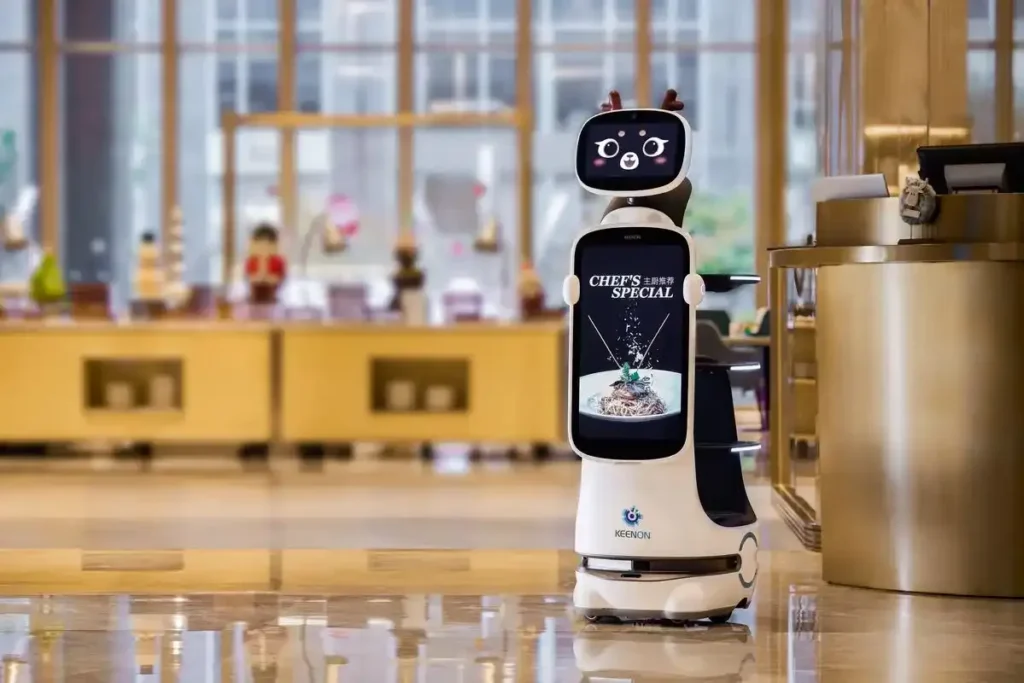
Keenon Robotics is another major Chinese name in service robotics. Today, Keenon has delivered more than 100,000 robots to over 60 countries and regions. The company holds approximately 60 percent of the global market share in hotel service robots.
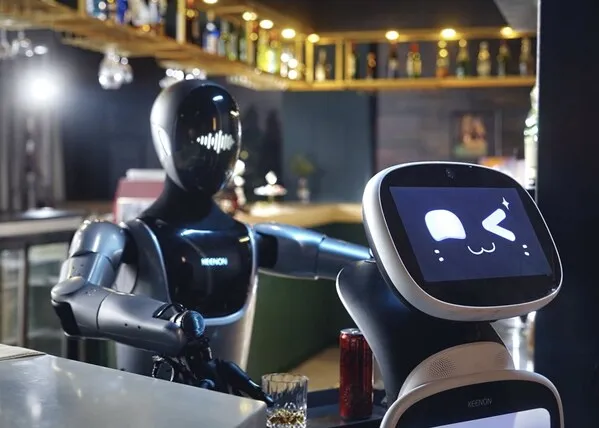
In March 2025, the company launched the XMAN-R1, an embodied service robot designed for restaurants and hotels. This was followed in July 2025 by the XMAN-F1, a bipedal version capable of navigating steps, slopes, and stairs.
Its site positions DINERBOT T10 around marketing, interaction, and delivery, with messaging that emphasizes reliability at peak hours and intelligence in off-peak times.
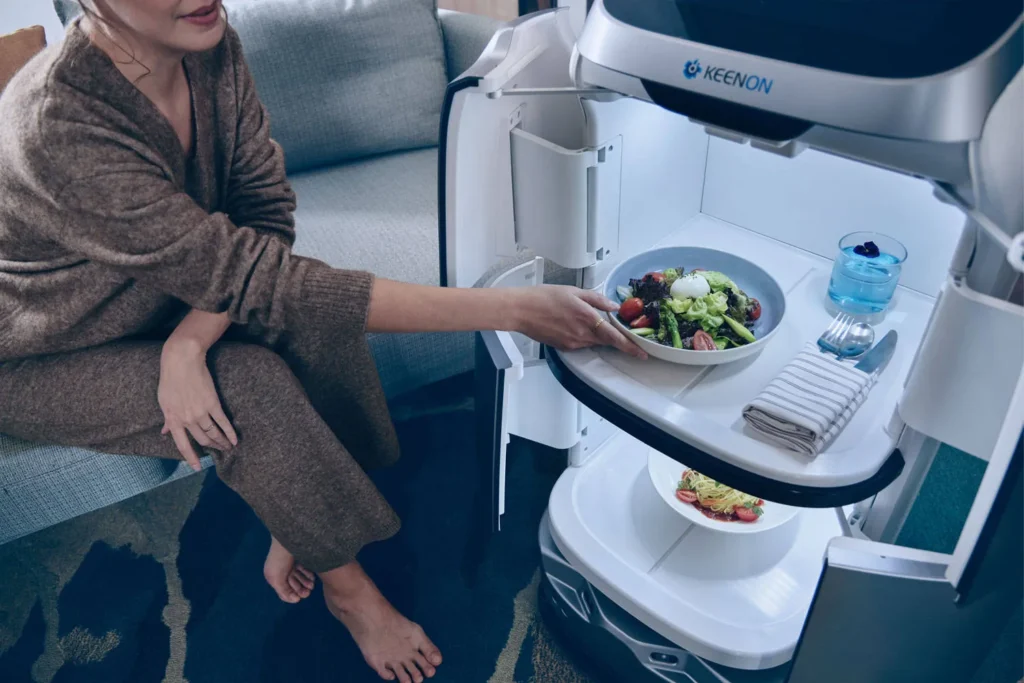
The company has also developed KEENON ProS, a specialized model for vertical industries such as hospitality, serving as professional training software for role-specific skills. This “Robot Role-Orientation” approach divides service scenarios into defined modules, each corresponding to a specific role such as delivery, cleaning, or guest service
For investors and technology leaders, the service robot race in China is moving from single-purpose delivery units toward multi-form embodied service robotics.
The business case for restaurant robots rests on clear financial metrics. A standard delivery robot costs approximately $3,700 to $4,400. During peak lunch and dinner hours, one robot can reliably handle the workload of 2 to 2.5 delivery staff.
A delivery staff member’s total monthly cost, including salary, social insurance, housing, and management expenses, averages approximately $1,030 to $1,180. Based on these estimates, a single robot could generate annual net savings of approximately $26,200. The estimated investment payback period is two to three months.
A practical ROI framework should track:
For multi-site brands, fleet management changes the equation. A single store may prove the concept, but the real value lies in how operators compare robot usage across districts, formats, and dayparts.
The effectiveness of robot waiters in real restaurant environments depends on several technical factors.
SLAM navigation (Simultaneous Localization and Mapping) enables robots to build and update maps of dynamic dining spaces. Pudu’s BellaBot uses a combination of LiDAR and RGBD cameras for this purpose, allowing it to operate in spaces with moving customers, temporary obstacles, and changing table configurations.
Obstacle avoidance is particularly critical in crowded Chinese restaurants where diners move freely, and staff carry hot dishes. BellaBot can detect obstacles at any angle, stop, and then recalculate its route. This capability reduces collision risks and minimizes service interruptions.
Fleet management systems allow restaurant operators to coordinate multiple robots simultaneously. Through centralized dashboards, managers can monitor robot utilization, view trip statistics, analyze load patterns, and optimize routes. This data-driven approach enables continuous operational improvement.
POS integration is emerging as a differentiator. When robots are connected to the restaurant’s ordering and payment systems, they can automatically receive delivery instructions, track order status, and provide real-time updates to kitchen staff and customers. This integration reduces manual coordination and speeds up service during peak hours.
KPMG’s 2026 China consumer and retail report states that China’s restaurant revenue reached approximately $853.5 billion in 2025, up 3.2 percent year-on-year. Restaurant revenue accounted for 11.6 percent of total retail sales.
That scale attracts automation, but it also punishes weak execution. A robot-waiter restaurant concept only works when the robot aligns with the brand promise. Hot pot may solve the tray delivery issue. For quick-service chains, it may support pickup and lobby movement, and for family dining, it may add entertainment value.
For global business leaders watching China, the key insight is that the adoption of automation is becoming more pragmatic. Restaurant owners want fewer gimmicks and clearer returns. The winners will be vendors and operators that connect hardware, software, training, and service design.
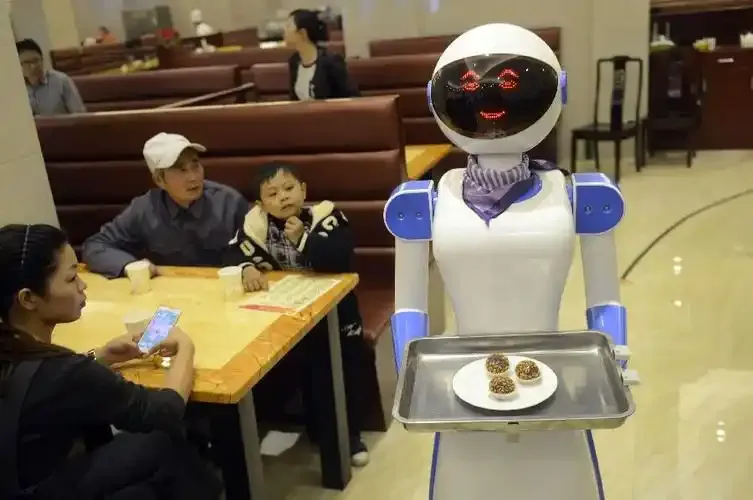
China’s robot waiters show that restaurant automation works best when it is operationally specific. A robot should not be added because a competitor has one. It should solve a defined pain point.
For investors, China’s market offers valuable signals about unit economics, maintenance burden, and product category maturity.
For technology teams, POS integration and fleet management may become more important than the robot shell itself.
The strongest opportunity is hybrid service. Humans have their own emotions, judgment, complaints, and selling points. Robots handle repeated movements, tray delivery, and predictable routing. That mix fits China’s commercial reality better than a full automation fantasy.
Navigating China’s rapidly evolving restaurant technology landscape requires on-the-ground expertise and strategic insight. Chozan helps global brands, executives, and teams understand China’s fast-moving consumer, tech, and retail landscape.
For strategy, training, market entry, or innovation insight around robot waiters and restaurant automation in China, Chozan brings practical, China-native intelligence to decision-making. Book a consultation with Chozan
Robot waiters typically handle tray delivery, table-service automation, birthday greetings, dish transport, and peak-hour service. They help staff reduce walking time, allowing teams to focus on customer care and sales.
In most practical cases, no. Robot waiters support human staff rather than replace them. The strongest model pairs robots with servers who manage hospitality, complaints, recommendations, and guest relationships.
Pudu Robotics and Keenon Robotics are two highly visible Chinese companies in this space. Their product lines include restaurant, delivery, and cleaning robots, as well as broader service automation solutions.
A robot server is usually customer-facing and may interact with guests. A delivery robot focuses on transport tasks. In restaurants, the two roles often overlap through tray delivery and routing.
POS integration is not always required, but it can improve workflow. When orders, table numbers, and kitchen status integrate smoothly, robot waiters can fit more seamlessly into daily restaurant operations.
RaaS means Robotics as a Service. Restaurants may pay a recurring fee instead of buying hardware outright. This model can reduce upfront costs and shift maintenance expectations toward the provider.
They can, but layout matters. Narrow aisles, crowded tables, steps, and frequent chair movement can reduce performance. Small venues should run peak-hour pilots before investing in a restaurant robot.
Customer response depends on venue type and execution. Families, tourists, and younger diners often enjoy the novelty. Regular customers care more about speed, accuracy, and warmth of service.
Track trips, staff walking time, table turnover, maintenance cost, guest feedback, and peak-hour delivery speed. A robot server restaurant should compare performance before and after deployment.
China shows that automation must fit operations, not only branding. The best results come from clear service design, staff training, workflow integration, and realistic ROI tracking.