CONTENT
China’s robotics race is moving from demonstrations toward repeatable work in factories, warehouses, infrastructure, and service environments. That shift raises the value of robot sensors. A robot can only act reliably when it can locate objects, estimate depth, detect contact, measure force, identify hazards, and interpret change.
The opportunity now lies at the intersection of sensing, AI, and control. In 2025, China’s Ministry of Industry and Information Technology called for AI applications that support autonomous perception, intelligent industrial robots, inspection vehicles, quality testing, and predictive maintenance.
The key question is no longer which sensor has the strongest specification sheet. The larger issue is how quickly a complete perception stack can reach stable deployment.
China’s push into embodied AI is increasing demand for machines that can operate around changing objects, people, layouts, and production conditions. Reuters reported in May 2025 that Chinese humanoid developers were targeting factory work, such as assembly and quality control, with support from domestic component supply chains and public investment.
Fixed automation can depend on controlled fixtures and repeatable coordinates. Flexible robots need richer information about object pose, free space, contact, surface condition, and human proximity. The sensor stack affects cycle time, fault recovery, safety, and the engineering required at each site.
China’s first national standard system for humanoid robotics was announced in March 2026. Developed under an MIIT technical committee with more than 120 institutions, companies, and industry users, it covers the industrial chain and the full robot life cycle.
Sensor suppliers will face more pressure to document calibration, repeatability, interface compatibility, environmental limits, and safety behavior.
A modern robot vision system does more than identify an object. Depth data helps estimate shape, distance, orientation, clearance, and viable grasp points. This supports bin picking, machine tending, depalletizing, assembly, and navigation.
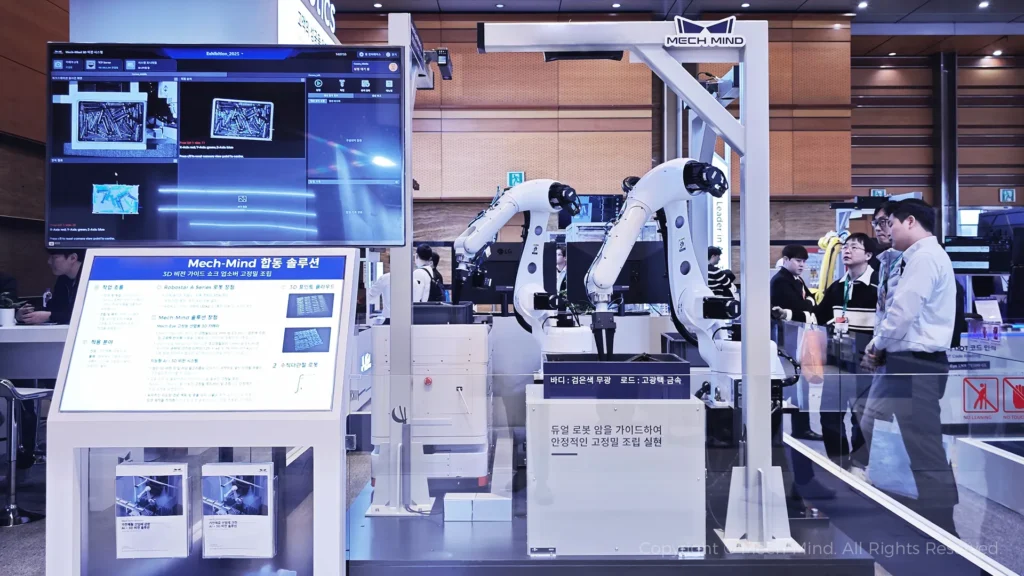
At SF and AW 2025, Beijing-based Mech Mind demonstrated a shock absorber assembly cell that used two 3D cameras to scan components in bins and a third camera to monitor the assembly area. AI and 3D vision-guided picking and assembly.
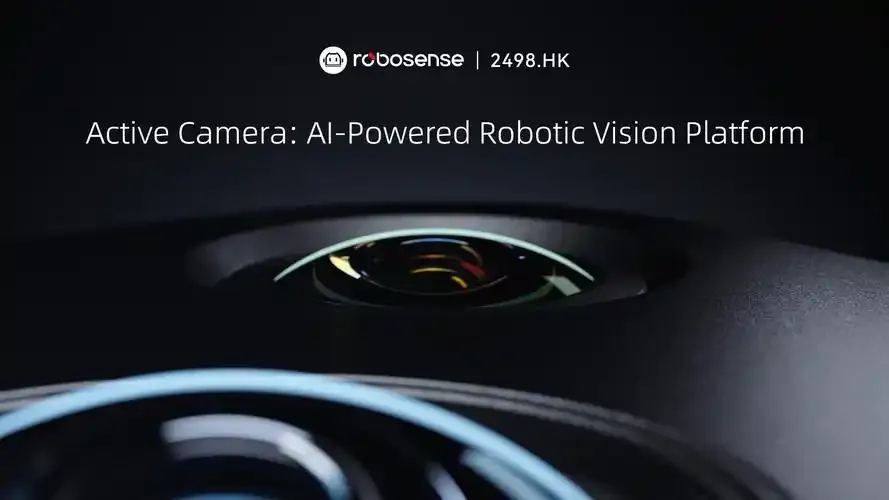
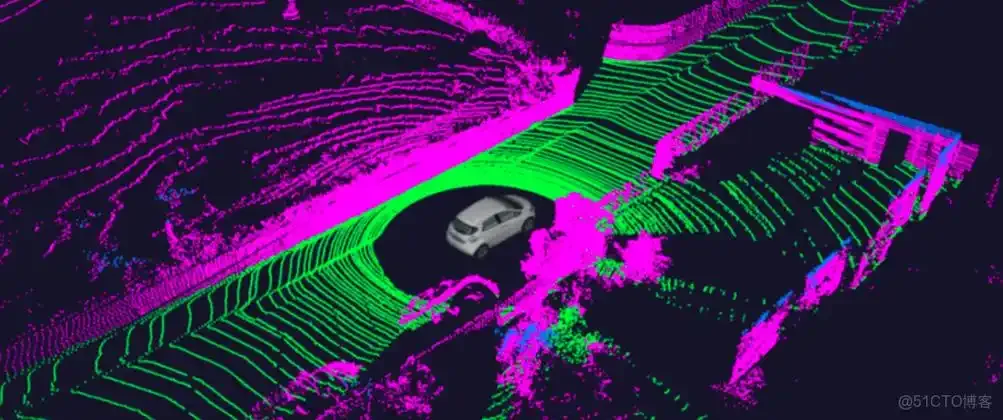
This is the direction of vision-guided robotic systems in China. Multiple viewpoints can divide perception between broad scene understanding and close-range alignment. RoboSense also expanded from LiDAR into integrated robotic perception in 2025. Its AC1 Active Camera combines color, depth, and motion information, while the AC2, launched later in 2025, is for manipulation development.
Integrated sensing can reduce calibration work, but raw data access, time synchronization, firmware support, and replacement lead times still require close review.
Vision systems for manufacturing are moving closer to process control. In December 2025, Mech Mind introduced a 3D inline measurement system that can inspect every workpiece or vehicle on a fast production line, flag dimensional drift, and preserve traceable quality data.
Machine vision inspection systems can reveal tool wear, fixture movement, assembly drift, or recurring defects. A vision system inspection project should connect camera outputs with manufacturing execution, quality records, and corrective action workflows.
The strongest robotic vision systems will be judged by false rejects, missed defects, recovery after lighting changes, model update effort, traceability, and performance across product variants.
If vision provides the eyes, force sensors in robotics provide the hands. The robot force sensor category, particularly six-axis force sensors, has become the most critical differentiator in robot manipulation capability.
Vision guides a robot toward the target, while force sensors in robotics help control what happens after contact. A robot force sensor can regulate pressure, detect misalignment, and support precise insertion, polishing, fastening, or assembly.
In 2025, researchers at Tsinghua University introduced a fingertip-sized six-axis force-and-torque sensor for fine robotic manipulation. Commercial production is also expanding. Beijing-based BluePoint Touch shipped more than 10,000 six-axis force sensors and over 100,000 joint torque sensors, strengthening China’s domestic supply of precision contact sensing.
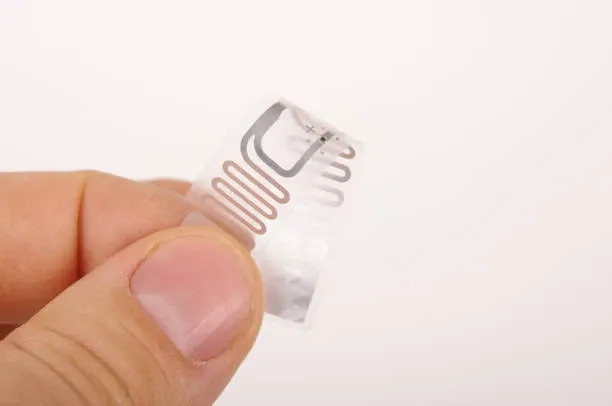
Tactile sensing adds information about local pressure, contact distribution, texture, slip, and object stability. In July 2025, Xinhua profiled Wuhan-based Huaweike’s electronic skin. The company said one square centimeter on a robotic fingertip could contain nearly 100 micro-sensing points. It’s a demonstration of controlled pressure while handling soft tofu.
Tactile arrays can support grippers that handle flexible packaging, fragile goods, irregular parts, or uncertain friction. The commercial test is durability across repeated contact, contamination, drift, and replacement.
China is also combining vision and force in factory automation. At Rokae’s industrial park in Shandong, collaborative robots equipped with force and vision sensors adjusted angle and pressure during precision USB port assembly.
Hanwei Technology’s flexible electronic skin measures just 0.3 mm thick, costs 40% to 50% less than overseas alternatives, and is now in volume supply to leading robotics companies. These advances in machine vision and tactile integration enable robots to handle delicate objects such as eggs and glass while maintaining grip stability over millions of press cycles.
Vision estimates where the part is. Force feedback reveals what happened during contact. The controller can use both signals to correct motion after a small alignment error.
Industrial perception reaches beyond factories. Mobile robots and quadrupeds need navigation sensors plus task-specific instruments for inspection, maintenance, and hazardous environments.
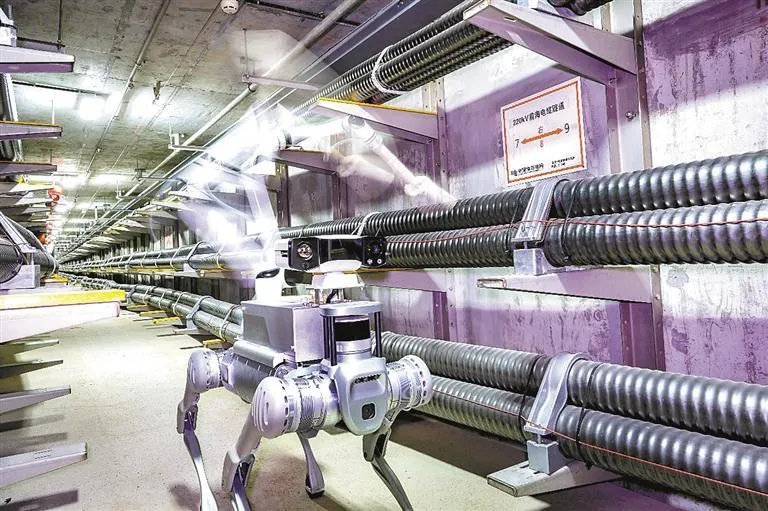
A 2025 deployment in Shenzhen’s Qianhai cable tunnels shows how this stack works. The quadruped inspection robot uses LiDAR and visual SLAM for mapping, navigation, and obstacle avoidance. Its extendable arm carries infrared thermal imaging, gas monitoring, and partial discharge sensors. Edge computing supports live data return and AI-based diagnosis.
Mobility creates access, while thermal cameras and gas sensors create operational value. Pilots should test the full sensing chain against dust, vibration, reflective metal, steam, low light, interference, and site safety requirements.
More sensors do not automatically produce better perception. The system needs synchronized data, calibrated coordinate frames, clear confidence scores, and enough local computing to meet control deadlines.
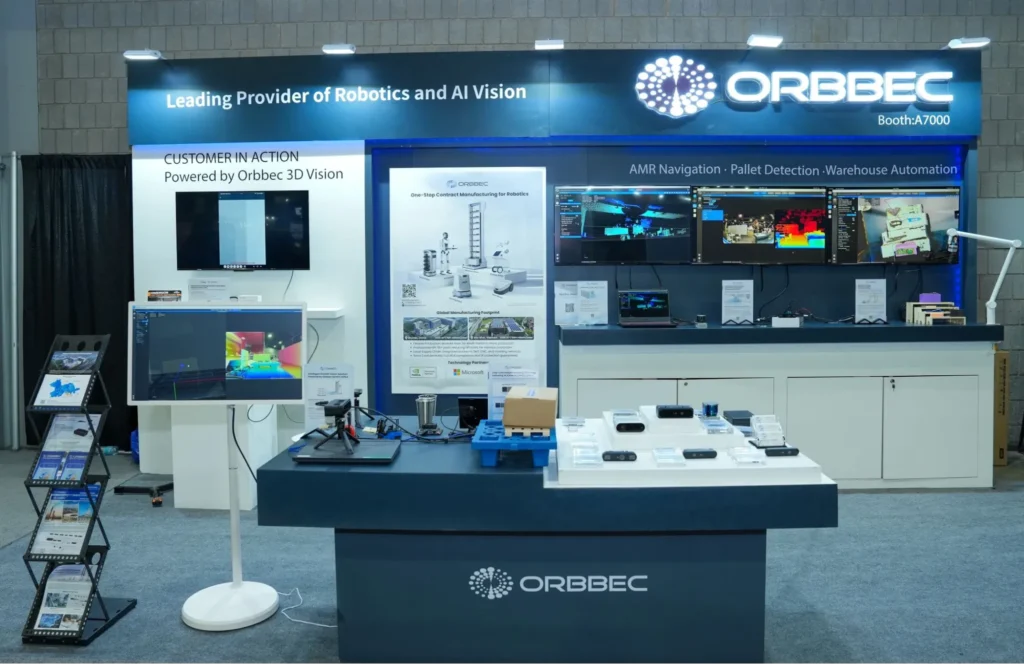
Orbbec’s 2025 integration of its Gemini 330 series 3D cameras with NVIDIA Jetson Thor shows how Chinese vision suppliers are aligning sensors with edge computing platforms for physical AI. The aim is to process rich depth streams close to the robot for real time perception.
In July 2026, Orbbec introduced a robot free data collection hardware platform with RGBD devices for first person observation, wrist views, and detailed hand object interaction.
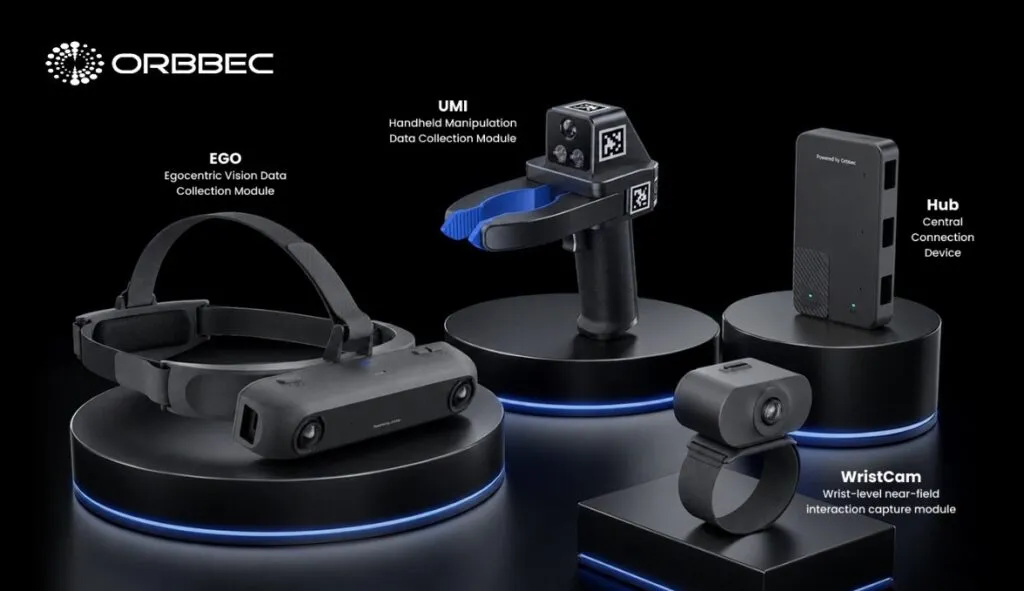
Sensor strategy now starts before the robot reaches the site. Data collection, labeling, model training, edge inference, and field feedback form one perception pipeline.
A strong sourcing process should begin with the task and its failure modes.
Robot sensors are one part of a wider shift across embodied AI, advanced manufacturing, and industrial automation. Chozan publishes research, reports, and analysis that place these developments within China’s broader technology and innovation ecosystem.
Explore Chozan’s resources to follow the companies, technologies, and deployment trends shaping China’s robotics sector.
For research linked to a specific market question or business priority, you can also book a consultation with the Chozan team.
Industrial robots can use encoders, cameras, proximity devices, force and torque sensors, tactile arrays, LiDAR, thermal cameras, and safety scanners. The right mix depends on the task, environment, speed, payload, and level of human interaction.
A 2D camera analyzes flat image features such as edges, color, and contrast. A 3D robot vision system adds depth and spatial geometry, which help with random picking, pose estimation, clearance checks, and variable object handling.
RGBD cameras capture color and depth in a synchronized stream. Mobile robots can use that information for obstacle detection, mapping, docking, human awareness, and route planning in environments where both object height and distance matter.
It measures force along three linear axes and torque around three rotational axes. This feedback helps robots regulate contact during insertion, polishing, assembly, fastening, testing, and other precision tasks with tighter process control.
Tactile arrays detect changes in pressure and contact distribution across a gripper or robotic hand. Control software can interpret those changes as early signs of movement, then adjust grip force before an object becomes unstable.
LiDAR provides reliable distance measurements and broad spatial coverage, while cameras add color, texture, and semantic detail. Sensor fusion can improve navigation and object understanding when a single sensing method encounters glare, darkness, or limited visual features.
Safety sensors protect people and equipment through functions such as presence detection, separation monitoring, collision detection, and emergency stopping. Task sensors guide workpiece handling, inspection, navigation, or contact control. Some devices can support both roles.
They should be checked after installation, impact, repair, relocation, firmware changes, or unexpected drift. Calibration intervals should reflect vendor guidance, operating hours, environmental stress, process tolerance, and the cost of an incorrect measurement.
They can lose accuracy due to lighting changes, dirty lenses, vibration, product variation, poor training data, camera movement, or unmonitored process drift. Strong deployments monitor image quality and model performance over time.
Buyers should ask about environmental ratings, calibration methods, raw data access, communication protocols, software support, replacement lead times, long term availability, cybersecurity, and local service. The selected devices should also be tested inside the intended workflow.